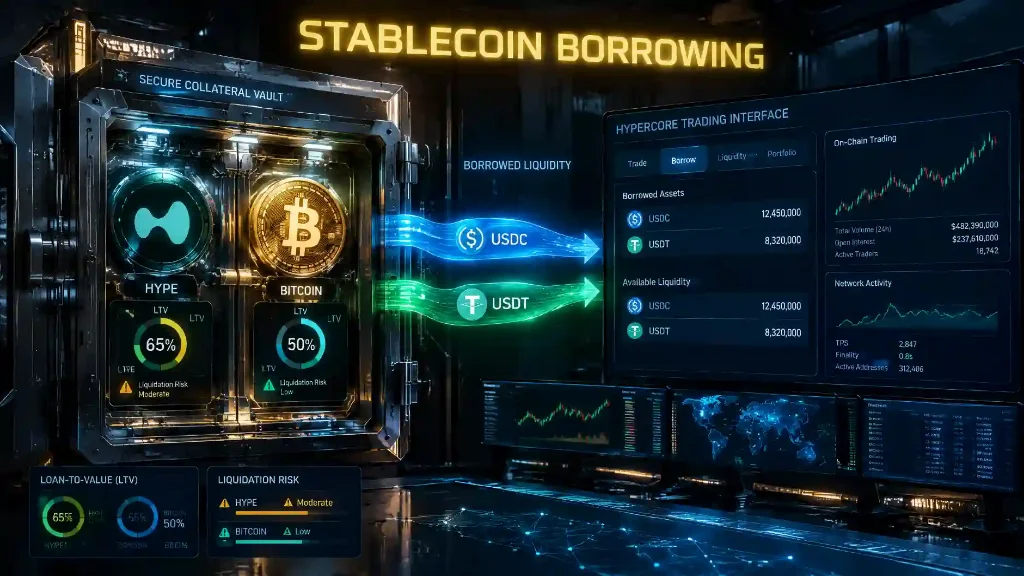


Catenaa, Monday, September 28, 2026-Hyperliquid has introduced manual borrowing, allowing eligible users to supply HYPE or Bitcoin as collateral and borrow USDC or USDT through its HyperCore trading infrastructure.
The feature went live September 18 and expands Hyperliquid beyond its core spot and perpetual futures markets into direct collateralized lending.
Hyperliquid said $269 million in assets had been borrowed through the underlying infrastructure on the first day of the rollout.
Manual borrowing uses the same HyperCore infrastructure that supports Hyperliquid’s portfolio margin system.
The difference is that users can now choose directly when to borrow and repay stablecoins against supplied collateral.
Manual and Standard account users, along with Unified Account users, can access the feature.
Portfolio Margin accounts do not use the manual function because borrowing is handled automatically under that system.
Hyperliquid currently accepts HYPE and BTC as collateral for manual borrowing.
Users can borrow USDC or USDT.
The protocol sets a 65% loan-to-value ratio for HYPE and 50% for Bitcoin.
That means $10,000 worth of HYPE could provide up to $6,500 in borrowing capacity, assuming prices and other account conditions remain unchanged.
The same value in Bitcoin could provide up to $5,000.
Hyperliquid calculates borrowing capacity using the amount of collateral supplied, its oracle price and the applicable loan-to-value ratio.
Multiple supported collateral assets can be combined when determining available borrowing capacity.
The borrowed stablecoins carry interest.
Rates are not fixed and change according to market utilization, with interest accruing continuously and being indexed hourly.
Users can also supply USDC or USDT to earn interest from borrowers.
Those supplied stablecoins do not increase the user’s manual borrowing capacity.
HYPE and Bitcoin supplied as collateral, meanwhile, do not themselves earn lending interest under the manual borrowing system.
Hyperliquid retains 10% of interest paid by borrowers as a buffer against potential future liquidation losses.
The remaining interest is distributed among suppliers.
The structure gives traders a way to obtain dollar-linked liquidity without selling their HYPE or Bitcoin positions.
A Bitcoin holder, for example, could pledge BTC and borrow USDC while retaining exposure to Bitcoin’s price.
That flexibility also introduces liquidation risk.
If the value of collateral falls relative to outstanding debt, the account can eventually reach the protocol’s liquidation threshold.
Hyperliquid sets the partial-liquidation threshold at 82.5% for HYPE collateral and 75% for Bitcoin.
A falling collateral price, additional borrowing, collateral withdrawals or accumulated interest can all push an account closer to liquidation.
Hyperliquid uses a health factor to show the relationship between a user’s LTV-adjusted collateral and outstanding debt.
A health factor at or below 100% prevents further borrowing.
However, dropping below 100% does not by itself immediately trigger liquidation.
Liquidation occurs when borrowed value exceeds collateral value after applying the separate liquidation threshold.
That distinction gives borrowers some room between reaching maximum borrowing capacity and entering liquidation territory.
It does not eliminate the risk.
HYPE and Bitcoin can both move sharply during volatile market conditions, potentially reducing collateral coverage quickly.
Borrowing is also limited by available liquidity and protocol-level supply and borrowing caps.
A user may therefore be unable to borrow the full theoretical amount even when sufficient collateral is available.
The lending feature adds another function to HyperCore, Hyperliquid’s native trading and settlement system.
Hyperliquid originally became prominent through decentralized perpetual futures trading, offering an on-chain alternative to centralized derivatives exchanges.
The platform has since expanded its spot markets and broader trading infrastructure.
Adding direct borrowing allows capital already held on Hyperliquid to be used without requiring users to sell collateral or move assets to a separate lending protocol.
It also strengthens the role of HYPE inside the ecosystem.
Until now, the native token’s main uses included staking, network participation and trading.
Its acceptance as collateral gives holders another potential use for the asset.
The launch coincided with HYPE reaching a record above $90 on September 18.
The timing does not establish that manual borrowing alone caused the price increase, with cryptocurrency prices influenced by broader market conditions and investor positioning.
The larger significance lies in how Hyperliquid is combining trading, collateral management and lending within the same infrastructure.
Decentralized finance protocols have long allowed users to borrow stablecoins against cryptocurrency.
Hyperliquid’s approach brings that function directly into an environment already used heavily for spot and derivatives trading.
That could reduce the number of separate platforms traders need to use when managing collateral.
It also means borrowing risk becomes more closely connected with trading activity on HyperCore.
Hyperliquid said every borrowed asset comes from supplied liquidity rather than being created through internal margin accounting.
That makes utilization an important part of the lending market because it directly affects borrowing and supply rates.
Higher demand for available stablecoins can push borrowing costs upward.
Lower utilization can reduce returns for suppliers.
The $269 million reported on launch day suggests substantial initial use of the underlying borrowing infrastructure.
Longer-term demand will depend on borrowing costs, collateral prices and whether traders find it useful to keep positions open while accessing stablecoin liquidity.
The feature marks another step in Hyperliquid’s evolution from a decentralized perpetual futures venue toward a broader on-chain financial platform.
For traders, the attraction is straightforward: HYPE and Bitcoin can remain invested while providing access to USDC or USDT.
The tradeoff is equally clear.
The liquidity comes with interest costs, collateral requirements and the possibility of liquidation if the assets backing the loan fall far enough.