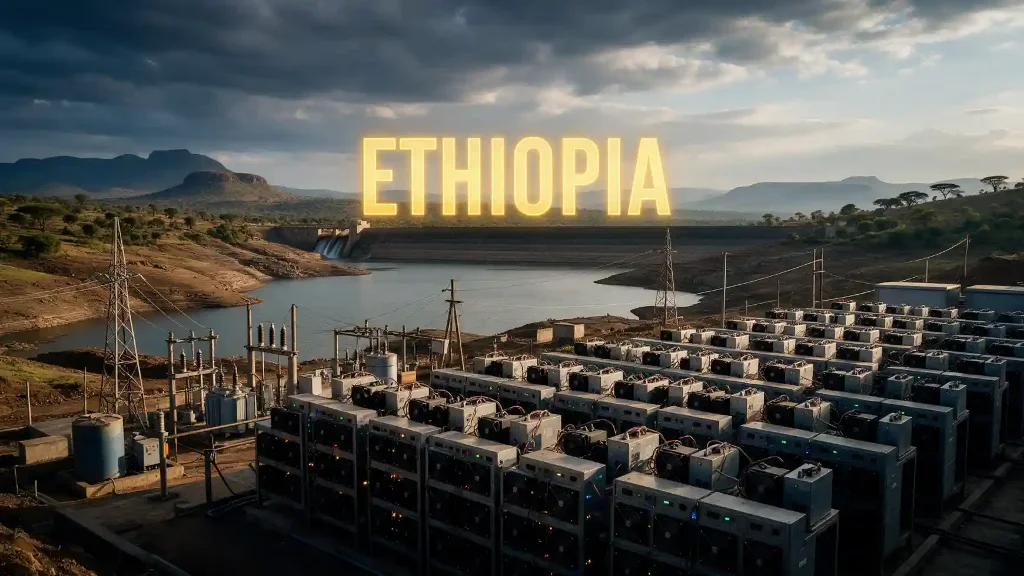


Catenaa, Tuesday, September 22, 2026-Ethiopia has sharply reduced electricity supplied to Bitcoin mining companies, leaving operators with about 23% of their contracted power as falling water levels squeeze the country’s hydroelectric generation.
State-owned Ethiopian Electric Power, or EEP, imposed the restrictions after water inflows into reservoirs fell about 20% during a dry period worsened by El Niño conditions.
EEP Chief Executive Ashebir Balcha said the utility initially reduced mining supply to 75% of contracted levels, then to 50%, before cutting it to about 23%.
The company plans to reassess conditions in October.
Bitcoin miners have become unusually important customers for Ethiopia’s power sector.
Mining companies accounted for about 35% of EEP revenue during the last financial year and consumed close to one-third of the country’s 9,730 megawatts of electricity production, according to Bloomberg.
EEP has power-purchase agreements with 39 mining companies, with 31 already operating.
The scale of the curtailment highlights a vulnerability in Bitcoin mining operations built around low-cost renewable electricity.
Ethiopia emerged as an attractive mining location because of abundant hydropower and relatively low electricity prices.
Chinese and other international miners moved into the country after restrictions in several other jurisdictions pushed operators to seek cheaper energy and more accommodating markets.
Hydropower offered another advantage.
Mining companies could argue that their energy-intensive operations were using renewable electricity rather than fossil fuels, helping counter criticism over Bitcoin’s environmental impact.
The latest shortage shows that renewable power can still be vulnerable to weather and seasonal conditions.
EEP said the restrictions are precautionary and intended to preserve electricity for households and manufacturers rather than signal a permanent retreat from Bitcoin mining.
The utility could reduce supply further if reservoir conditions fail to improve.
Mining companies face an immediate operational challenge because profitability depends heavily on uninterrupted access to inexpensive electricity.
A 75% cut can force miners to shut down machines, reduce Bitcoin production and spread fixed infrastructure costs across much less computing capacity.
The disruption also comes as global mining economics remain under pressure from higher network difficulty and increased competition.
CoinShares recently reported that some publicly traded miners are moving capacity toward artificial intelligence infrastructure, where returns per megawatt can exceed those from Bitcoin mining.
Ethiopia presents a different problem.
The electricity itself is inexpensive and largely renewable, but the supply is no longer guaranteed.
For hydro-dependent mining centers, that may prove as important as the price of power.