

October 01, 2026 – The upgrade brings enshrined proposer-builder separation and block-level access lists. Mainnet timing is still undecided.
In Summary
Glamsterdam activates on Sepolia on 6 October 2026 at 13:53:36 UTC; Hoodi and mainnet dates are not set.
Its headline changes are enshrined proposer-builder separation (EIP-7732) and block-level access lists (EIP-7928).
Gas repricing may affect contracts that rely on fixed gas stipends or hardcoded limits.
Fusaka took 50 days to move from Sepolia to mainnet; ETH rose about 71% in the third quarter.

Ethereum developers have set 6 October for the first public testnet launch of Glamsterdam, the network’s next major upgrade. It will go live on the Sepolia test network at 13:53:36 UTC.
The Ethereum Foundation announced the date in a post on 28 September. Glamsterdam follows Fusaka, which reached the main network in December 2025.
Developers have not set a mainnet date yet. Similarly, the Hoodi test network still has no activation date, and the post says client teams will decide both later.
For ordinary ETH holders, nothing changes for now. The foundation says users do not need to take any action for the Sepolia test.
Node operators on Sepolia, however, must act. They need to update both their execution and consensus clients before activation. Otherwise, their nodes will not follow the upgraded chain.
What the Glamsterdam upgrade does
Glamsterdam combines two upgrades. Amsterdam changes the execution layer, which runs transactions. Gloas changes the consensus layer, which agrees on blocks.
The biggest change brings proposer-builder separation into the protocol itself, as set out in EIP-7732. Today, block proposers and specialist builders deal with each other through outside middleware.
Under the upgrade, the protocol itself handles that exchange and the payment to the proposer. As a result, the network relies less on trusted third parties.
The change also gives validators more time to check each block’s transactions. A new committee will confirm whether builders revealed their payloads on time.
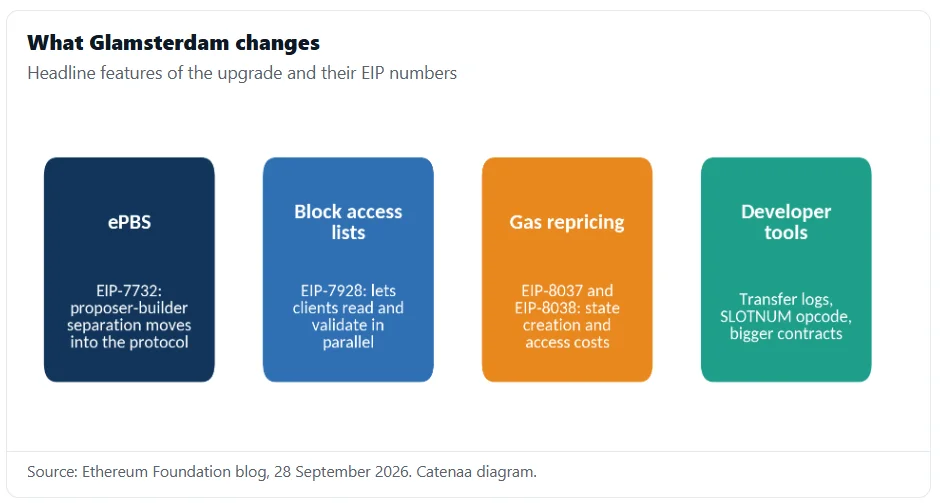
The second major feature is block-level access lists. These record which accounts and storage slots each block touches.
With that list in hand, clients can read data from disk in parallel and validate transactions in parallel. Together, the two features lay the groundwork for more throughput on the main chain.
Gas costs and developer changes
Glamsterdam also reprices several operations. For instance, creating new state will cost more gas, and the cost of accessing state will change too.
The foundation warns that some smart contracts may need updates. Contracts that rely on fixed gas stipends or hardcoded gas limits are most at risk.
Developers also get new tools. ETH transfers will emit logs, and a new opcode will expose the slot number. In total, the upgrade tracker lists 18 scheduled EIPs plus seven supporting ones.
Other additions include a higher maximum contract size and a deterministic factory contract. On the consensus side, slashed validators will no longer be able to propose blocks.
In addition, the upgrade raises the churn limit for validator exits and consolidations. It also removes the burn behaviour of SELFDESTRUCT.
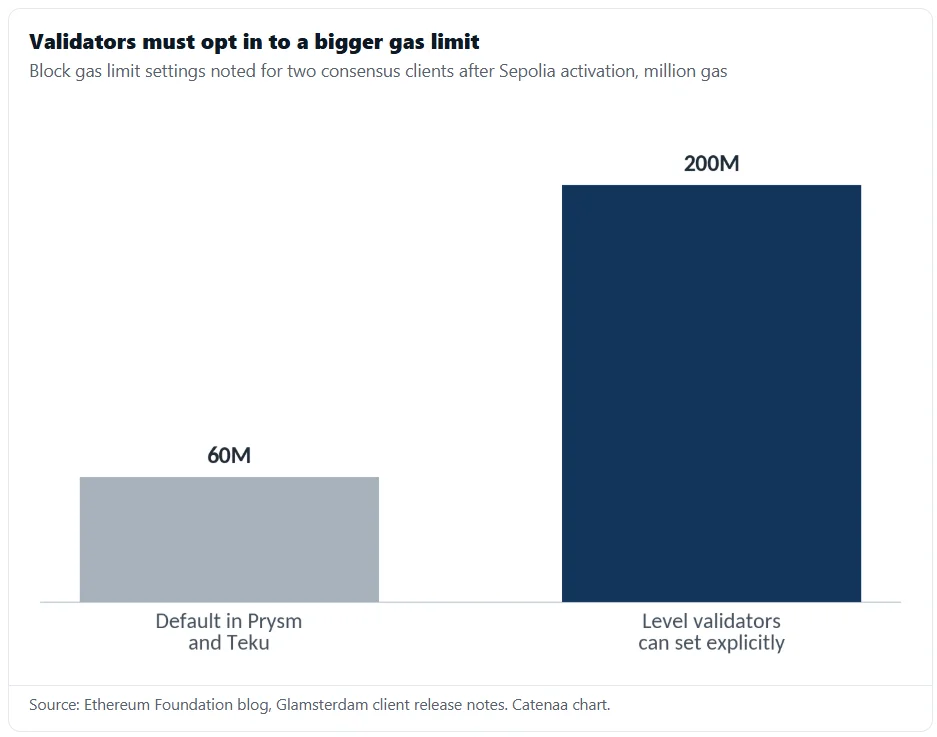
Validators should also watch their settings. Two consensus clients, Prysm and Teku, default to a 60 million gas limit after activation. Validators who want 200 million must set it explicitly.
What the timeline tells us
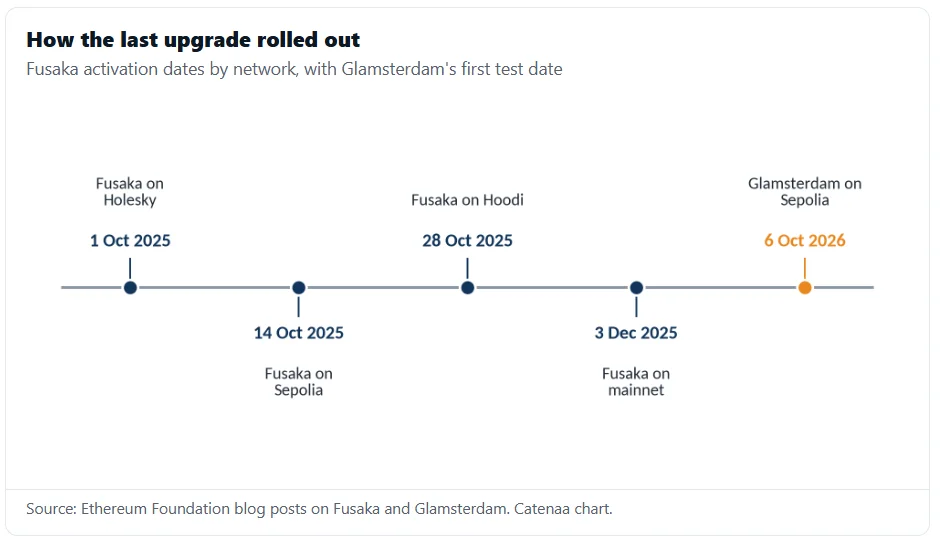
Testnets give client teams a chance to catch bugs before real money is at stake. Fusaka followed a clear path through three test networks.
It reached Holesky on 1 October 2025 and Sepolia on 14 October. It then hit Hoodi on 28 October and mainnet on 3 December.
That meant 50 days passed between Sepolia and mainnet. If Glamsterdam followed the same gap, mainnet would land in late November. However, developers have not committed to any date.
Fusaka itself was a scaling upgrade. Its headline feature, PeerDAS, raised the network’s capacity for blob data, which layer 2 networks use to post transactions cheaply.
Glamsterdam shifts the focus to the main chain. In effect, it aims to let the base layer process more transactions while keeping node requirements practical.
Security work is already under way. The Ethereum bug bounty programme now covers the Glamsterdam specifications and EIPs.
Six execution clients have Sepolia-ready releases, including go-ethereum 1.17.7, Nethermind 2.0.0 and Reth 2.7.0. Five consensus clients have releases listed so far.
How ether is trading
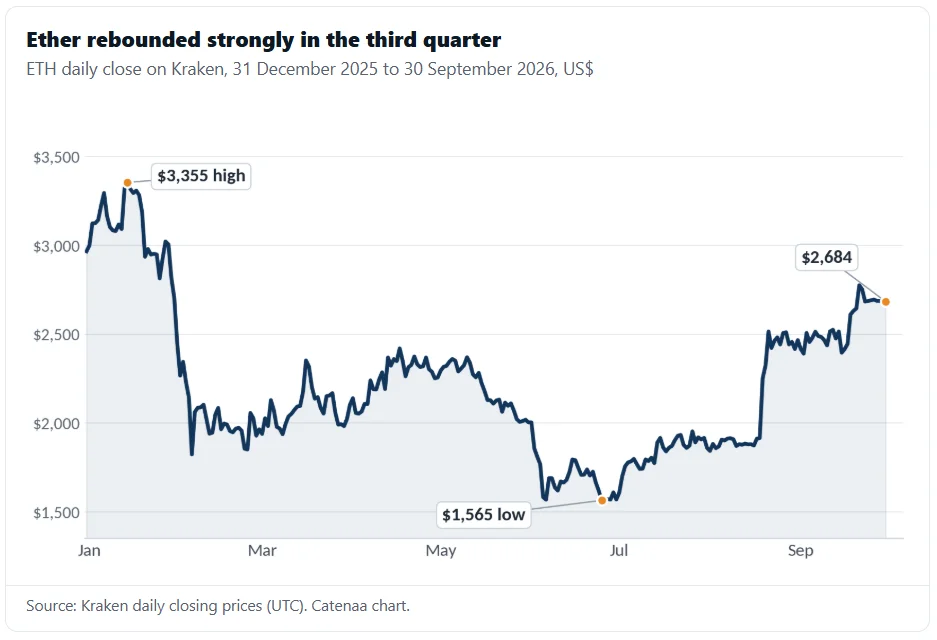
The upgrade news lands after a strong quarter for ether. ETH closed September at $2,684, according to Kraken data, up about 71% from $1,570 at the end of June.
Even so, ether remains about 10% lower for the year. It closed 2025 at $2,967 and hit its 2026 low of $1,565 on 25 June.
Upgrades rarely move prices on their own. Still, faster block validation and cheaper scaling support the long-term case for the network.
For more on Ethereum and crypto markets, follow our coverage. All eyes now turn to Sepolia on 6 October for the first public Glamsterdam test.