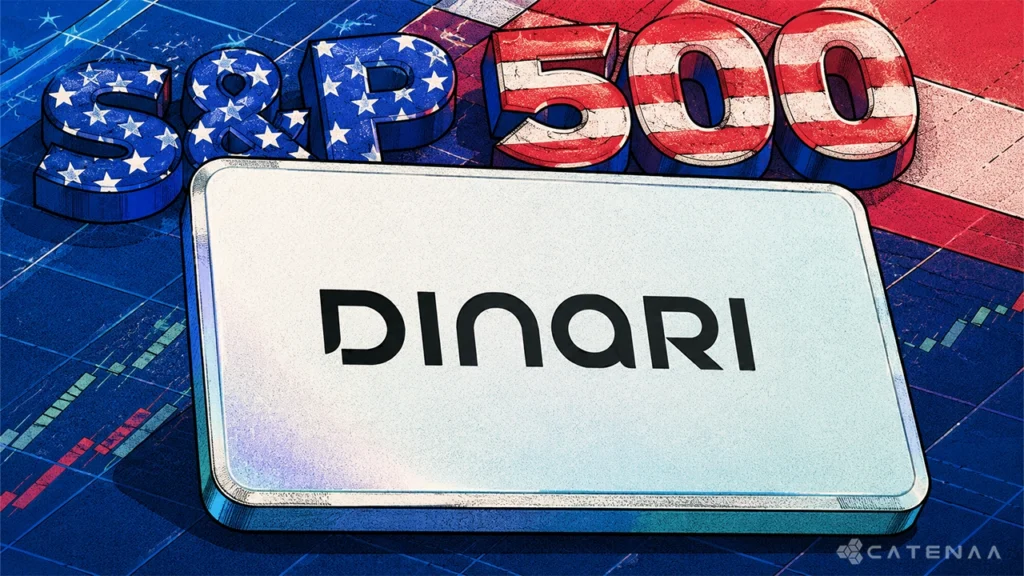


Catenaa, Monday, August 10, 2026– Tokenized equities took another step toward mainstream adoption after Dinari launched onchain trading of more than 700 US stocks for eligible American investors, allowing them to buy and sell S&P 500 securities directly from self-custody cryptocurrency wallets using the USDC stablecoin.
The company said it is the first platform to enable eligible US individuals and businesses to trade every stock in the S&P 500 through self-custody wallets without relying on a traditional brokerage account.
The service is being introduced through a partnership with Circle, the issuer of the USDC stablecoin, enabling investors to move between digital dollars and tokenized US equities within a blockchain-based environment.
Dinari Chief Executive Officer and co-founder Gabriel Otte said the launch bridges the long-standing divide between conventional capital markets and digital assets by allowing investors to transition seamlessly between stablecoins and regulated securities while maintaining traditional market protections.
The platform offers tokenized securities known as dShares, with each digital token backed one-for-one by an underlying share held in qualified custody.
Unlike synthetic assets, the tokenized shares represent ownership backed by actual securities, allowing blockchain-based settlement while remaining linked to regulated financial infrastructure.
The launch comes amid growing institutional interest in tokenized financial assets as banks, exchanges and asset managers increasingly explore blockchain technology to modernize securities markets.
However, Dinari cautioned that tokenized securities remain an emerging market and could experience limited liquidity, potentially affecting investors’ ability to sell holdings quickly or at preferred prices.
The company also noted that regulatory treatment of tokenized securities continues to evolve and future legal or policy changes could affect trading, transfers or platform operations.
Momentum behind tokenized equities has accelerated in recent months.
Last month, the Depository Trust & Clearing Corporation (DTCC), the United States’ primary securities clearing and settlement organization, successfully completed production trades involving tokenized equities and US Treasuries with participation from more than 30 financial institutions, including BlackRock, Circle, Goldman Sachs, JPMorgan and Nasdaq.
Dinari became the first US-authorized tokenized equity platform after securing regulatory approval last year, positioning the company among the early participants seeking to merge blockchain infrastructure with traditional securities markets.
Industry observers view tokenized stocks as one of the fastest-growing areas of digital finance, offering near-instant settlement, programmable ownership and broader accessibility while remaining backed by regulated underlying assets.
Tokenization converts traditional financial assets into blockchain-based digital tokens representing legal ownership of underlying securities. Financial institutions increasingly view tokenized stocks as a way to improve settlement efficiency, reduce operational costs and enable around-the-clock trading. While regulatory frameworks are still developing, major banks, exchanges and asset managers are investing heavily in tokenized securities infrastructure, making the sector one of the fastest-growing segments of digital finance.