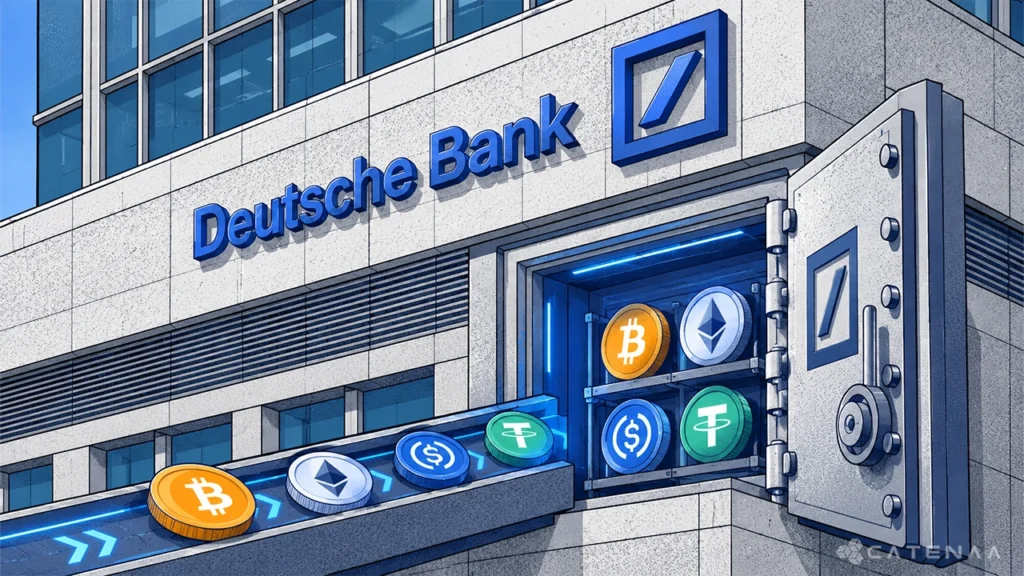


October 18, 2026 – Deutsche Bank will hold bitcoin, ether, and selected stablecoins for institutional clients in Europe. One token on its day-one list has under half a million euros in circulation.

In Summary
Deutsche Bank will offer digital asset custody to institutional and corporate clients in Europe, managing wallets and private keys itself.
Bitcoin and ether come first, alongside selected stablecoins and e-money tokens including USDC, EURC and EURAU, with tokenised securities later.
The launch is planned for this year but still depends on completing the applicable regulatory process.
EURAU, the BaFin-licensed euro token from the bank’s AllUnity venture, had roughly 444,000 euros in circulation on 17 October.
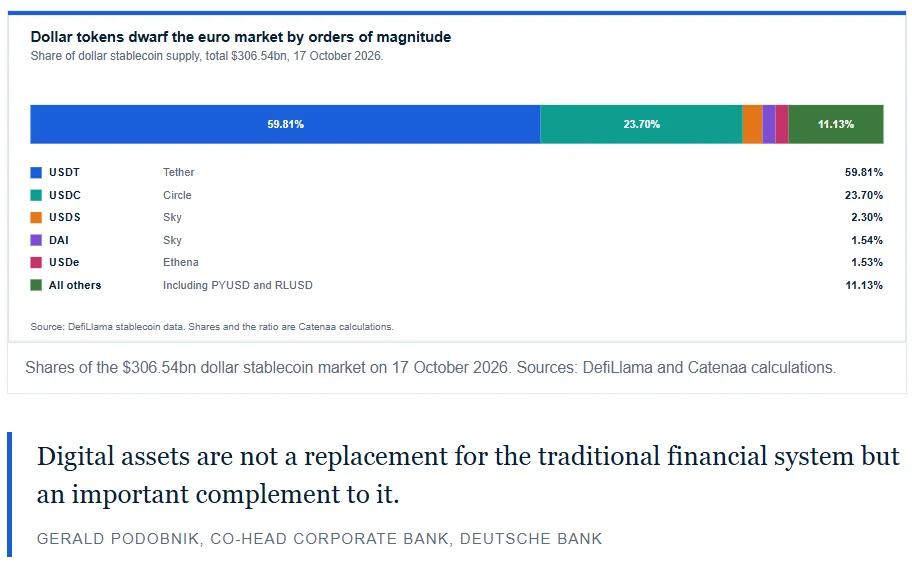
Dollar stablecoin supply totals $306.54bn against about 696m euro in euro tokens, a gap of more than 300 times in value terms on Catenaa calculations.
Deutsche Bank has set out plans for crypto custody in Europe. The bank will hold selected digital assets for firms, and manage the wallets and keys itself. Clients can also send those assets to third parties.
The bank plans to launch this year. However, the service is still awaiting regulatory approval. The first clients will go live once that process ends.
What the crypto custody service covers
Bitcoin and ether lead the list. The bank also names selected stablecoins and e-money tokens, among them USDC, EURC and EURAU. Tokenised securities come later.
The target list reads institutional. It spans corporates, asset managers, hedge funds, custodians, brokers and sovereign bodies. Retail does not appear.
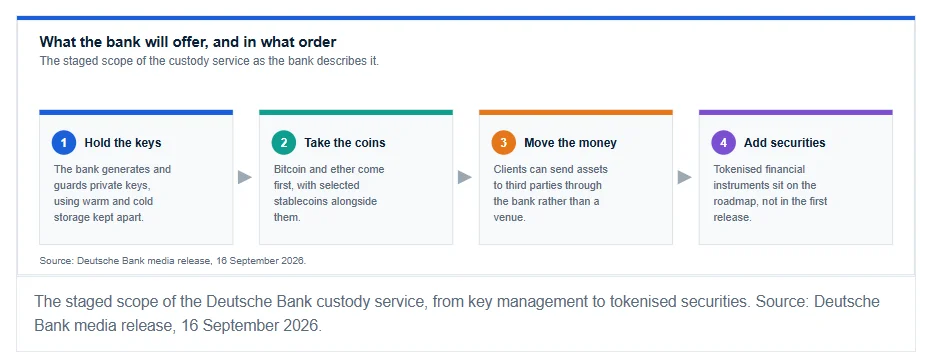
Controls get plenty of space in the release. The bank lists hardware-based protection, split duties, multi-person approvals and separate warm and cold storage. It also flags redundant systems and backup recovery.
One warning stands out. The release says crypto-assets carry no deposit-guarantee scheme comparable to the protection that covers eligible bank deposits. So a custody client bears the asset risk in full.
Notably, the release names no technology partner. The bank says only that it will use selected outside providers for defined parts. That silence leaves the build-versus-buy split unclear.
Why the token choices raise eyebrows
Two of the three named tokens are dollar and euro coins from Circle. The third, EURAU, comes from AllUnity. That venture won a BaFin e-money licence in July 2025. It pairs the bank’s asset arm with Flow Traders and Galaxy.
Yet EURAU barely exists in the market. Supply stood near 444,000 euros on 17 October. EURC, by contrast, had 499m euro outstanding.
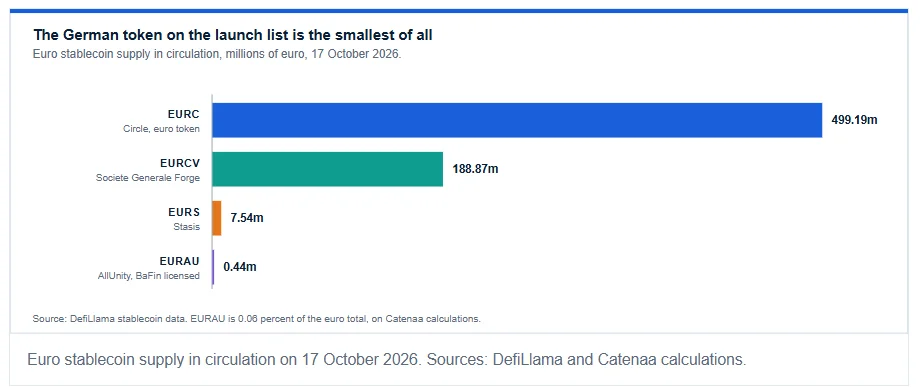
That gap is more than 1,100 times, on Catenaa sums. Hence the German token looks like a strategic bet rather than a response to demand.
The logic is still sound. A bank that lists a token it part-owns can seed the market it wants. Custody comes first, then issuance, then flows.
The euro is a rounding error
Dollar tokens still own this market. Supply totals $306.54bn across dollar stablecoins, with Tether and Circle holding 83.5 percent between them.
Euro tokens add up to roughly 696m euro. In value terms, the dollar pool is therefore more than 300 times larger, on Catenaa sums. Europe wants that balance to shift.
Rules first, then the rollout
Europe gave banks a rulebook before they moved. Regulation 2023/1114 on markets in crypto-assets passed on 31 May 2023. That clarity is why German launches now follow licences rather than press releases.
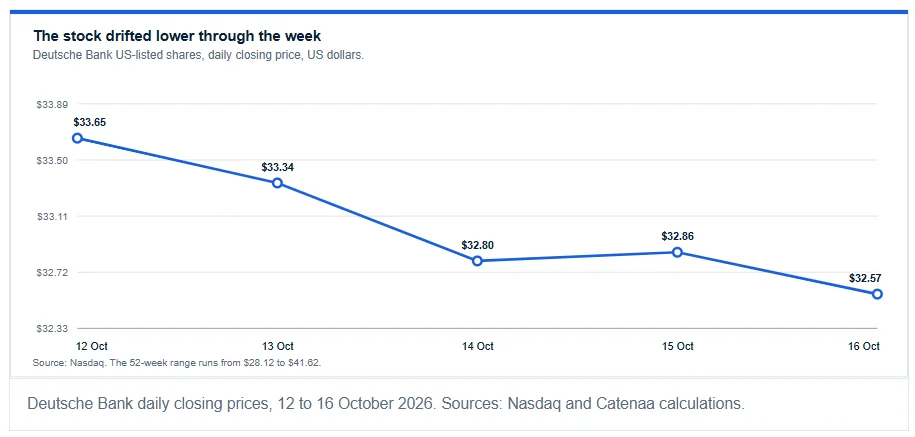
Investors have shown little reaction. The shares closed at $32.57 on 16 October, down 0.88 percent on the day. Across the week, they fell 3.2 percent, on Catenaa sums.
Scale will decide the outcome. Custody earns thin fees on its own. Tokenised bonds and deposits are where the bank expects the money to sit.
Three markers will show whether it works. First, the date the regulator clears the service. Second, the names of the first live clients. Third, whether EURAU supply grows beyond a rounding error.




