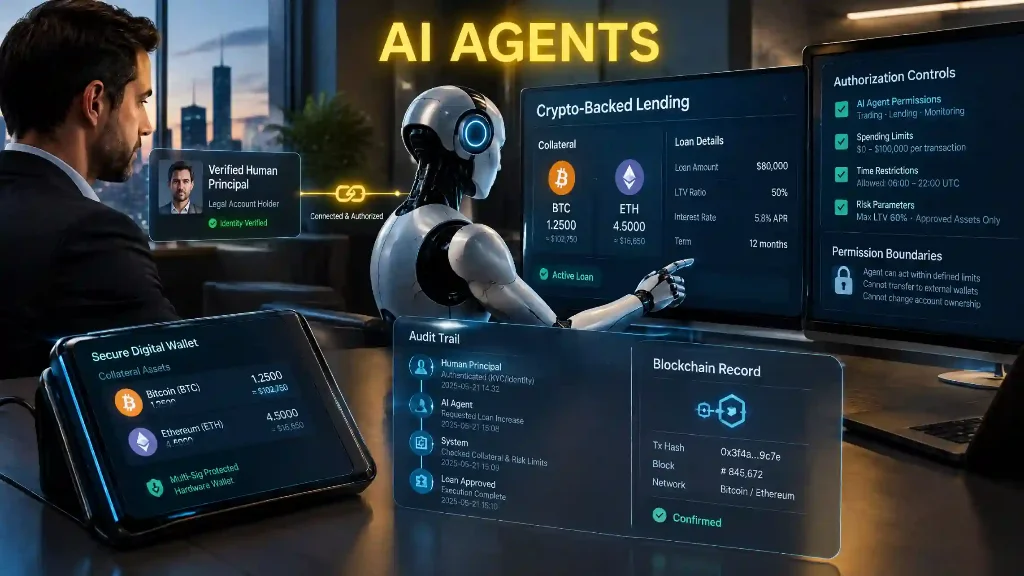


Catenaa, Sunday, September 27, 2026- CryptoPawn has introduced a system allowing authorized AI agents to participate in crypto-backed borrowing while keeping the verified person or company legally responsible for the loan and pledged assets.
The digital asset pawnbroker released the integration September 21 alongside a framework identifying four issues it says financial providers must resolve before autonomous software can participate in regulated lending: identity, permission, collateral and liability.
The model does not treat an AI agent as the borrower.
Instead, a verified individual or business remains the contractual customer and owner of the cryptocurrency pledged as collateral.
That customer can authorize software to perform certain actions within limits established through CryptoPawn’s agent-access system.
CryptoPawn’s published policy says verified customers can create revocable API credentials for an AI agent after completing identity and compliance checks.
The credentials can allow the agent to interact with existing account functions involving quotes, contracts, payouts, wallets, repayments, settlement and collateral returns.
The customer can revoke access.
CryptoPawn says AI agents cannot bypass identity checks, sanctions screening or other controls applied to the underlying customer.
The structure reflects an emerging distinction between software capable of conducting a financial transaction and an entity legally entitled to enter one.
AI agents can already operate cryptocurrency wallets, transfer assets and interact with decentralized finance protocols.
Some developer systems allow autonomous programs to supply collateral, borrow assets and repay loans without a human executing each individual transaction.
Those activities generally occur through blockchain protocols.
Regulated lending introduces additional questions over who owns the collateral, who authorized the transaction and who bears responsibility if software acts incorrectly.
CryptoPawn’s framework starts with identity.
An AI agent may control credentials or initiate an instruction, but that does not automatically make the software a legal customer.
Under CryptoPawn’s model, the verified person or legal entity remains the borrower.
US law already contains a legal foundation for transactions involving automated software.
Section 101 of the federal Electronic Signatures in Global and National Commerce Act, commonly known as the E-SIGN Act, says a contract cannot be denied legal effect solely because one or more electronic agents participated in its formation, creation or delivery.
The law adds an important condition.
The action of the electronic agent must be legally attributable to the person being bound.
The E-SIGN Act defines an electronic agent as software or another automated system capable of initiating or responding to an electronic transaction without human review at the moment the action occurs.
That principle does not remove lending, identity or financial crime requirements.
It instead establishes that automation alone does not invalidate a contract.
Permission creates the next problem.
Access to a wallet does not necessarily give software authority to pledge the assets inside it.
A company could, for example, authorize an AI treasury system to make payments while prohibiting it from borrowing against corporate cryptocurrency.
CryptoPawn’s model therefore links agent activity to authority granted by the verified customer.
The system also creates a record connecting each request with the credential used by the agent.
That approach resembles identity and authorization work underway at the National Institute of Standards and Technology.
NIST’s National Cybersecurity Center of Excellence published a concept paper in February examining identity and authorization for software and AI agents.
The agency identified identification, authorization, auditing and non-repudiation as areas requiring stronger controls as autonomous systems gain access to data, applications and financial tools.
It also highlighted prompt-injection attacks, where malicious instructions could cause an AI system to perform actions its owner did not intend.
Collateral creates another layer of risk.
CryptoPawn currently accepts Bitcoin, Ethereum, XRP, BNB and Solana as collateral for cash loans, according to its published loan information.
An agent may technically possess credentials capable of moving those assets.
That does not prove the software has permission to place them at risk under a loan agreement.
CryptoPawn says its system keeps ownership with the verified principal while allowing authorized software to assist with the transaction.
Liability may prove more difficult.
An AI agent could act using outdated information, misunderstand an instruction or execute a transaction beyond what its owner intended.
Financial contracts must then determine whether responsibility falls on the customer, software operator, financial provider or another party.
CryptoPawn’s approach attributes authorized agent activity to the customer behind the credentials.
The US Treasury has also begun addressing broader AI risks in finance.
In February, Treasury released a Financial Services AI Risk Management Framework based on the NIST AI Risk Management Framework.
The guidance calls for financial institutions to build accountability, transparency and resilience into AI deployments while assessing risks throughout the technology’s lifecycle.
Neither the Treasury framework nor NIST guidance creates a separate legal identity for autonomous AI.
Instead, both focus heavily on governance and controls around systems acting for people and organizations.
That distinction could become increasingly important as AI moves from recommending financial actions to carrying them out.
An AI assistant that analyzes loan offers creates relatively limited legal uncertainty.
An agent capable of pledging Bitcoin, signing instructions and moving funds raises different questions.
CryptoPawn’s integration represents one attempt to address those questions by placing AI inside an existing principal-agent relationship rather than treating software as an independent economic actor.
The company’s model leaves the human or business customer at the center of the transaction.
The AI may act.
The customer remains responsible.