

October 17, 2026 – Cross River Bank has embedded Ripple’s RLUSD stablecoin in its core platform, giving fintech clients XRP Ledger settlement through an API they already use, in a limited set of states.

In Summary
Cross River Bank announced on 15 October that it has embedded RLUSD in its Core Operating System.
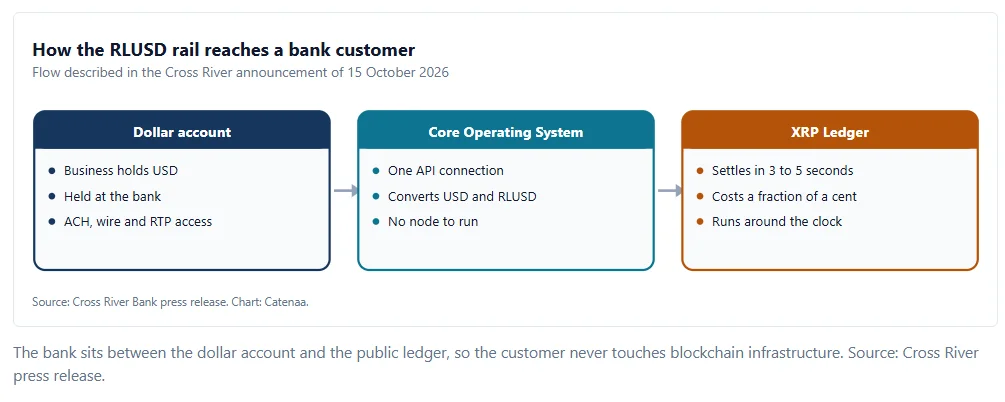
Clients reach the token through one API, with conversion between dollars and RLUSD handled by the bank.
The bank cites XRP Ledger settlement of three to five seconds and more than $1.3 trillion settled to date.
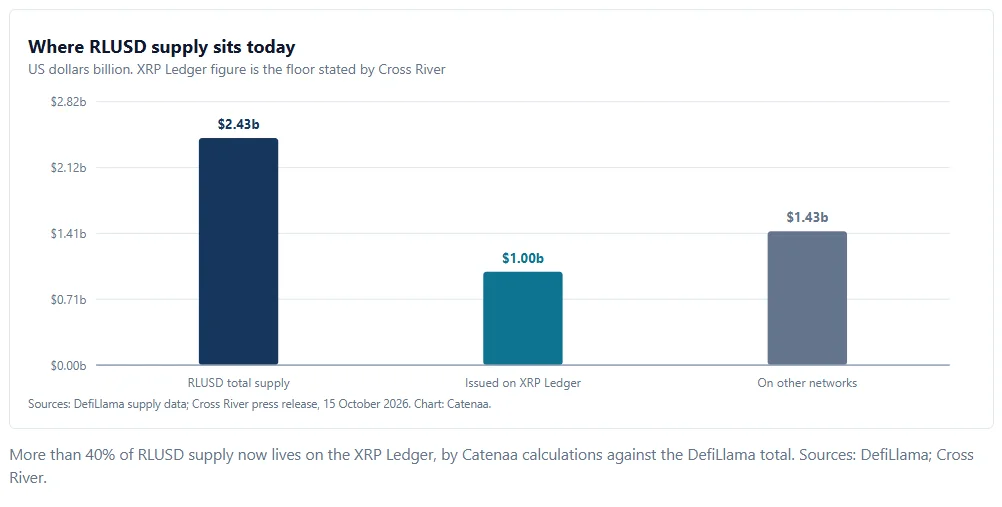
RLUSD supply stood at $2.43 billion on 17 October, ninth in the market and about 0.8% of total supply.
Availability covers a limited number of unnamed states, and the release gives no client names or volumes.
A regulated US bank has wired RLUSD directly into its core ledger. Cross River Bank announced on 15 October that it has embedded Ripple’s dollar stablecoin in its Core Operating System. Consequently, its fintech clients reach the token through one existing API.
What the RLUSD integration actually does
The design removes the usual engineering burden. Clients do not deploy nodes or custody infrastructure themselves. Instead, the bank handles conversion between dollars and the token. Moreover, that happens inside the platform that already moves ACH, wires, and real-time payments.
Settlement speed is the pitch. Transfers on the XRP Ledger clear in three to five seconds for a fraction of a cent. Furthermore, they run on weekends. Therefore, issuers and acquirers can fund positions intraday instead of waiting for the next banking day.
Scope stays narrow for now. The release says services remain available in a limited number of states, although it names none of them. Besides that, it discloses no client names, no volumes, and no rollout timetable.
Therefore, the announcement reads as a capability launch rather than a scaled product. Still, the plumbing is the hard part. Once a token sits inside a core banking system, adding clients becomes a sales task.
Scale behind the announcement
Cross River puts RLUSD market capitalisation above $2.5 billion in its release. Supply data from DefiLlama showed $2.43 billion on 17 October. Meanwhile, the bank says more than $1 billion of that total sits on the XRP Ledger.
The ledger itself carries a longer record. Cross River cites more than $1.3 trillion of value settled on it to date. Ripple, meanwhile, holds over 85 licences across its operating markets, according to the same release.
That licensing count explains the bank’s comfort. Regulated institutions rarely take on a token without a licensed counterparty behind it. Similarly, a single API lowers the compliance review each client must run.
RLUSD remains a small share of a concentrated market
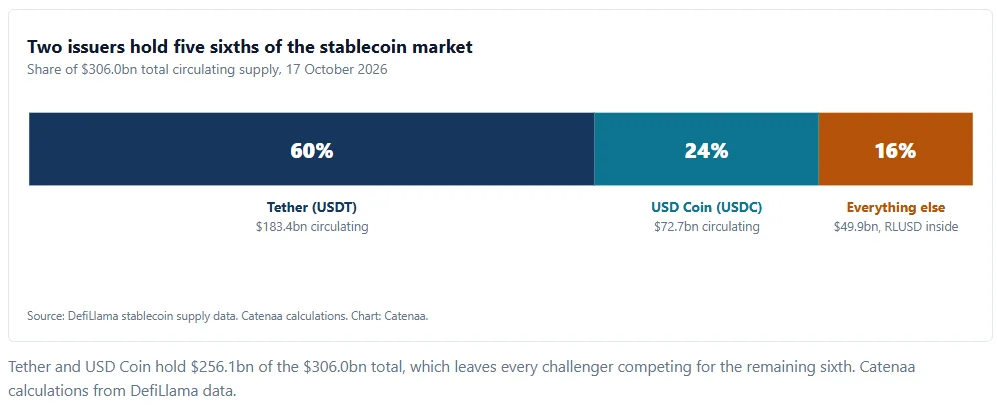
Context matters here. RLUSD ranks ninth by supply, so it holds about 0.8% of the $306.0 billion stablecoin market. Tether and USD Coin together control close to 84% of it. Consequently, every challenger fights over the remaining sixth.
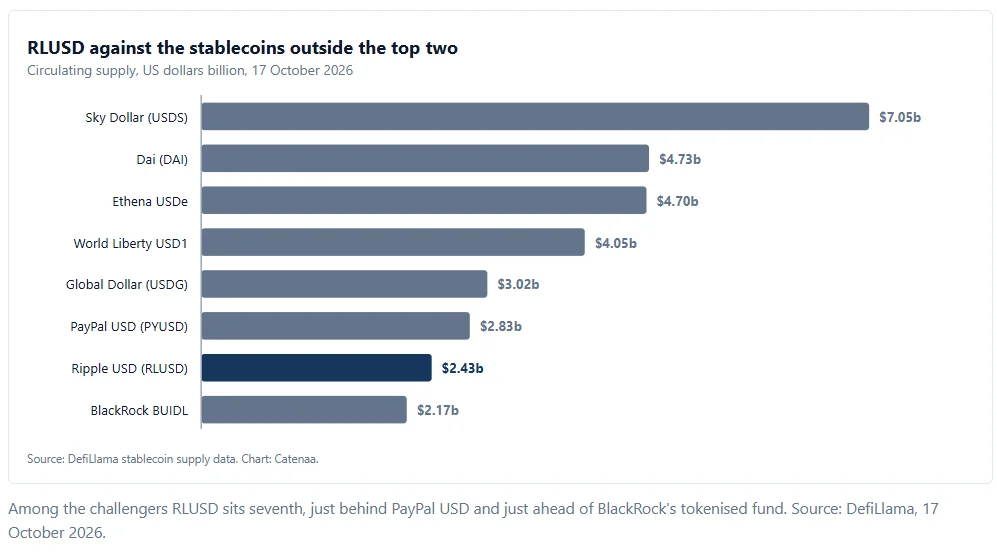
So distribution, not supply, is the prize. A bank that already serves fintech programmes can place a token in front of them cheaply. Cross River lists stablecoin payments as a live product, covering on-ramps, off-ramps, off ramps and settlement.
What to watch next
Three disclosures would turn this into a measurable trend. First, a named client. Second, monthly volume through the rail. Third, the list of eligible states. Ripple publishes reserve and product detail on its stablecoin page, yet bank-level flow data stays unpublished for now.
Until then, judge the deal on reach rather than revenue. The product page already names USDC and RLUSD as supported tokens. If even a handful of clients route treasury flows through RLUSD, the supply figure will move quickly.




