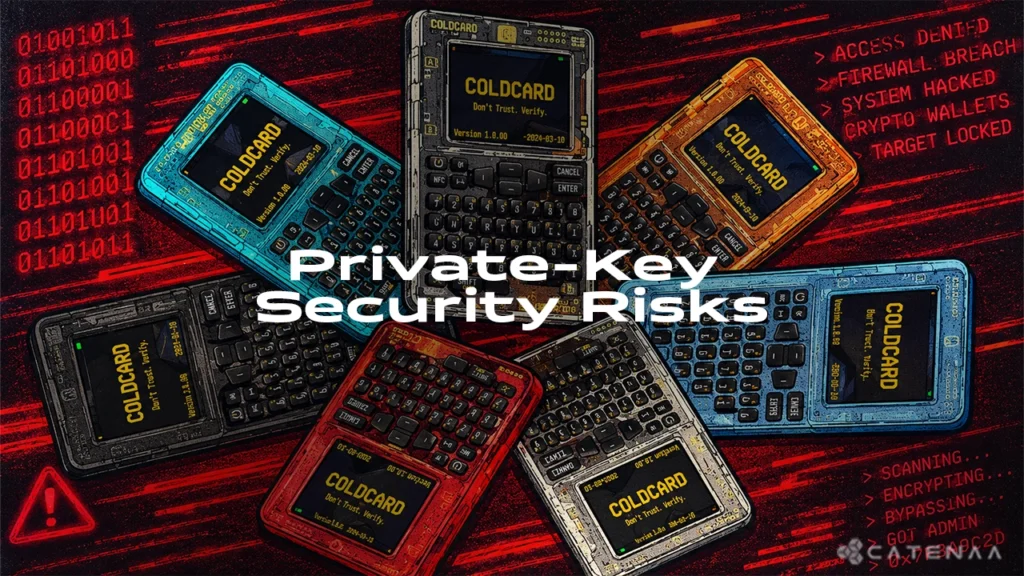


Catenaa, Thursday, August 13, 2026- The Coldcard Bitcoin wallet exploit has exposed a deeper weakness in cryptocurrency security, with Blockaid CEO Ido Ben-Natan warning that reliance on private keys creates a potential single point of failure even for assets held offline.
The attack affected certain Coldcard hardware wallets manufactured by Coinkite. These devices are designed to isolate private keys from internet-connected systems, a practice generally regarded as one of the safer methods of holding Bitcoin.
However, the vulnerability involved how affected devices generated wallet seeds. Insufficient randomness could make some seeds predictable, potentially allowing attackers to reconstruct the private keys controlling Bitcoin stored in affected wallets.
Loss estimates have continued to rise. Galaxy Research has identified at least $111 million in confirmed thefts and estimated total losses could exceed $130 million.
More than 7,000 Bitcoin addresses may have been targeted, according to estimates cited by researchers. Multiple attackers also appear to be exploiting the vulnerability.
Ben-Natan said the incident illustrates a fundamental security trade-off created by private-key ownership.
A private key gives its holder exclusive control over crypto assets without requiring approval from a bank or other intermediary. But compromising that credential can effectively give an attacker the same control.
The Coldcard incident is particularly notable because it challenges a common assumption that keeping keys offline alone is sufficient protection.
Hardware wallets reduce exposure to many online attacks, but their security still depends on software, firmware, cryptographic implementation and the integrity of the process used to generate private keys.
Private-key compromises have become one of the industry’s largest sources of losses.
Blockaid reported that nearly 75% of funds lost through crypto exploits during the first half of 2026 were linked to private-key compromises.
More than $1 billion was lost to crypto hacks during the period as the number of verified incidents climbed to record levels.
The figures suggest attackers are increasingly targeting the credentials and infrastructure controlling assets rather than attempting to break the underlying blockchains themselves.
Ben-Natan also warned that advances in artificial intelligence could lower the technical barriers facing cybercriminals.
More capable AI systems can help attackers analyze software, automate reconnaissance and identify potential weaknesses faster. Crypto assets offer particularly attractive targets because stolen funds can often be transferred immediately.
The Coldcard attack therefore carries implications beyond one hardware-wallet manufacturer.
Self-custody eliminates reliance on traditional financial intermediaries, but it does not eliminate security risk. Instead, much of that responsibility moves to wallet software, hardware manufacturers and ultimately users.
For Bitcoin holders, the incident delivers a stark reminder: keeping private keys offline is only as secure as the technology that creates and protects them.