


October 04, 2026 – The new clearinghouse handles fully collateralized contracts with USDC and round-the-clock settlement. Margined products still rely on outside partners for now.

In Summary
The CFTC registered Coinbase Clearing LLC as a derivatives clearing organization on September 28.
Coinbase now owns its broker, exchange, and clearinghouse, a fully vertical US derivatives setup.
The new DCO can clear only fully collateralized contracts, using USDC and 24/7 settlement.
Five new DCOs registered this year, while the CFTC weighs rules on affiliated market structures.
Coinbase Clearing is now a licensed clearinghouse. The exchange announced the CFTC approval on September 28. It calls the new unit the first clearinghouse built around USDC.
The move completes Coinbase’s US derivatives chain. It already owned a broker, Coinbase Financial Markets, and an exchange, Coinbase Derivatives. Now it also runs the layer that backs and settles each trade. In short, Coinbase can now clear fully funded contracts without a third party.
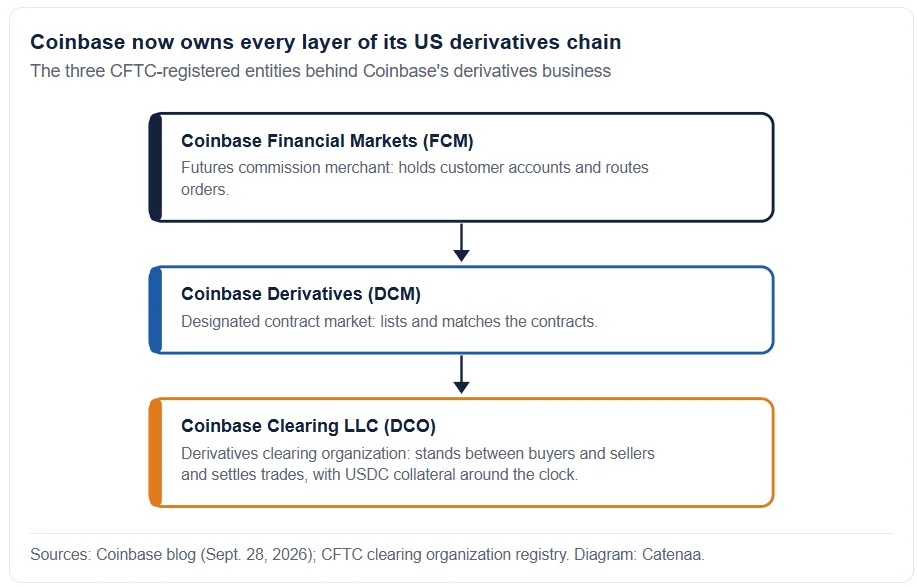
What Coinbase Clearing Can Do
A clearinghouse steps into the middle of every trade. Buyers and sellers then face the clearinghouse, not each other. That way, one firm’s failure does not ripple straight to its trading partners.
Under US law, such a firm must register with the CFTC before it clears futures or swaps. The agency’s registry of clearing firms shows Coinbase Clearing approved by order on September 28.
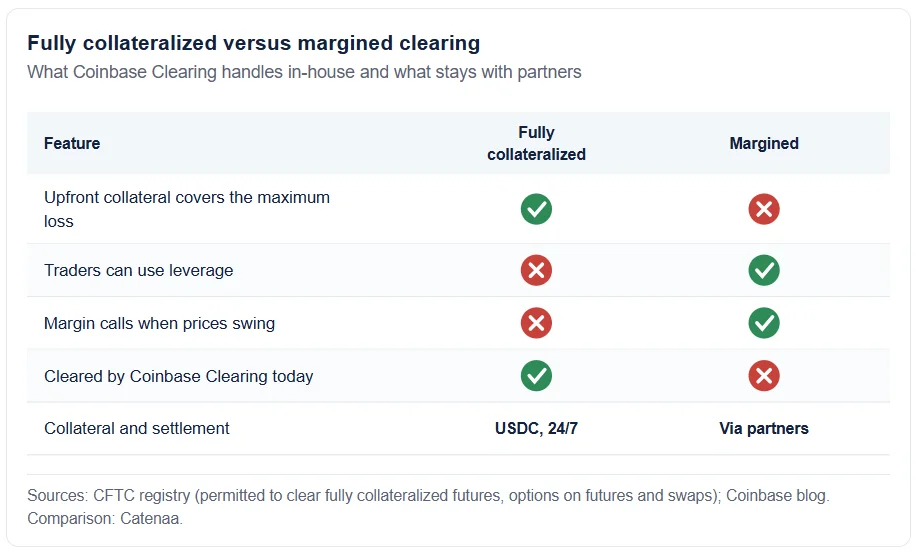
Its license has one key limit. It may clear only fully collateralized futures, options on futures and swaps. In these deals, traders post enough cash up front to cover their largest possible loss. So there is no leverage and no margin call.
Coinbase says the unit will create and settle such contracts itself. It will take USDC as collateral and settle around the clock, every day of the week. That matters because USDC can move on a blockchain at any hour. Bank wires, by contrast, largely pause on weekends.
Abraham added that the setup will help bring more regulated products to market. Even so, Coinbase will keep using outside partners for its margined derivatives. The same goes for its planned single-stock perpetual futures. It gave no launch dates.
A Crowded Field of New Clearinghouses
Coinbase is far from alone. The CFTC registry now lists 26 registered clearinghouses. Quanta Clear won approval on the same day, and five firms have joined so far in 2026.
The others this year were Gemini Olympus, ICE Direct Clear and ProphetX. Each holds the same fully funded permission as Coinbase. Meanwhile, 12 more applications are still pending, including ones from Bullish and tZERO. Applicants range from sports trading venues to tokenization firms.
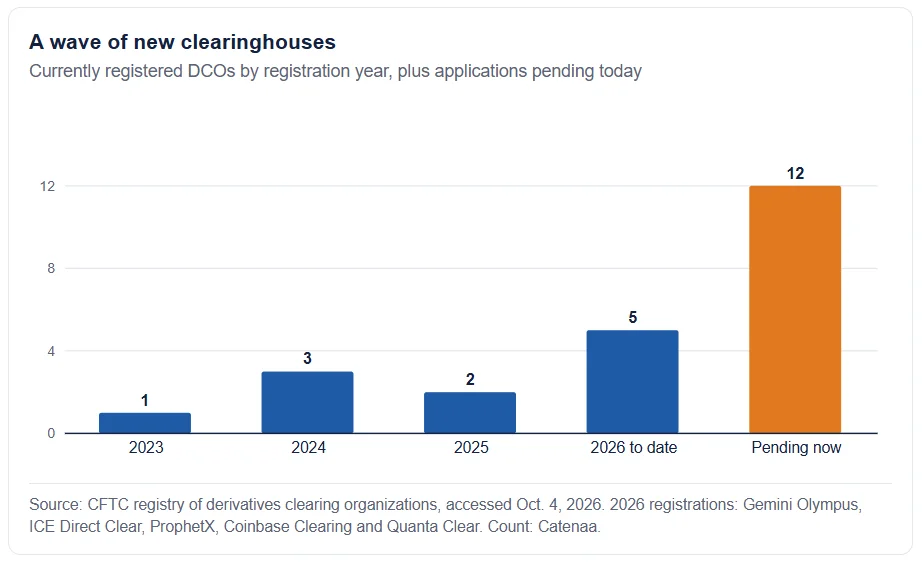
Earlier entrants show where the model came from. Kalshi Klear and Polymarket’s clearing unit joined in 2024, while Bitnomial’s clearinghouse arrived in late 2023. Prediction markets and crypto venues, it seems, like to own this plumbing.
Regulators Watch Vertical Integration
That trend has drawn attention in Washington. On July 30, the CFTC proposed new rules for ties between clearinghouses, exchanges, brokers and market makers under one roof.
The agency said such links can create potential or perceived conflicts of interest. Chairman Michael Selig said the plan sets broad principles without stifling new market designs. The comment period closes on Monday, October 5.
Separately, the CFTC has asked for views on 24/7 trading for standard futures. It also asked about perpetual contracts tied to energy. As a result, always-on clearing could soon reach well beyond crypto.
Collateral rules are shifting, too. On September 24, CFTC staff updated their crypto guidance on investing customer funds in tokenized forms of approved assets. Taken together, these steps point to markets that trade and settle without a closing bell.
Why Coinbase Clearing Matters for the Business
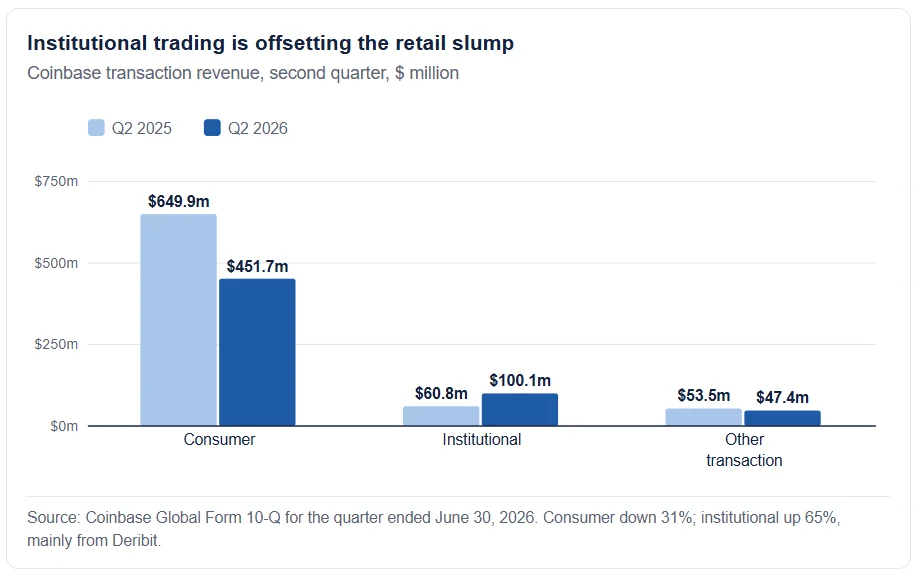
Derivatives now carry more weight at Coinbase. Its second-quarter report shows institutional trading revenue up 65% to $100.1 million. Most of that gain came from Deribit, which it bought in August 2025 for $4.3 billion.
Retail trading, by contrast, has slumped. Consumer trading revenue fell 31% to $451.7 million as consumer spot volume dropped 38%. Total revenue slid to $1.22 billion, and the company posted a net loss of $359.5 million. Monthly transacting users also fell to 7.6 million from 8.7 million a year earlier. Assets on the platform dropped to $245.9 billion, mostly because crypto prices fell.
Stablecoins tie the plan together. Average USDC held in Coinbase products has hit a record this year. Customers also held $8.87 billion of USDC on the platform at June 30.
For now, Coinbase says it will first strengthen the systems behind today’s products. After that, it plans to build a base that can scale.
Owning the clearing layer gives Coinbase more say over product launches, collateral, and trading hours. Next, watch whether it brings margined products in-house. The CFTC’s final rules on affiliated firms will shape that step.