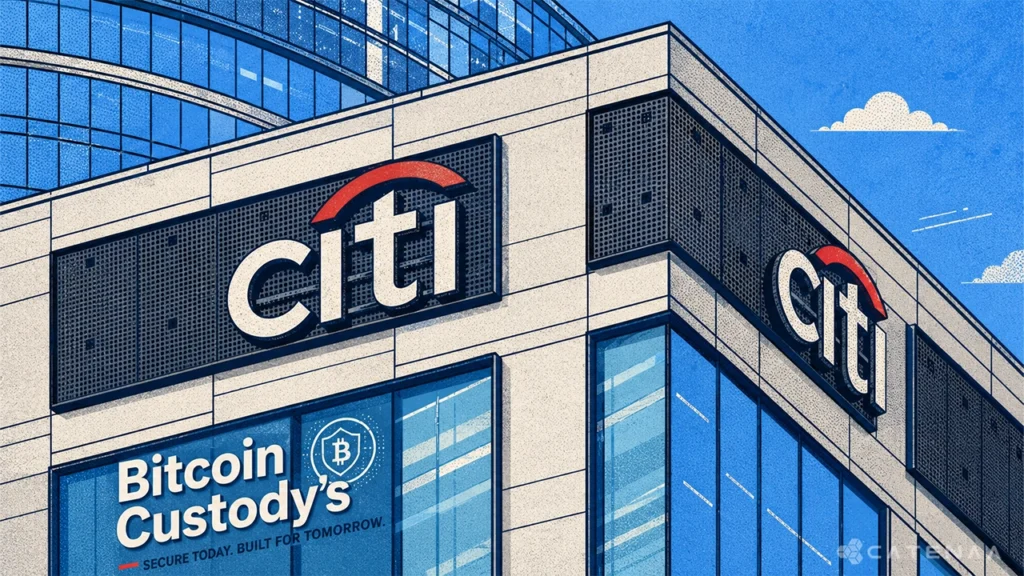


Catenaa, Monday, August 24, 2026- Citi plans to launch institutional Bitcoin custody later this year through its new Custody+ platform, allowing clients to manage cryptocurrency and traditional assets within the same banking framework.
The Wall Street bank confirmed Tuesday that Bitcoin will be the first digital asset supported by the service.
The move goes beyond simply adding another cryptocurrency product.
Citi is integrating digital asset custody into infrastructure already serving institutional investors across traditional securities markets.
Custody+ is designed for markets shifting toward continuous trading, shorter settlement cycles and near-real-time movement of assets and cash.
Citi said its digital asset custody service is being built on a common digital asset architecture.
Clients will eventually be able to access conventional and crypto custody through a single framework rather than maintaining separate systems for each asset class.
That could simplify a major operational problem for institutions entering digital asset markets.
Asset managers, banks and other financial firms traditionally rely on established custodians for securities, cash management, settlement and corporate actions.
Crypto has often required a separate network of specialist custodians, wallet providers and technology platforms.
Citi is attempting to bring those functions closer together.
The bank has not disclosed which digital assets could follow Bitcoin.
Custody+ reflects a wider change underway in financial infrastructure.
Bitcoin and other digital assets already trade around the clock and can settle without waiting for traditional banking hours.
Tokenized securities and deposits are beginning to introduce similar characteristics into conventional markets.
Citi designed Custody+ around that shift.
The platform includes real-time asset servicing, faster settlements, liquidity tools, foreign exchange services and market intelligence.
It also incorporates Citi Token Services, which enables near-instant transfers of tokenized deposits around the clock in selected markets.
Bitcoin custody therefore sits within a broader effort to prepare the bank for markets that increasingly operate beyond conventional trading and settlement windows.
Citi has been building several pieces of that infrastructure during 2026.
The bank has worked with Intercontinental Exchange on using tokenized deposits across clearing operations.
The concept could allow clearing members to move money outside normal banking hours to meet margin and funding requirements.
Citi also joined a Swift initiative involving major banks testing blockchain infrastructure for tokenized deposits and round-the-clock cross-border payments.
It is separately involved in a major U.S. banking initiative developing tokenized deposit infrastructure through The Clearing House.
Together, those projects show Citi pursuing both sides of institutional onchain finance.
Tokenized deposits provide digital cash.
Digital asset custody provides a way to safeguard assets such as Bitcoin.
Custody is one of the largest barriers separating institutional finance from crypto-native markets.
Holding Bitcoin requires management of cryptographic keys rather than the conventional account records used for many traditional securities.
Losing control of those keys can mean losing access to the assets.
Institutions also need systems covering authorization, cybersecurity, transaction monitoring and regulatory compliance.
Large banks can potentially provide those functions inside relationships institutions already use for other financial services.
That reduces the need for a fund or corporation to build its own crypto custody infrastructure.
It could also make Bitcoin easier to incorporate into existing treasury and investment operations.
Citi’s move is part of a wider change in how major banks approach digital assets.
Earlier institutional involvement often focused on trading, research or providing services to crypto companies.
Banks are now moving closer to the underlying infrastructure.
Custody places a financial institution directly between the client and the digital asset.
Tokenized deposits put commercial bank money onto programmable infrastructure.
Settlement systems connect those assets with conventional capital markets.
The boundaries between crypto infrastructure and traditional banking are consequently becoming less distinct.
Catenaa View
Citi’s Bitcoin launch matters because of where the bank is putting it.
Bitcoin is not being isolated inside a specialist crypto division.
It is being incorporated into Custody+, alongside infrastructure designed for securities, cash, foreign exchange, settlement and liquidity.
That suggests institutional crypto adoption is moving into a different stage.
The first stage was access.
Bitcoin ETFs, futures and trading desks allowed institutions to obtain exposure without directly handling cryptocurrency.
The next stage is infrastructure.
Banks are beginning to build systems capable of holding digital assets, moving tokenized money and servicing investments continuously.
Citi’s model could eventually allow an institutional client to hold conventional securities and Bitcoin with the same banking group while also using tokenized deposits for settlement.
That is much closer to the integrated financial system envisioned by advocates of tokenization. It also reflects an important competitive shift.
Crypto-native custodians built much of the early institutional infrastructure because traditional banks were reluctant or unable to offer comparable services.
Large global banks are now beginning to enter that territory. Their advantage is not necessarily blockchain technology.
It is their existing relationships with asset managers, corporations and financial institutions.
If Bitcoin custody becomes another service inside those relationships, institutions may no longer need to treat crypto as an entirely separate operational environment.
What Comes Next
Citi expects Bitcoin custody to become available later in 2026 but has not announced a specific launch date. The bank also has not detailed pricing or which client groups will receive access first. The larger question will be whether Citi expands beyond Bitcoin.
Adding stablecoins, tokenized securities or other digital assets would turn Custody+ into a wider bridge between blockchain markets and Citi’s conventional custody network.
For now, Bitcoin is the starting point.
Citi disclosed plans for native digital asset custody in 2025 and has expanded its blockchain infrastructure during 2026. Its Custody+ platform combines near- and real-time custody services designed for continuous markets and shorter settlement cycles. Citi also operates tokenized deposit services and participates in initiatives involving blockchain-based clearing and cross-border payments. The bank’s custody business operates across more than 100 markets.