

October 17, 2026 – Circle paid $819.3 million to distribution partners and in transaction costs in the first half of 2026, against total revenue of $1,395.4 million, and kept $103.5 million in net profit.

In Summary
Circle paid $819.3 million to USDC distribution partners and transaction costs in the first half of 2026.
That absorbed 58.7% of the $1,395.4 million in total revenue and reserve income, down from 61.0% a year earlier.
Operating expenses fell to $496.8 million from $714.7 million, which lifted net income to $103.5 million.
Coinbase held a record $20 billion of average USDC balances in the second quarter, up 44% year on year.
USDC in circulation ended June at $73.3 billion, below the $77.0 billion peak reached in March.
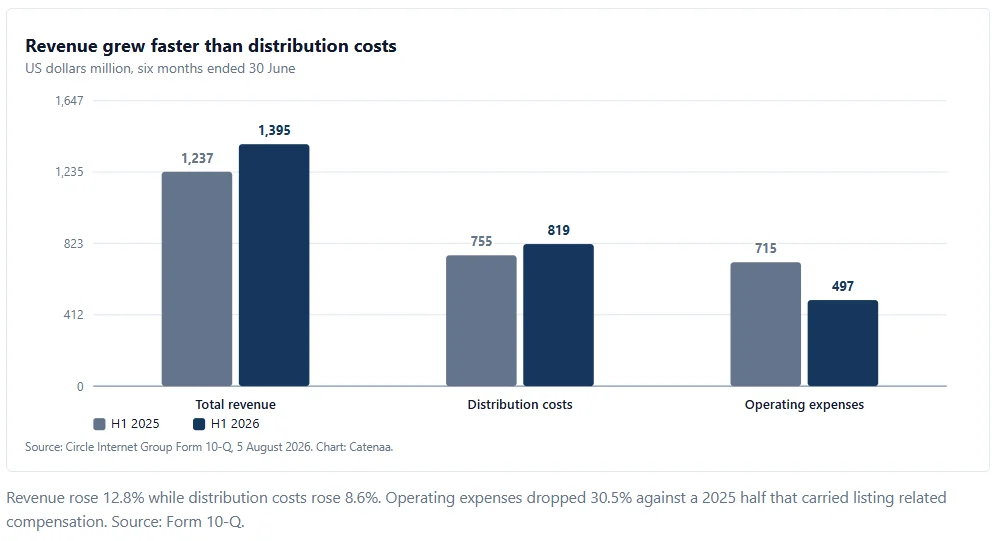
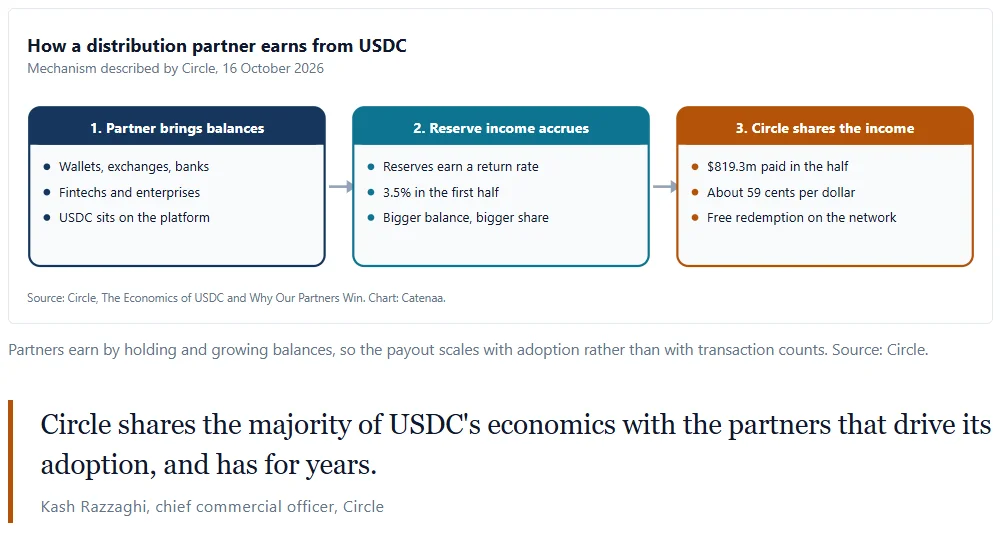
Circle has published the split behind its USDC revenue. In the first half of 2026, the company paid $819.3 million to distribution partners and transaction costs. Moreover, that equals roughly 59 cents of every revenue dollar.
How the USDC revenue split works
The disclosure came in a company post by Kash Razzaghi, Circle’s chief commercial officer. He framed the split as a defence of the model. Partners that grow USDC balances earn a share of the income those balances generate.
Circle’s own quarterly filing confirms the figures. Total revenue and reserve income reached $1,395.4 million in the half. Distribution, transaction and other costs took $819.3 million of it.
Costs are growing slower than revenue
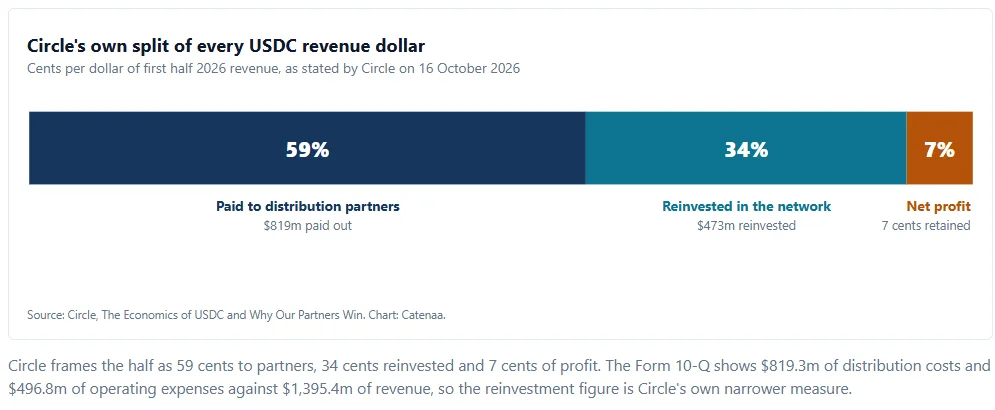
The ratio actually improved year on year. In the first half of 2025, distribution costs absorbed 61.0% of revenue. This year they took 58.7%. Therefore, Circle kept a slightly larger slice despite paying more in absolute terms.
Operating expenses tell a sharper story. They fell to $496.8 million from $714.7 million. Compensation alone ran $306.9 million lower than a year earlier. Consequently, net income swung to $103.5 million from a $417.3 million loss.
Partner concentration remains the risk
Coinbase stays the dominant counterparty. Average USDC held across Coinbase products hit a record $20 billion in the second quarter, Circle said. That balance grew 44% in a year. Binance then signed a five-year commercial agreement in September and put $100 million into Circle.
Such concentration cuts both ways. A single large partner delivers scale cheaply, yet it also holds pricing power at renewal. Furthermore, the economics reset whenever a bigger platform arrives, as the Binance deal shows.
Beyond those two, Circle counts more than 150 partners with an economic interest in USDC. That breadth supports the claim that USDC carried about 77% of global stablecoin transaction volume in June. A year earlier, the share sat near 60%.
Circle also leans on compliance spending to justify the retained share. It cites more than 55 licences and registrations, plus monthly attestations on a government money market fund. Reserves sit with BlackRock as manager and BNY as custodian.
What to watch in the next print
Supply momentum has stalled, which matters more than the split itself. USDC in circulation ended June at $73.3 billion, below the $77.0 billion recorded in March. Meanwhile, the reserve return rate slipped to 3.5% from 4.1% across full-year 2025.
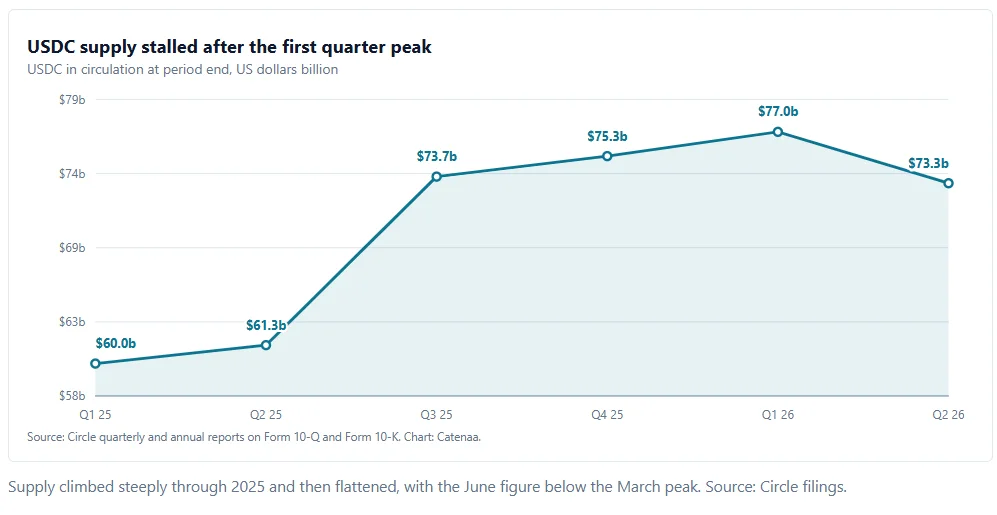
Both lines squeeze the same revenue pool. If balances stay flat while rates fall, partner payments still climb with adoption. Circle has scheduled third-quarter results for 4 November, so the distribution ratio is the line to watch.
Investors have already marked the stock down. Shares closed at $82.22 on Nasdaq on 16 October, far below the 52-week high of $147.44. In short, the market reads the partner split as a ceiling on margins rather than proof of reach.




