

September 20, 2026 – Some of the largest names in finance are now running nodes on a public blockchain. Circle’s new Layer 1 went live with more than 100 firms connected.

In Summary
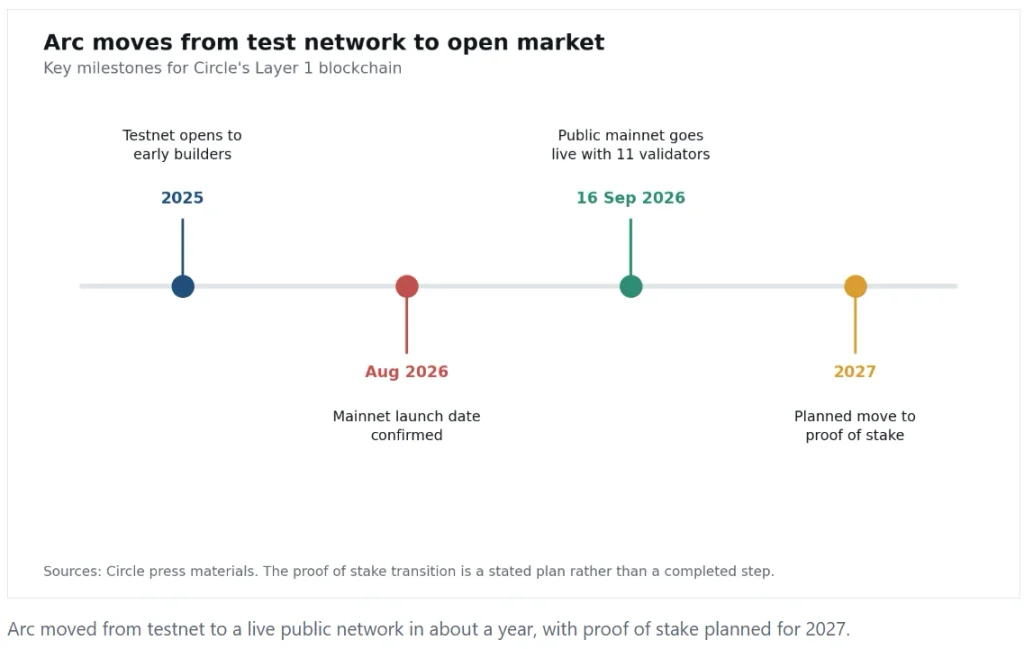
Circle Arc opened its public mainnet on 16 September 2026.
BlackRock, DTCC, ICE, Mastercard, Visa and Standard Chartered are among 11 founding validators.
More than 100 institutional and ecosystem builders went live on day one.
Gas fees are paid in USDC, and settlement is final in under a second.
Circle plans a move toward proof of stake during 2027.
BlackRock now helps run a public blockchain. So do Visa, Mastercard and the DTCC. All four became founding validators of Circle Arc when its mainnet opened on 16 September.
That list matters more than the technology. Institutions have talked about public chains for years. This time they are operating the infrastructure themselves.
Markets noticed quickly. Circle shares closed at 85.09 dollars, a gain of 5.77 percent on the day.
What Circle Arc actually does
Arc is a Layer 1 network built for payments, not trading. Circle calls it an economic operating system for the internet. The phrase is grand, but the aim is plain enough.
Three design choices stand out. Users pay gas fees in USDC, so they never need a volatile native token. Settlement lands in under a second and stays final.
Those two choices solve a real problem. Treasurers hate holding a token just to move money. They also hate waiting to know a payment cleared.
Privacy works by choice, not by default. Private transfers use view keys, so auditors and regulators can still see what they need.
The chain also runs EVM code as it is. So developers can port old contracts straight across. That lowers the cost of trying it.
Circle even added post quantum signatures. Few chains bother, yet banks ask about it in every review.
Eleven names secure the network
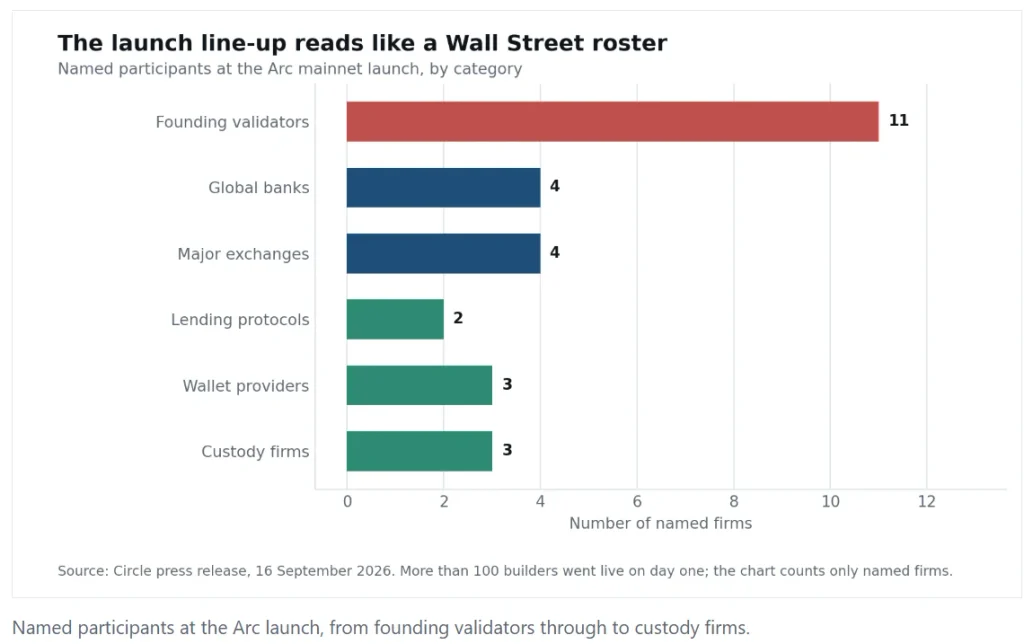
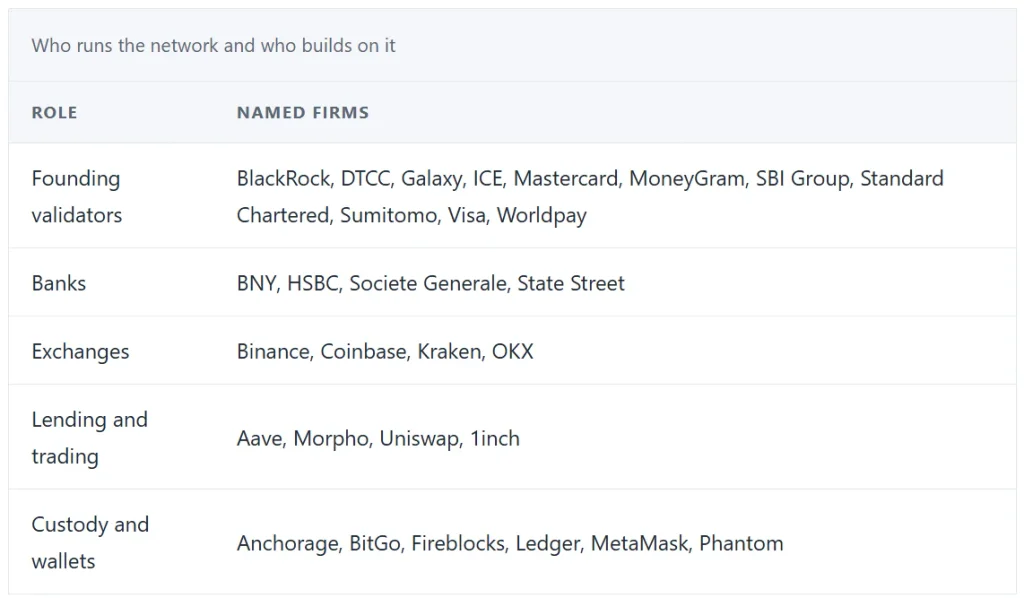
The validator cohort is unusually institutional. BlackRock, DTCC, Galaxy, ICE, Mastercard, MoneyGram, SBI Group, Standard Chartered, Sumitomo Corporation, Visa and Worldpay all run nodes.
Circle keeps that set closed for now. It plans a move toward proof of stake during 2027, which would open validation more widely.
Robbie Mitchnick of BlackRock framed the appeal simply. Purpose built chains can accelerate adoption, he said, and Arc looks positioned for payments at scale.
More than 100 firms went live on day one
Breadth sets this launch apart from earlier ones. BNY, HSBC, Societe Generale and State Street all joined. So did Binance, Coinbase, Kraken and OKX.
Rival camps rarely share a network. Big banks and crypto exchanges now sit on the same rails, which is new.
Decentralised finance arrived too. Aave opened a V4 market on Arc, while Morpho, Uniswap and 1inch all connected.
Custody and wallet support followed. Anchorage, BitGo and Fireblocks cover institutions, and MetaMask, Ledger and Phantom serve retail users.
Stani Kulechov of Aave explained the logic. His team wanted credit infrastructure on a network built to bring real world finance onchain.
The stablecoin engine underneath
Arc runs on Circle’s existing money rails. It supports USDC, EURC and more than 20 local stablecoins through Circle StableFX.
That combination enables round the clock cross currency settlement. Payments can move between currencies without waiting for banking hours.
Scale looks plausible already. The test network processed more than 700 million transactions in under a year of operation. Few new chains reach that before launch.
Local stablecoins matter for emerging markets. A Philippine peso token settling against USDC removes a costly correspondent hop. Remittance corridors stand to gain most.
Why Circle needs this
Circle earns most of its money from interest, not from software. Its quarterly filing shows reserve income of 667.7 million dollars in the June quarter.
Total revenue and reserve income reached 701.3 million. Distribution and transaction costs then took 410.4 million, leaving net income of 48.2 million.
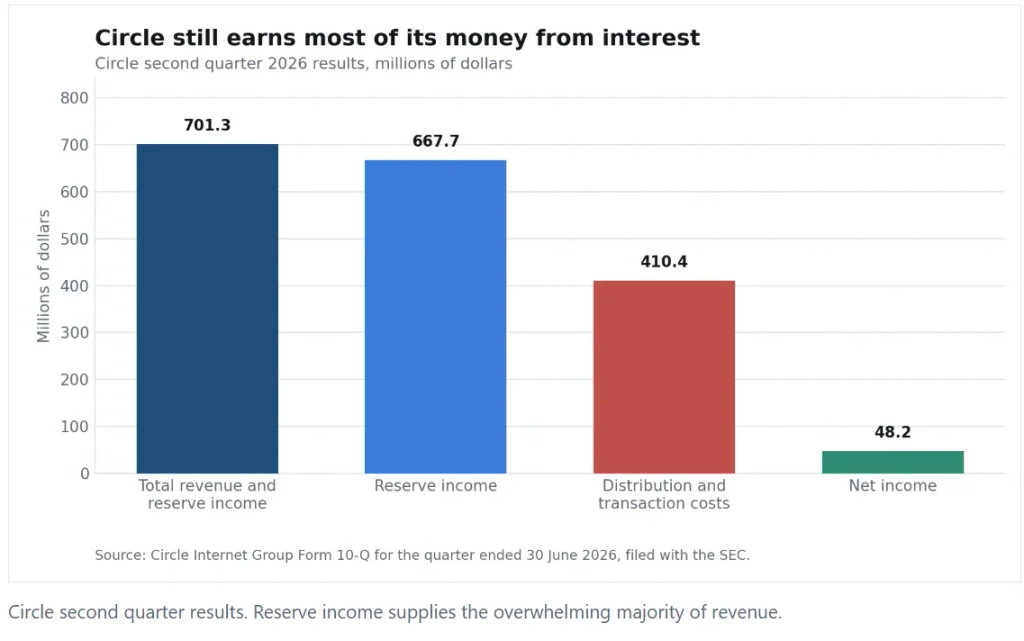
That model leans on interest rates. A cutting cycle would squeeze it hard. So new revenue lines matter a great deal.
Arc could add fees over time. Circle has not set out a pricing model yet, and gas in USDC keeps the chain cheap by design.
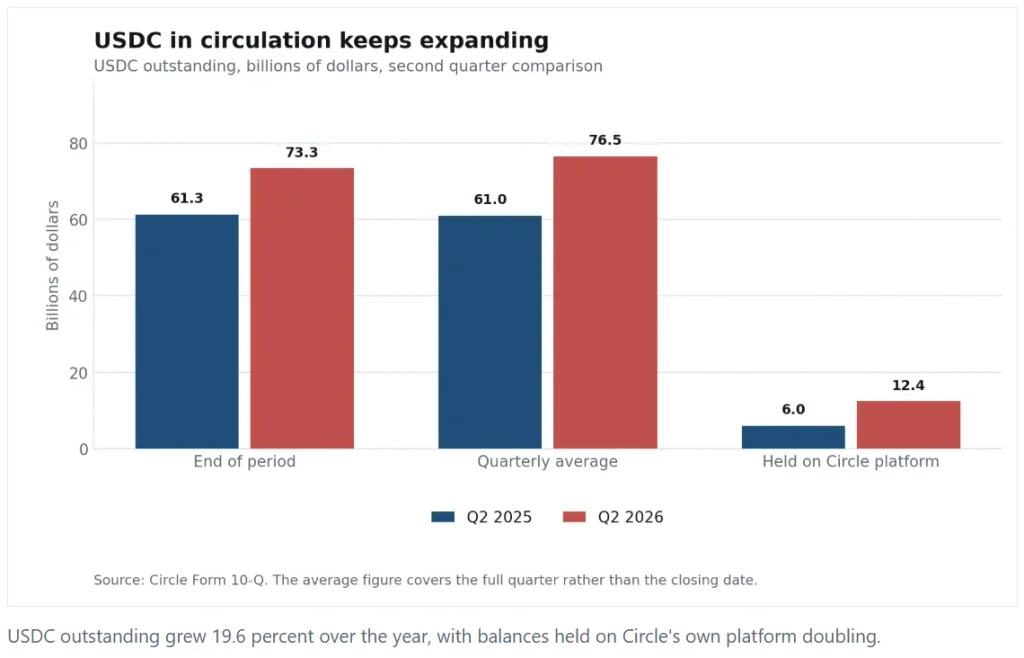
Volume growth helps meanwhile. USDC outstanding reached 73.3 billion dollars at the end of June, against 61.3 billion a year earlier.
Regulation remains the open question
American rules remain a work in progress. The Commission’s proposed Regulation Crypto Assets sits in its comment period until 20 October.
Arc launched with 10 billion ARC tokens minted at genesis. How regulators treat that token will shape the network’s next phase.
Circle has trodden carefully so far. Gas in USDC keeps the token out of everyday payment flows. That choice shrinks the regulatory surface considerably.
Europe adds its own layer. EURC support brings the network inside MiCA’s scope, so Circle must satisfy two rulebooks at once.
What to watch next
Three signals will show whether this sticks. Watch settled volume first, since validator names count for little without transactions.
Track which banks move real client money next. A pilot differs greatly from production use, and the launch materials describe intent rather than flows.
Finally, follow the proof of stake plan. Opening validation would test whether an institutional chain can stay open and neutral at the same time.