

November 23, 2026 – Early tallies counted only Ethereum assets. Chainflip’s own notice shows Bitcoin made up about 60% of a loss of nearly $12 million.

In Summary
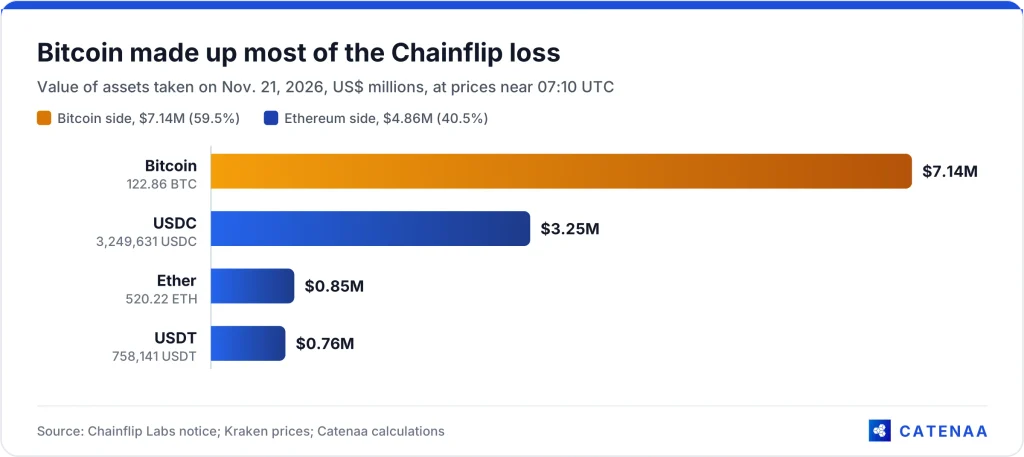
Chainflip’s notice lists 122.86 BTC, 520.22 ETH, 3.25 million USDC and 758,141 USDT taken on Nov. 21.
At prices near the time of the theft, the loss was about $12.0 million. Bitcoin accounted for $7.1 million.
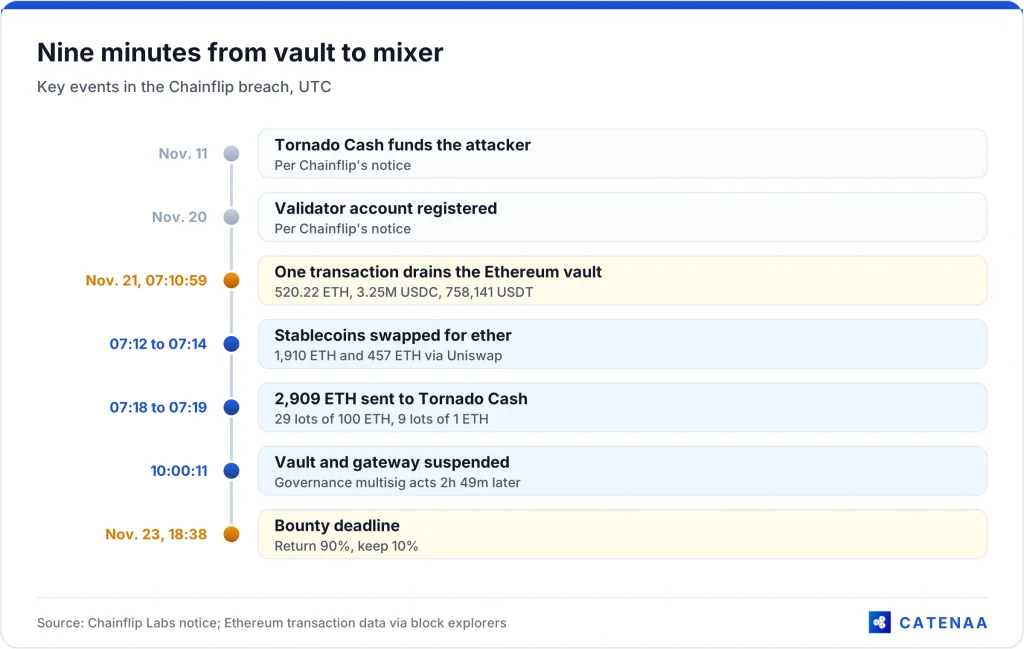
One Ethereum transaction emptied the ether and stablecoins at 07:10:59 UTC. Within nine minutes, 2,909 ETH reached Tornado Cash.
Chainflip offers a 10% bounty if 90% returns by 18:38 UTC on Nov. 23. No funds had come back by Sunday afternoon.
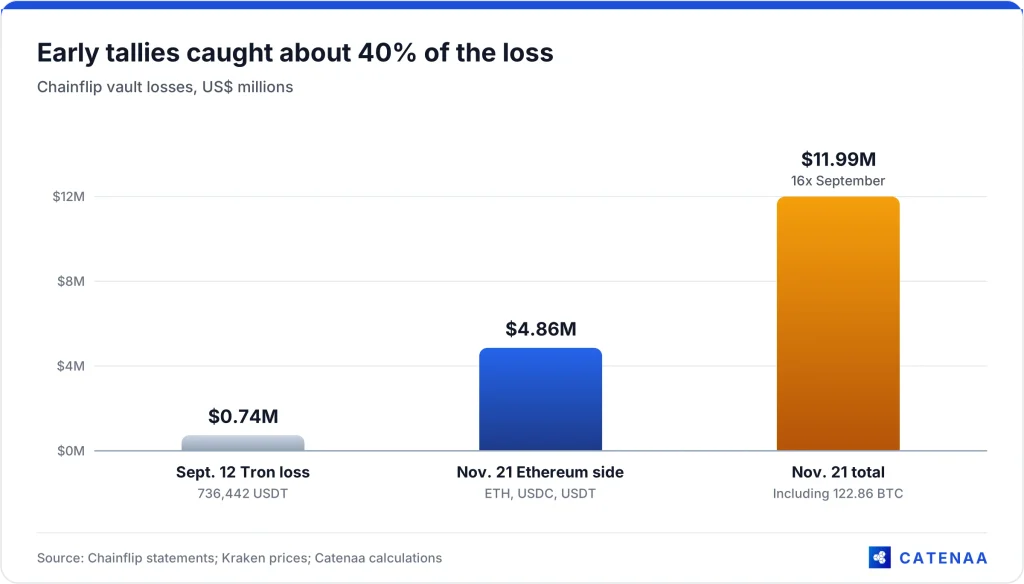
The Chainflip breach is far larger than the first tallies showed. Early counts of about $4.86 million covered only Ethereum assets. However, Chainflip’s own recovery notice also lists 122.86137042 BTC taken from its vaults on Nov. 21.
How big is the Chainflip breach?
The notice names four assets. It lists 122.86137042 BTC, 520.2243399 ETH, 3,249,631.41 USDC and 758,141.33 USDT. Catenaa priced each asset at Kraken’s quotes for 07:00 to 07:15 UTC that morning. On that basis, the loss comes to about $12.0 million.
Bitcoin alone was worth about $7.1 million, or 59.5% of the total. By contrast, the Ethereum side came to $4.86 million. The early figures therefore missed well over half of the damage.
One transaction emptied the Ethereum vault
On-chain records show how fast the Chainflip breach moved. A single transaction at 07:10:59 UTC sent all of the ether, USDC and USDT to one wallet. It called the vault’s batch transfer function, which pays out against a valid vault signature.
Next, the wallet swapped both stablecoins for ether within four minutes. The proceeds were gathered in a second wallet. Then, between 07:18 and 07:19 UTC, it sent 2,909 ETH to the Tornado Cash router.
The deposits came in 29 lots of 100 ETH and nine lots of 1 ETH. Those sizes match standard Tornado Cash pools. As a result, the ether side left the open chain within nine minutes of the drain.
Meanwhile, Chainflip’s governance multisig suspended the Ethereum vault and its State Chain Gateway at 10:00:11 UTC. That came two hours and 49 minutes after the drain. The docs explain why speed matters. Smart contract vaults have no payout delay, so a freeze can only stop the next transfer.
The signing model under scrutiny
Chainflip’s security documentation says vault signatures need a two-thirds majority of up to 150 validators. That means about 100 nodes must agree. Yet the notice says the attacker registered a validator account only on Nov. 20.
Chainflip says it has identified “the mechanism of key exposure” and has prevented similar attacks. It also traced Tornado Cash funding on Nov. 11 and a FLIP token purchase. Still, the team has not published technical details.
The bounty deadline
Chainflip offers the attacker 10% to return 90%. It asks for 110.57523337 BTC and 2,618.1 ETH by 18:38 UTC on Nov. 23. Notably, the ether figure is exactly 90% of the 2,909 ETH sent to Tornado Cash.
Both return addresses also appear in Chainflip’s published safe harbour policy. As of 16:45 UTC on Nov. 22, the Bitcoin return address showed zero transactions. Likewise, the governance multisig had received no ether.
At Sunday prices, the requested return is worth about $11.3 million. That splits into $6.8 million of Bitcoin and $4.5 million of Ether. As a result, the bounty would be worth roughly $1.25 million.
Chainflip also says major blockchain analytics firms have flagged the attacker’s addresses. If so, cashing out at size would be hard. That pressure is the main lever behind the offer.
What the Chainflip breach means for LPs
This is Chainflip’s second vault loss in ten weeks. On Sept. 12, a Tron memo flaw cost 736,442.17 USDT, the team said at the time. By comparison, the Chainflip breach in November is about 16 times larger.
After that loss, Chainflip said Tron LP balances needed a reset because the vault held less than LPs were owed. So far, it has not said how it will treat Bitcoin and Ethereum LPs. For now, its website says services are temporarily unavailable. Pending swaps and LP withdrawals therefore depend on the restart plan.