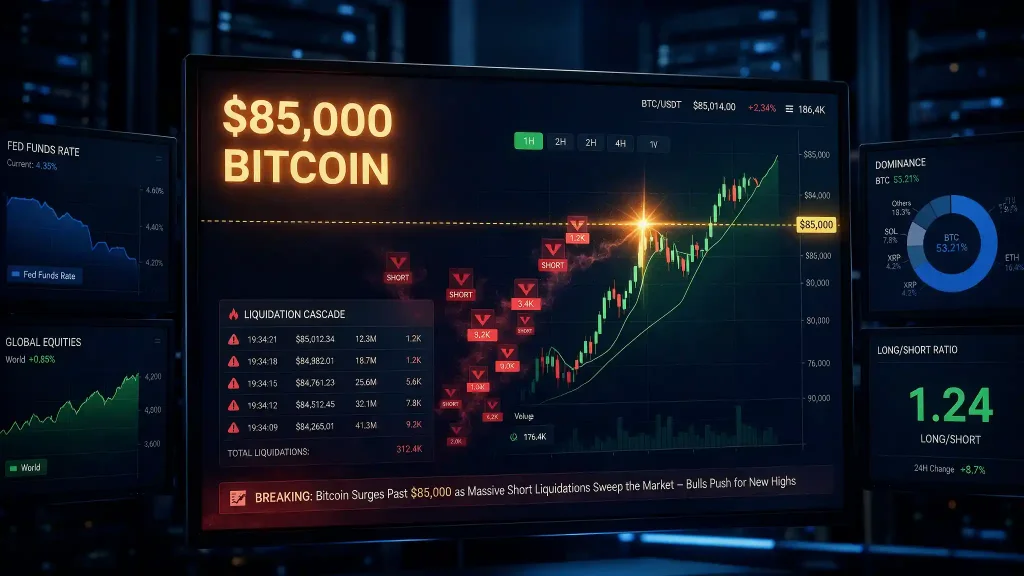


atenaa, Wednesday, September 23, 2026-Bitcoin briefly climbed above $85,000 on early this Monday for the first time since January, extending a sharp recovery from last week’s selloff as hundreds of millions of dollars in bearish crypto positions were liquidated.
The world’s largest cryptocurrency gained more than 5% over 24 hours after trading near $75,000 on September 15.
Bitcoin had recovered above $80,000 by Friday before accelerating during Monday’s session.
The move left the cryptocurrency less than 3% lower for the year, although it remained about 32.5% below its October record near $126,000.
The rally spread across the cryptocurrency market.
Ether gained about 5.6% to $2,717, while XRP rose 7.8% to $1.49. Solana advanced about 7.2% to $115.75.
The rapid advance caught traders positioned for further declines on the wrong side of the market.
More than $750 million in leveraged cryptocurrency positions were liquidated over 24 hours, according to CoinGlass data cited by The Block.
Short positions accounted for $648.3 million of that total, showing that traders betting on falling prices absorbed most of the losses.
Bitcoin alone generated about $360.7 million in liquidations.
The largest individual liquidation was an $11.3 million BTC-USDT position on Binance.
A short liquidation occurs when an exchange forcibly closes a leveraged position after the market rises far enough against a trader who had bet on falling prices.
Those closures can require Bitcoin or related contracts to be bought back, adding demand while prices are already rising.
That process can accelerate an upward move when large numbers of short positions are concentrated around similar price levels.
The liquidation figures therefore suggest forced position closures added momentum to Bitcoin’s recovery.
They do not, however, explain the rally on their own.
The cryptocurrency advance coincided with improving sentiment across broader financial markets.
Technology and semiconductor stocks led gains in Asia before European equities opened higher, while US stock futures also advanced.
Lower oil prices offered some relief after energy costs had risen sharply amid attacks on Saudi infrastructure and disruptions to Middle Eastern supply routes.
Saudi Arabia increased crude shipments through its Gulf terminals after damage to its East-West pipeline disrupted exports through the Red Sea.
Brent crude moved lower as traders assessed the improving flow of Saudi oil and the prospect of restoring part of the damaged pipeline capacity.
Cheaper oil can improve investor appetite for risk by reducing concerns that higher energy costs will feed further inflation.
That relationship has become especially important after the Federal Reserve raised US interest rates by 25 basis points on September 16.
The increase lifted the federal funds target range to 3.75% to 4%.
The Fed said inflation remained elevated even as economic activity continued to expand at a solid pace.
Higher interest rates can pressure Bitcoin and other risk assets because they raise returns available from lower-risk investments and increase borrowing costs throughout financial markets.
Markets are now assessing whether persistent inflation could require another rate increase.
The US two-year Treasury yield was around 4.75% during Monday’s trading, reflecting expectations that monetary policy could remain restrictive.
Bitcoin’s ability to advance despite those concerns marks a reversal from the weakness seen only days earlier.
The cryptocurrency was near $75,000 on September 15, leaving the subsequent move above $85,000 equivalent to a recovery of more than 13% from that level.
The speed of the rebound is also important.
Large price movements in a short period can force leveraged traders to reduce positions rapidly, increasing volatility in both directions.
Monday’s liquidation data showed that bearish traders bore the immediate cost of that volatility.
Bitcoin’s recovery also came after months of weakness from its October peak.
At $85,000, the cryptocurrency remained more than $40,000 below its record near $126,000.
That gap shows the latest rebound has recovered only part of the decline from the previous high.
The broader crypto market nevertheless moved with Bitcoin, suggesting the rally was not confined to a single asset.
Ether, XRP and Solana all posted strong daily gains as traders returned to riskier digital assets.
Bitcoin has historically exerted a strong influence over the wider cryptocurrency market because of its size and liquidity.
Rapid movements in Bitcoin can also affect leveraged positions across exchanges, particularly when traders use the same collateral to maintain exposure to several assets.
The latest rebound therefore combines two forces that can reinforce each other in cryptocurrency markets.
Improving sentiment encouraged buyers to return after last week’s decline, while rising prices forced heavily leveraged short traders out of their positions.
Whether that momentum lasts will depend on conditions beyond the crypto market.
Oil prices, US interest-rate expectations, Treasury yields and global equity sentiment remain capable of shifting investor demand for risk.
For Bitcoin, the return above $85,000 marks its strongest price level since January.
The more immediate test is whether the cryptocurrency can hold those gains after the wave of forced short covering subsides.