


October 17, 2026 – Bitcoin settled at $81,500.80 on Friday after a dip below $80,000, while US spot funds shed $228.4 million over the week and short Treasury yields stayed above the policy rate.

In Summary
Bitcoin closed at $81,500.80 on 16 October, down 1.28% on the week and 2.47% for October so far.
Thursday’s $79,709 low marked the first break below $80,000 this month, and buyers defended it.
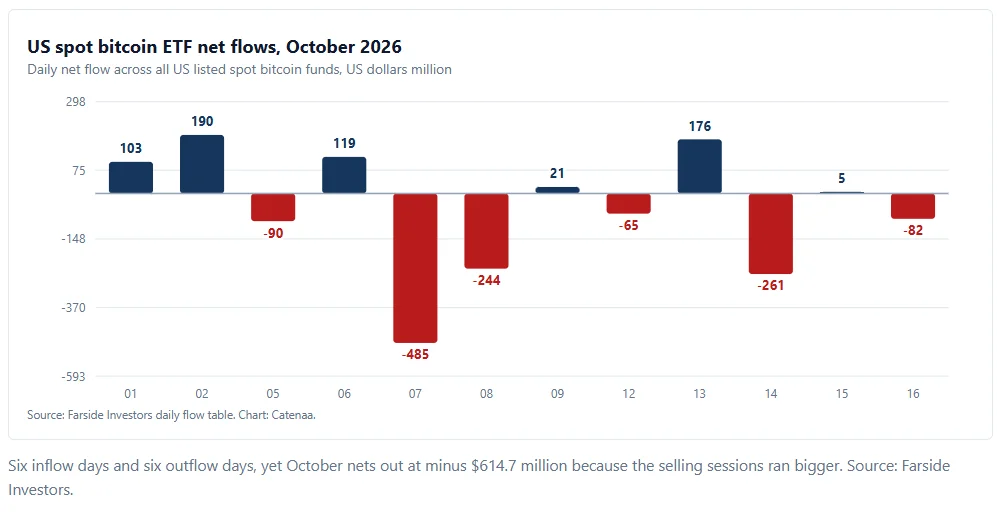
US spot bitcoin funds recorded net outflows of $228.4 million last week, taking October to minus $614.7 million.
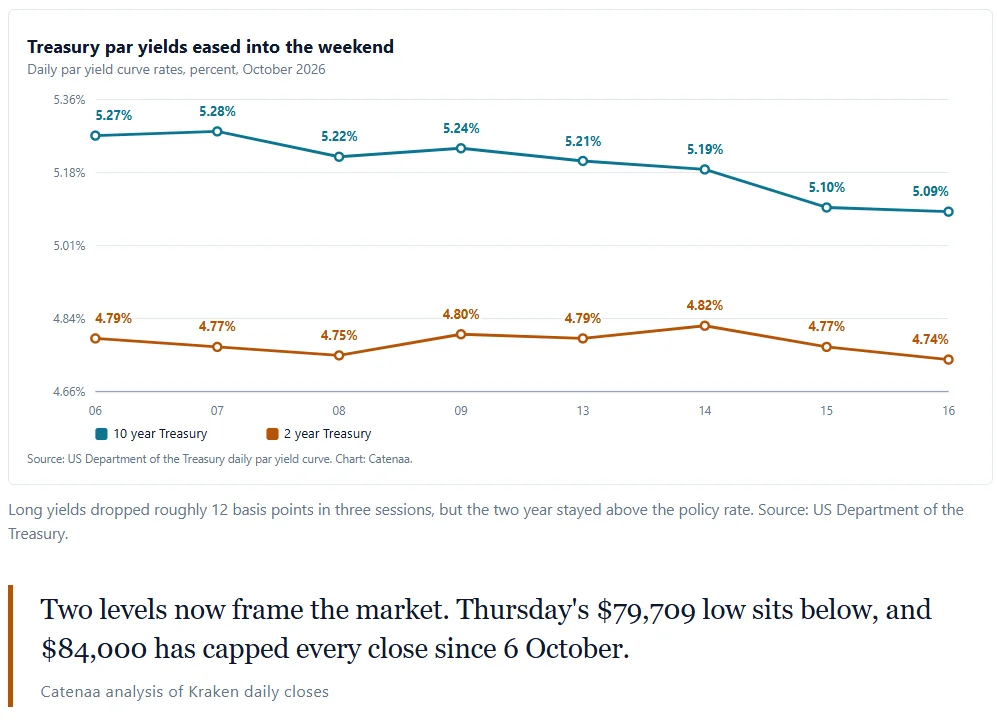
Long Treasury yields fell, yet the two-year at 4.74% still sits above the 3.75% to 4.00% policy range.
The next Federal Reserve decision lands on 28 October, after September inflation printed at 3.7%.
The bitcoin price closed a second straight week in the red on Friday. It settled at $81,500.80 on Kraken, down 1.28% over five sessions. Furthermore, the previous week had already cost holders 2.30%.
Why the bitcoin price slipped again
Friday’s close capped a jittery stretch. On Thursday, the token sank to $79,709, its first visit below $80,000 this month. However, buyers stepped in quickly. They pushed it back above $82,000 before the bid faded again.
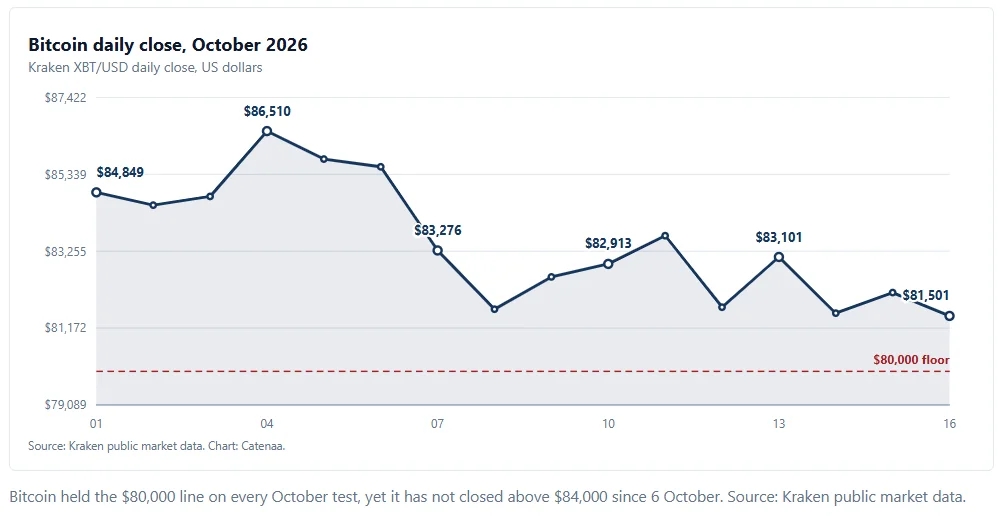
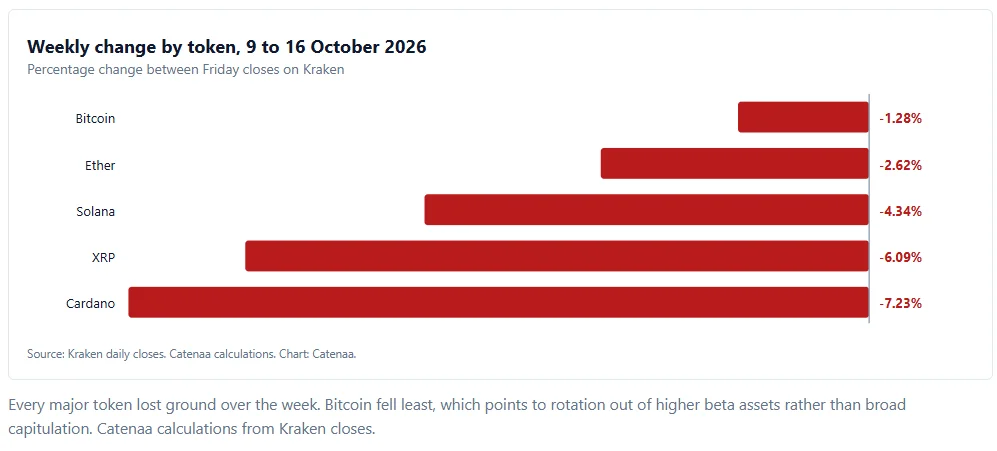
October has been unkind so far. Since the 30 September close of $83,564.70, bitcoin has shed 2.47%. Altcoins fared worse. Ether lost 2.62% on the week, while XRP fell 6.09%. Cardano dropped 7.23%, the steepest slide in the group.
That spread matters for reading the tape. When bitcoin falls least, money is usually rotating down the risk curve rather than fleeing the asset class. Conversely, a broad and even selloff tends to signal forced liquidation. This week looked like the former.
Exchange-traded funds kept leaking money
US spot bitcoin funds lost assets for a second week. Net outflows reached $228.4 million between 12 and 16 October, according to Farside Investors data. Meanwhile, the prior week shed a heavier $678.9 million.
Therefore, October now carries a cumulative net outflow of $614.7 million. Notably, six of the month’s twelve sessions still drew net inflows. The outflow days were simply much larger.
Two sessions did most of the damage. On 7 October investors pulled $484.9 million, and on 14 October another $261.4 million left. Together, those two days exceed the whole month’s net outflow. Meanwhile, the biggest inflow day reached only $189.9 million.
Rate expectations still cap the bitcoin price
Treasury yields fell hard into the weekend, which usually helps risk assets. The 10-year yield eased to 5.09% on Friday from 5.21% on 13 October, per Treasury data. Similarly, the 30-year slipped to 5.43% from 5.56%.
Still, the front end tells a tougher story. The two-year note yields 4.74%. That sits well above the 3.75% to 4.00% federal funds target range. As a result, traders price in more tightening rather than relief.
The Federal Reserve raised rates by a quarter point on 16 September. September headline inflation then landed at 3.7%, which hardened those bets. Policymakers meet again on 27 and 28 October.
That backdrop explains the muted response to Friday’s yield relief. Normally a 12 basis point drop in long rates would lift speculative assets sharply. Instead, Bitcoin gave back most of Thursday’s rebound. In short, the rate story caps rallies for now.
What to watch next
The October drift looks likely to persist until one of those levels breaks. Fund flows give the clearest running signal, because they update daily and without a lag. A return to steady daily inflows would mark the first real change of tone.
Above all, the October meeting now sets the mood for the quarter. Another hike would keep short yields elevated and the dollar firm. Equally, a pause could release the pressure that has capped every bitcoin price close under $84,000 since 6 October.




