

November 01, 2026 – Two steep October adjustments pushed the network’s difficulty to its highest level since November 2025. Meanwhile, falling bitcoin prices squeezed what each machine earns.

In Summary
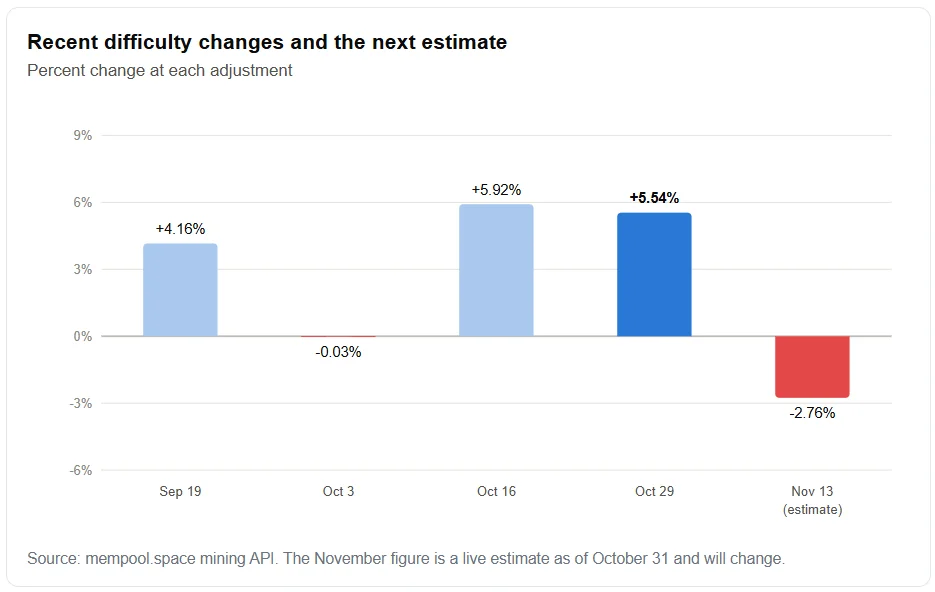
Bitcoin’s mining difficulty rose 5.54% to 148.36 trillion at block 973,728 on October 29.
That follows a 5.92% rise on October 16 and leaves difficulty 4.9% below its record from October 2025.
With bitcoin near $77,000, each petahash of computing power now earns about $33 a day, by Catenaa’s estimate.
Older machines using 25 joules per terahash only cover power below about 5.5 cents per kilowatt-hour.
Bitcoin’s mining difficulty jumped 5.54% on October 29 to 148.36 trillion. The change took effect at block 973,728, according to network data. It was the second large rise this month, after a 5.92% increase on October 16.
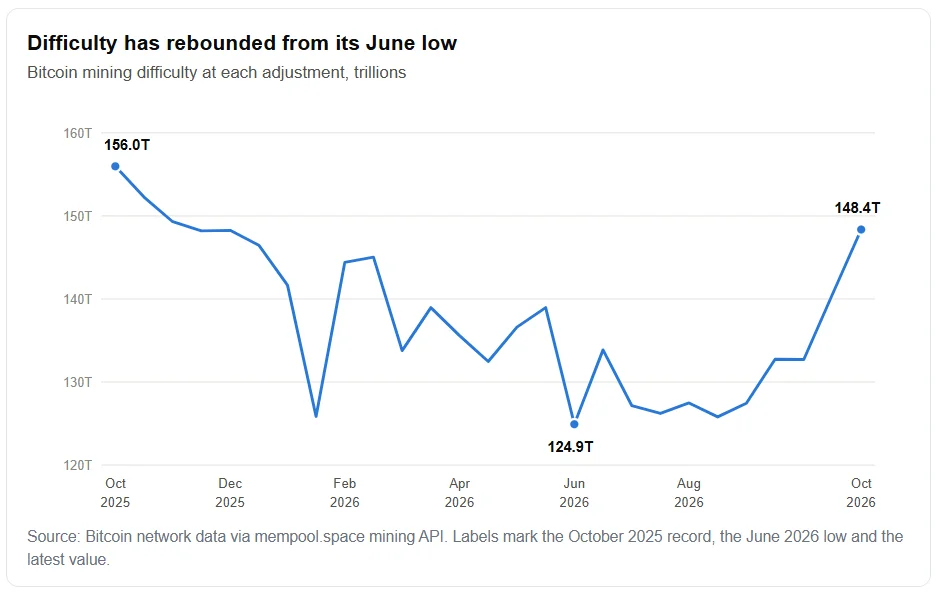
Difficulty now stands at its highest level since late November 2025. Still, it sits 4.9% below the record of 155.97 trillion set on October 29, 2025.
How mining difficulty works
The network resets difficulty every 2,016 blocks, or roughly every two weeks. Its goal is to keep blocks coming about every 10 minutes, as the Bitcoin developer guide explains. When more machines join, blocks arrive faster, so difficulty rises.
That is what happened this autumn. Difficulty fell to 124.93 trillion in mid-June as hashing power dropped. Since then, it has climbed almost 19%. In other words, a large wave of hashing power has returned to the network. By Catenaa’s math, today’s difficulty implies about 1,062 exahashes per second of computing power. That remains below the roughly 1,116 exahashes implied at last year’s peak.
Revenue per machine is shrinking
Higher mining difficulty means each machine wins a smaller share of new coins. At the same time, bitcoin’s price has fallen. It closed near $77,050 on Kraken early on October 31.
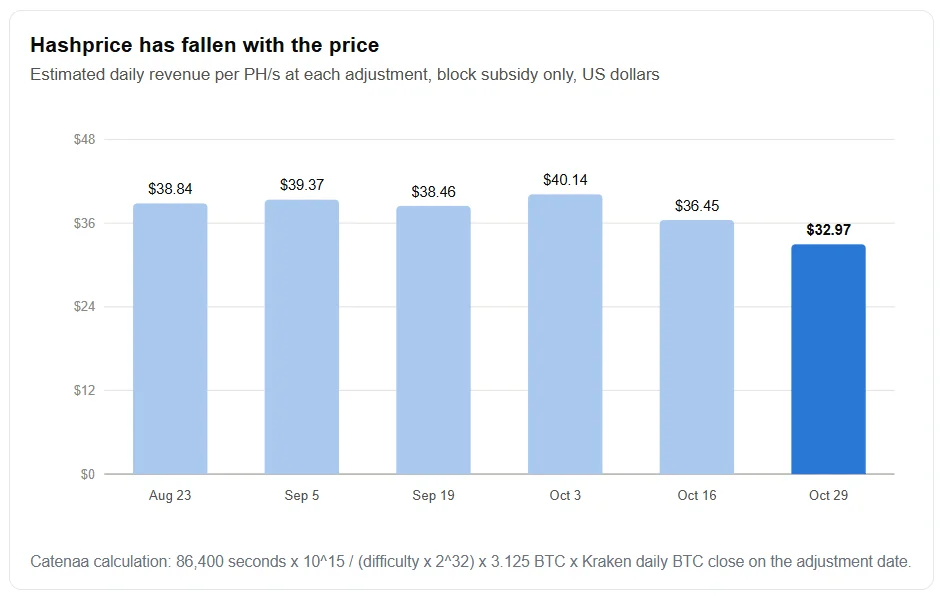
Together, those forces hit hashprice, the daily revenue per unit of computing power. Catenaa estimates it at about $33 per petahash per second per day. That uses the 3.125 bitcoin block subsidy, which took effect at the April 2024 halving. It also adds recent fees of about 0.024 bitcoin per block, based on the last 144 blocks.
On the same basis, hashprice was about $40 after the October 3 adjustment. It has since lost roughly a fifth of its value in under four weeks. Fees offer little help, either. Over the last 144 blocks, they added up to 3.48 bitcoin, or less than 1% of total miner rewards. So miners still depend almost entirely on the subsidy and the bitcoin price.
Older rigs are close to the edge
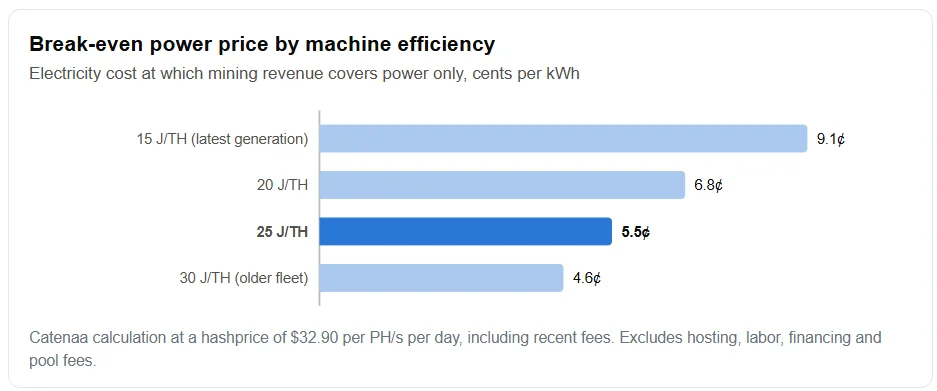
The squeeze lands hardest on older machines. A rig using 25 joules per terahash burns 600 kilowatt-hours a day for each petahash. Therefore, it covers its power bill only when electricity costs less than about 5.5 cents per kilowatt-hour.
Newer machines have more room. A 15 joule rig breaks even at about 9.1 cents, before staff, hosting and debt costs. As a result, miners with old fleets or costly power face pressure to switch off or upgrade.
Relief may come in mid-November
Some relief could arrive soon. Early in the new cycle, blocks are arriving a little slower than the 10-minute target. Based on that pace, the mempool.space estimate points to a cut of about 2.8% around November 13.
That outlook can shift quickly, though, since the cycle is only about 10% complete. Mining difficulty reacts to miner behavior, and miners react to price. If bitcoin keeps falling, more miners may unplug. Then the next cut would likely be larger, and margins would reset from a lower base. For now, difficulty sits above every other reading this year.