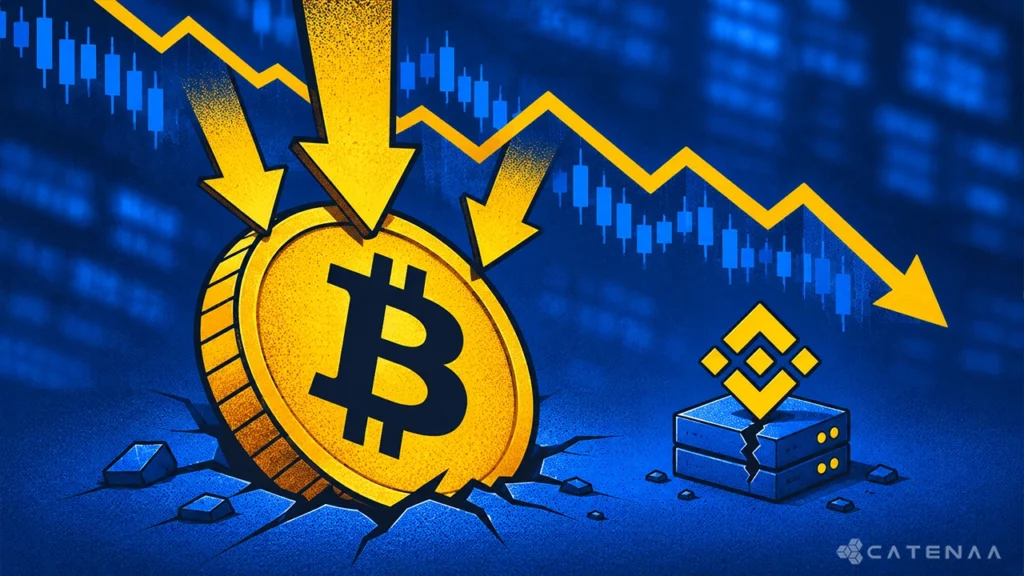


November 28, 2026 – Binance confirmed a $6.34 billion theft on October 29. Catenaa’s rebuild of prices, funding, leverage and fund flows shows the hack started the slide, while leveraged longs and ETF redemptions did most of the damage.

In Summary
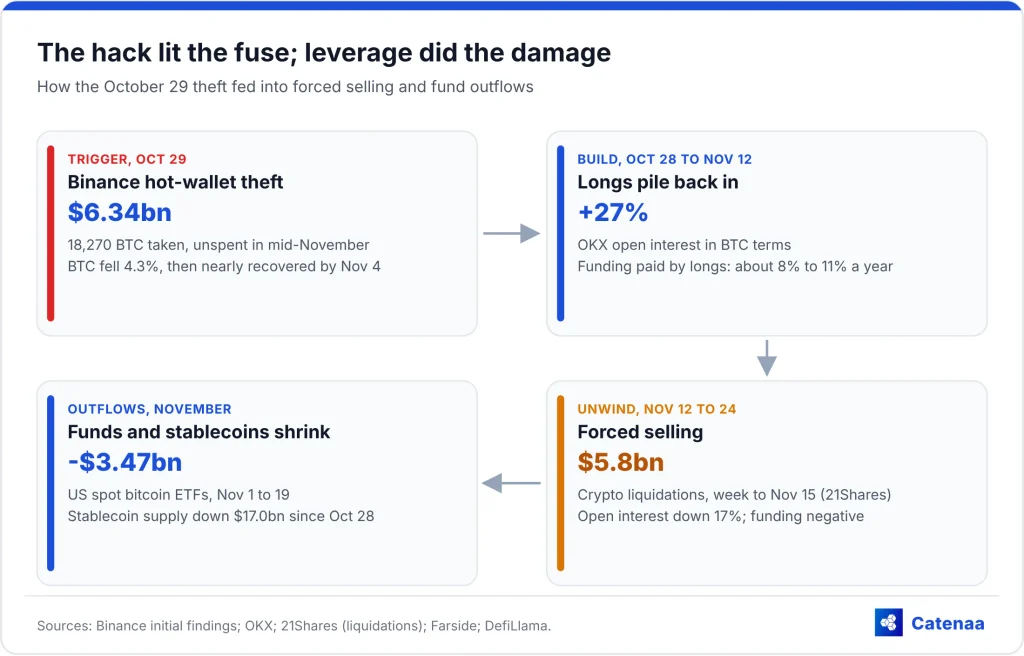
Binance says attackers took about $6.34 billion from its hot wallets on October 29, including 18,270 BTC that stayed unspent into mid-November.
Bitcoin fell 4.3% on the hack day, then closed only 1% below its pre-hack level on November 4.
OKX open interest rose 27% in bitcoin terms after the hack, then fell 17% as funding turned negative.
Bitcoin closed at $60,368.6 on November 25, down 25.7% from October 28, as ETF outflows and a $17.0 billion stablecoin drop added pressure.
Bitcoin forced selling, not the Binance hack itself, explains most of the slide since late October. That is the central claim of new research from 21Shares, published on November 24. Catenaa tested the claim against exchange data, fund records, and Binance’s own disclosure, and the evidence largely holds up.
What Binance actually disclosed
First, the breach itself. In its initial findings, Binance said the attack began at about 20:05 UTC on October 29. The exchange put the loss at roughly $6.34 billion. One hot wallet sent 18,270 BTC to an attacker-controlled address.
Binance also put frozen or intercepted assets at about $2.85 billion. It said it would absorb the loss, not its users. By October 31, it had replenished 98% of the affected tokens. Furthermore, it cited FBI information linking the attack to North Korea.
The hack lit the fuse, then faded
Price data support the trigger story. Bitcoin closed at $81,287.1 on October 28, the eve of the theft. It fell 4.3% to $77,800 the next day. However, it closed at $80,440.8 on November 4, only 1% below its pre-hack level.
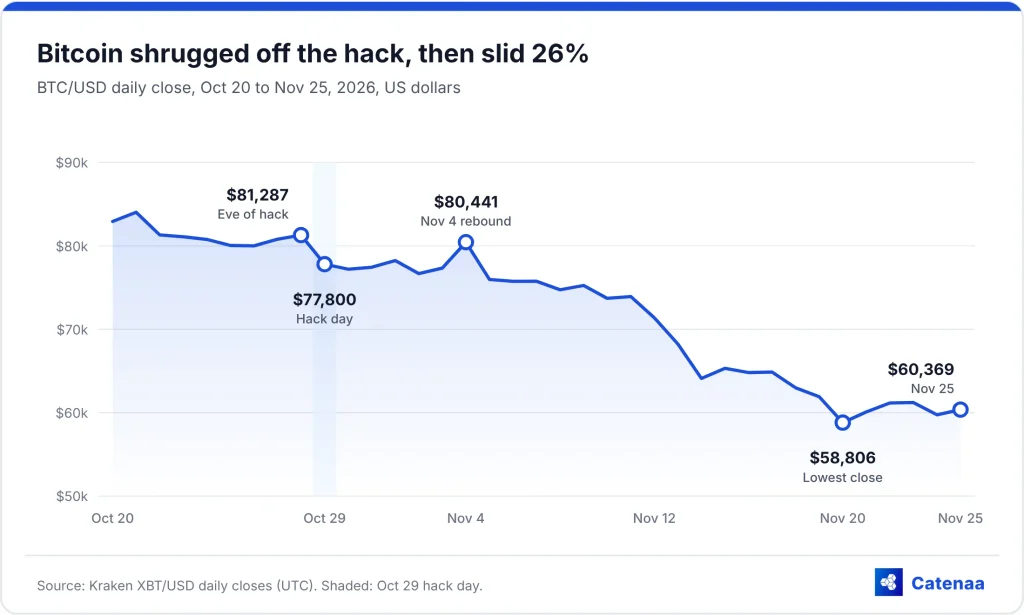
Meanwhile, the stolen coins stayed put. The attacker’s 18,270 BTC sat unspent in mid-November, according to Elliptic data that 21Shares cites. So the feared dump never arrived.
Bitcoin forced selling followed a leverage build
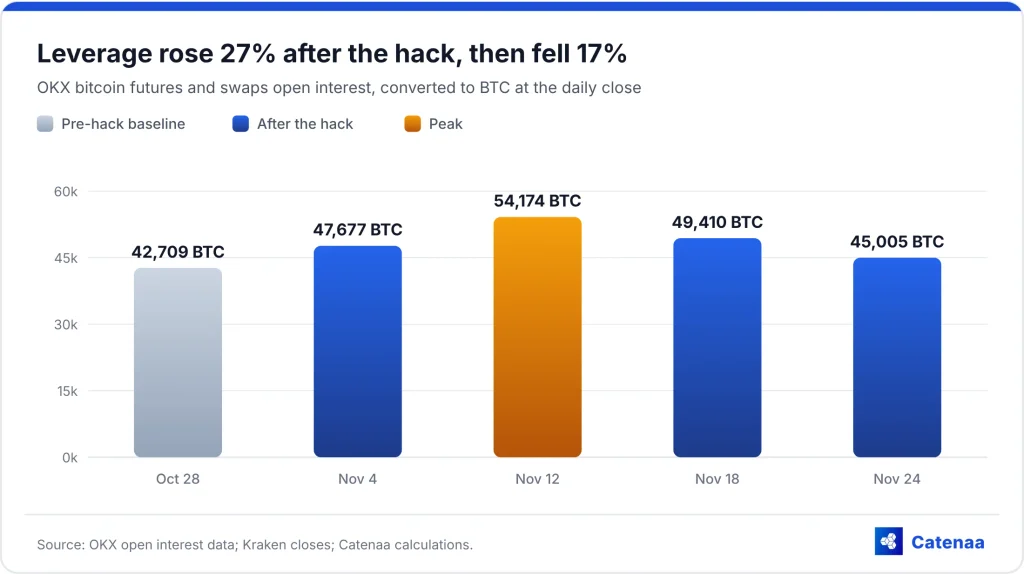
The real damage came later, and leverage drove it. On OKX, open interest in bitcoin futures and swaps stood at about 42,700 BTC on October 28. By November 12, it had reached 54,200 BTC, a 27% build in coin terms.
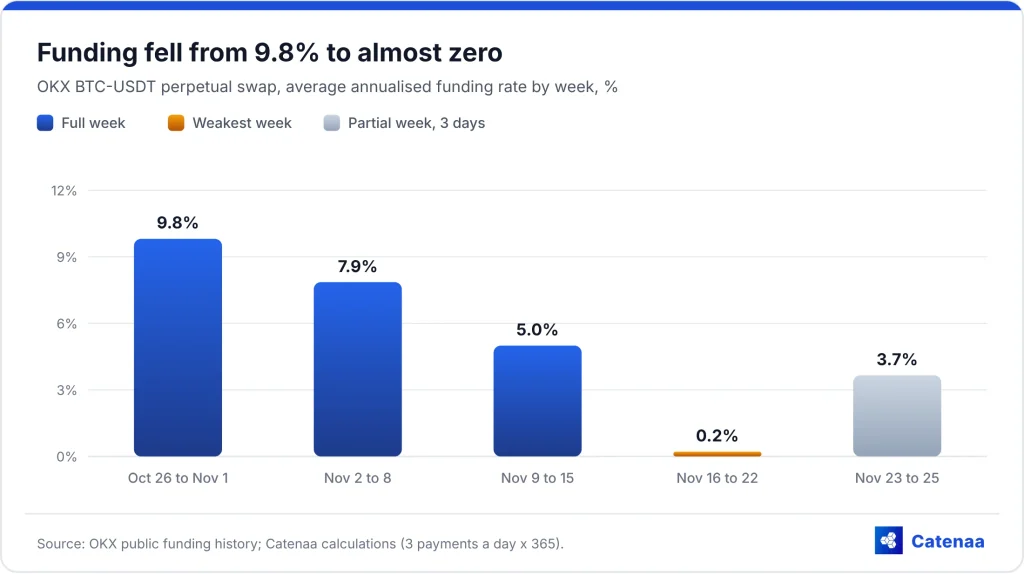
Funding rates tell the same story. Longs paid shorts about 8% to 11% a year on OKX’s BTC-USDT swap from October 28 to November 5. Then the trade unwound. Funding turned negative on November 15 and again from November 19 to 21. By November 24, open interest had fallen to about 45,000 BTC, 17% below the peak.
21Shares counts $5.8 billion of crypto liquidations in the week to November 15, with 81% hitting longs. Catenaa could not rebuild that total, because exchanges do not publish full liquidation records. Still, the swing in funding and open interest fits the pattern.
ETF redemptions kept the pressure on
Fund flows turned at the same moment. US spot bitcoin ETFs lost $643.2 million on October 30, Farside Investors data show. By November 19, outflows for the month had reached about $3.47 billion.
Moreover, iShares data show the selling continued. IBIT’s share count fell from 1,360,960,000 to 1,329,760,000 between its November 20 and November 24 updates. At 22.63 BTC per 40,000-share basket, that equals about 17,650 BTC. In other words, ETF holders redeemed almost as much bitcoin in a few sessions as the hacker stole.
Liquidity drained too. Total stablecoin supply fell from $299.5 billion on October 28 to $282.5 billion on November 25, DefiLlama data show. That is a $17.0 billion drop in under a month.
What to watch next
Bitcoin closed at $60,368.6 on November 25, down 25.7% from the eve of the hack. It touched $55,100 on November 21. 21Shares flags a realised price near $53,250 as the next key level. Past bear markets bottomed 24% to 61% below that mark, although the firm sees a repeat as unlikely, not impossible.
The firm expects caution to last until stablecoin supply and ETF demand recover. US jobs data arrive on December 4, and the Fed decides on December 9. Therefore, fund flows, not the hacker’s wallet, look like the signal to watch.