


October 25, 2026 – Spot bitcoin funds lost $635.6 million on Thursday as a tech selloff spread. The move erased the prior day’s inflow and pushed bitcoin back toward $81,000.

In Summary
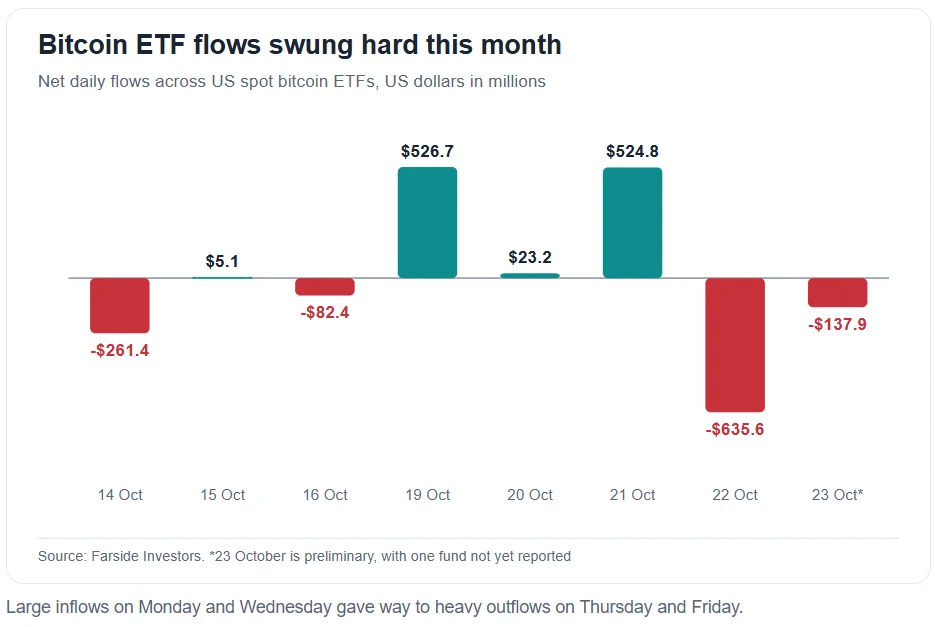
US spot bitcoin ETFs lost a net $635.6 million on 22 October, per Farside data.
That was the biggest daily outflow since 25 June, when funds lost $691.7 million.
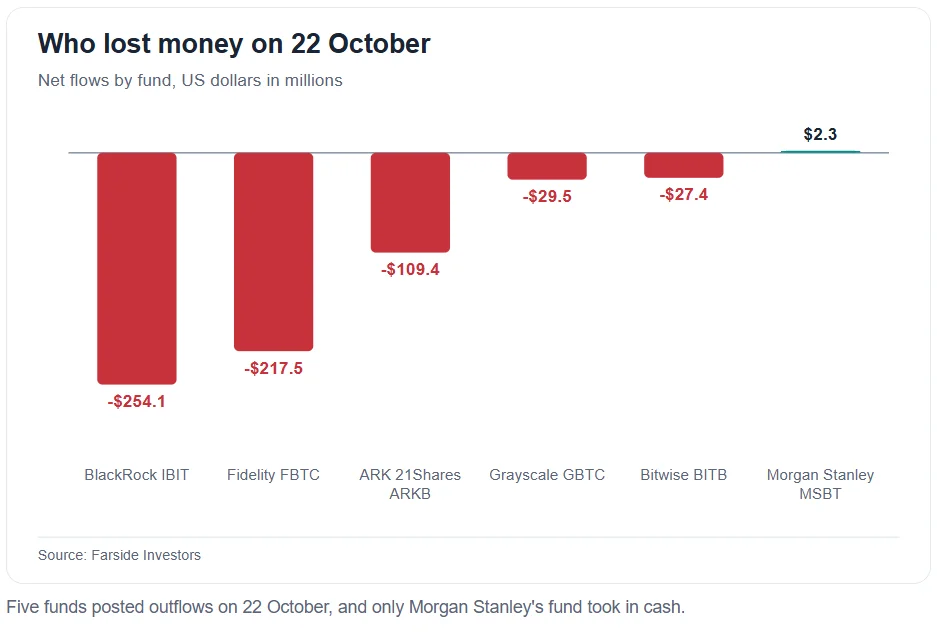
BlackRock’s IBIT led with $254.1 million out, followed by Fidelity’s FBTC.
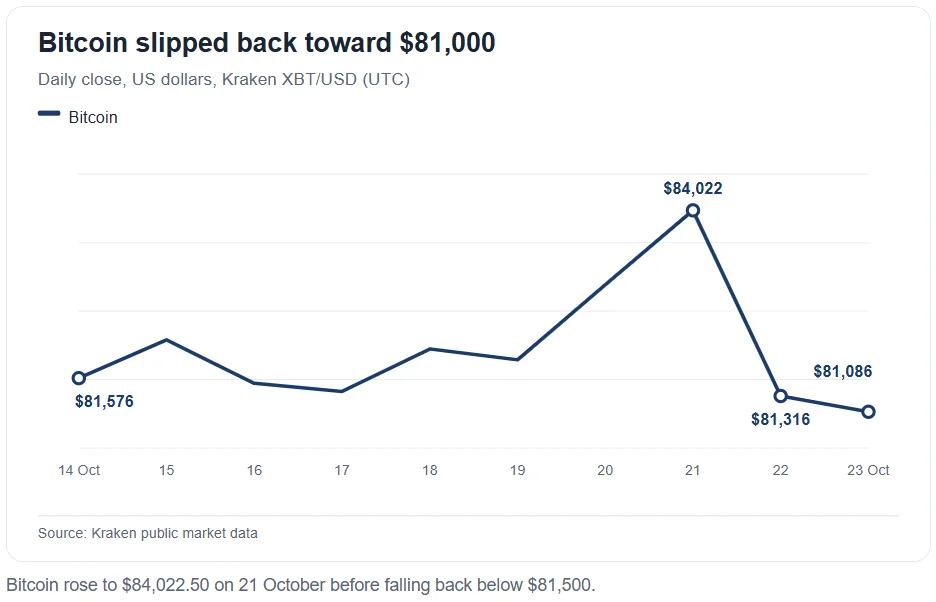
Bitcoin fell 3.22% on the day as the Nasdaq Composite dropped 2.60%.
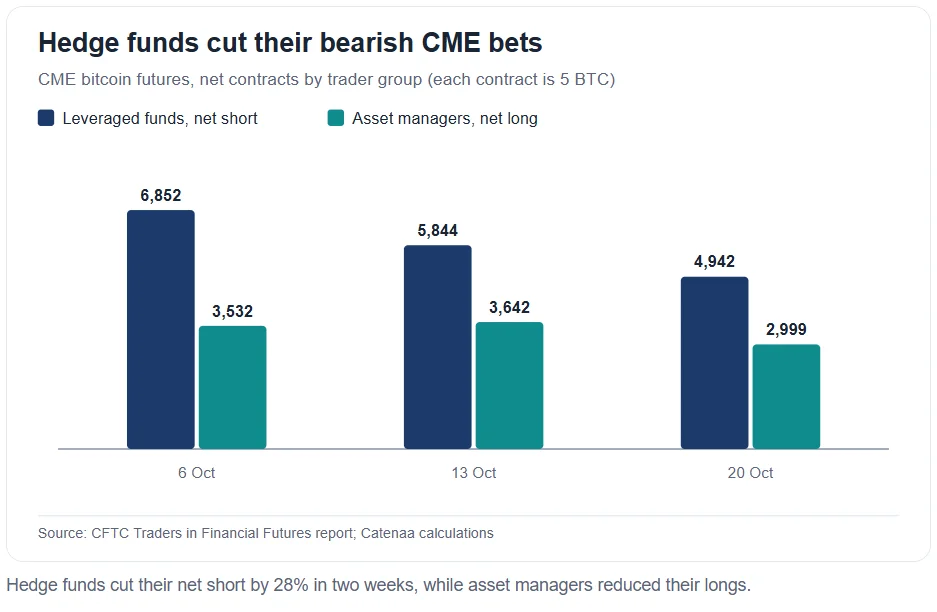
Hedge funds still trimmed their net short in CME bitcoin futures.
Money rushed out of US spot bitcoin ETF products on Thursday. The funds lost a net $635.6 million on 22 October, Farside Investors data show. That wiped out the $524.8 million inflow from the day before. It was also the largest single-day outflow since 25 June.
Bitcoin ETF outflows spread across issuers
The selling hit almost every major fund. BlackRock’s IBIT lost $254.1 million, while Fidelity’s FBTC shed $217.5 million. ARK’s ARKB gave up $109.4 million. Only Morgan Stanley’s MSBT took in fresh cash, adding $2.3 million. Together, IBIT and FBTC made up 74% of the day’s outflow. Even so, IBIT remains huge, with net assets of $68.47 billion as of 21 October. Its Thursday loss equals only about 0.37% of that total. The fund charges a 0.25% sponsor fee, BlackRock’s page shows.
The week shows how quickly the mood can turn. Funds took in $526.7 million on Monday and $524.8 million on Wednesday. Then came Thursday’s reversal. Early data show a further $137.9 million left on Friday, with one fund still to report. Across the five sessions, net flows still came to about $301 million.
The longer record puts the drop in context. Since January 2024, IBIT alone has gathered a net $66.13 billion, Farside’s totals show. Grayscale’s GBTC, by contrast, has lost $27.99 billion as holders left the older fund. Across all funds, net inflows still total $57.25 billion. So, even a $635.6 million day barely dents the total.
Tech selloff drags on bitcoin
Stocks set the tone. The selloff centred on chipmakers, whose index dropped 6.72% that day. Meanwhile, the Nasdaq Composite fell 2.60%, FRED data show. Bitcoin moved the same way. It closed at $81,315.90 on Kraken, down 3.22% on the day. By Friday’s close, it had slipped further to $81,086.20, according to Kraken market data. On Saturday morning in UTC, it traded near $80,790.
In other words, bitcoin traded like a tech asset this week. When AI and chip shares sold off, crypto followed. As a result, ETF holders cut risk at the same time as equity investors.
Futures traders turn less bearish
Positioning tells a calmer story. Leveraged funds held a net short of 4,942 CME bitcoin contracts on 20 October, CFTC data show. That is down from 6,852 two weeks earlier. Each contract covers five bitcoin, so the net short now equals 24,710 BTC. However, asset managers also trimmed their net long, to 2,999 contracts. Total open interest stood at 21,040 contracts. Part of that short often hedges ETF holdings in basis trades. So it is not a pure bet on falling prices. In short, hedge funds have scaled back bearish exposure, but long-term buyers also look more cautious.
What it means for Bitcoin ETF demand
One bad day does not undo two years of demand. Still, the pattern matters. Big inflow days now alternate with big outflow days. That suggests investors are trading the funds tactically rather than simply buying and holding. Traders will also watch the Fed meeting on 27 and 28 October. Rate expectations move both tech stocks and crypto. For now, the next Bitcoin ETF flow figures will show whether Thursday was a one-off.