


November 21, 2026 – BlackRock’s IBIT lost a record $541.1 million in one session, while Morgan Stanley’s cheaper MSBT drew $49.6 million. The data point to broad selling, not a simple switch.

In Summary
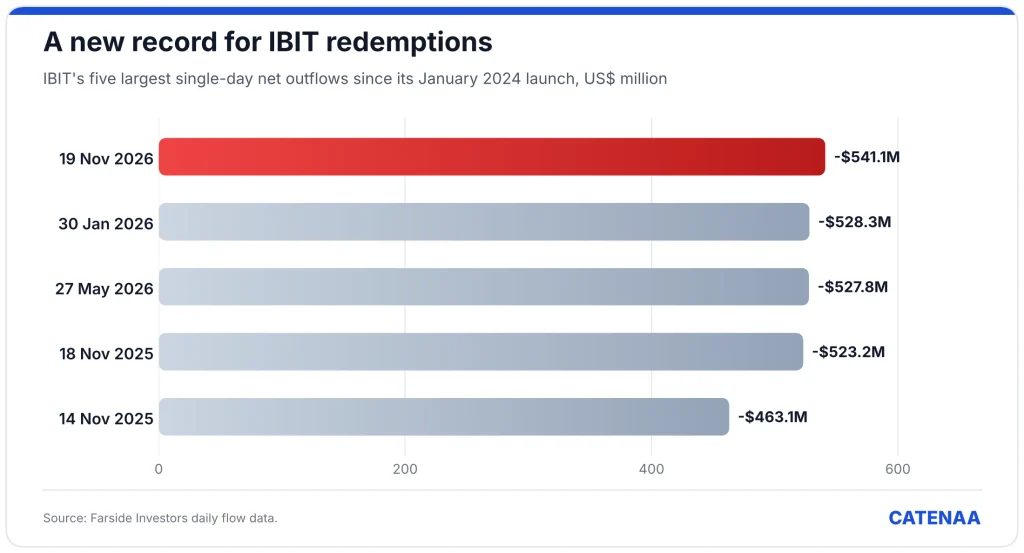
IBIT posted its largest one-day outflow since launch, $541.1 million on November 19.
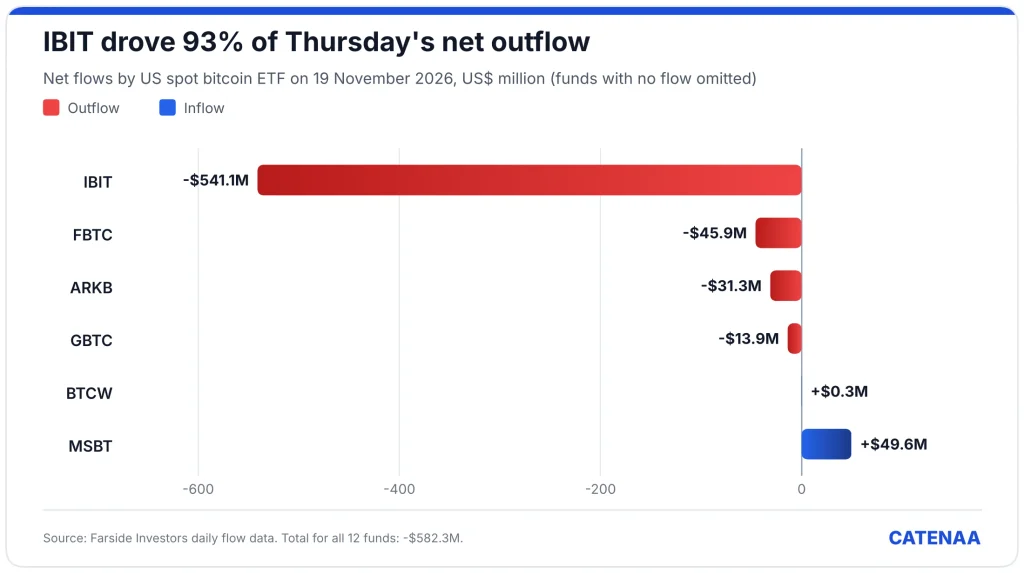
All 12 US spot funds lost $582.3 million that day; IBIT supplied 92.9% of it.
MSBT’s $49.6 million inflow offset only 9.2% of IBIT’s loss, so this was not a simple switch.
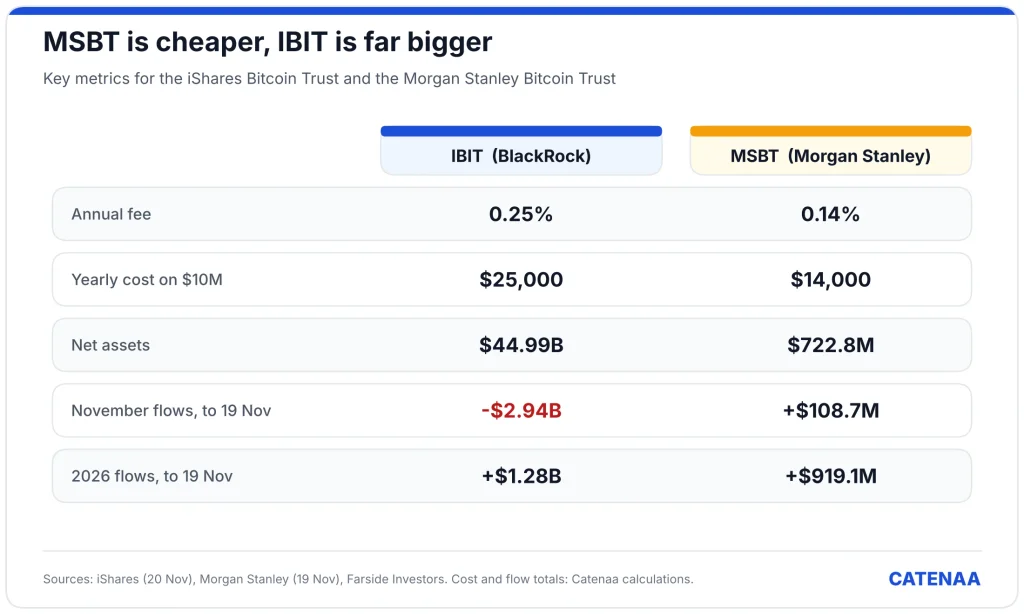
MSBT charges 0.14% a year against IBIT’s 0.25%, a 44% fee gap.
Bitcoin fell 20% between October 31 and November 19 as the wider exit deepened.
Bitcoin ETF outflows hit a new extreme on Thursday, November 19. BlackRock’s iShares Bitcoin Trust (IBIT) shed $541.1 million in one session, Farside Investors flow data show. That was its largest one-day exit since launch in January 2024. Meanwhile, Morgan Stanley’s Bitcoin Trust (MSBT) took in $49.6 million on the same day.
How large were the Bitcoin ETF outflows?
The 12 US spot funds lost a combined $582.3 million that day. IBIT alone supplied 92.9% of that net figure. Fidelity’s FBTC also lost $45.9 million, and ARK’s ARKB lost $31.3 million. Grayscale’s GBTC gave up a further $13.9 million.
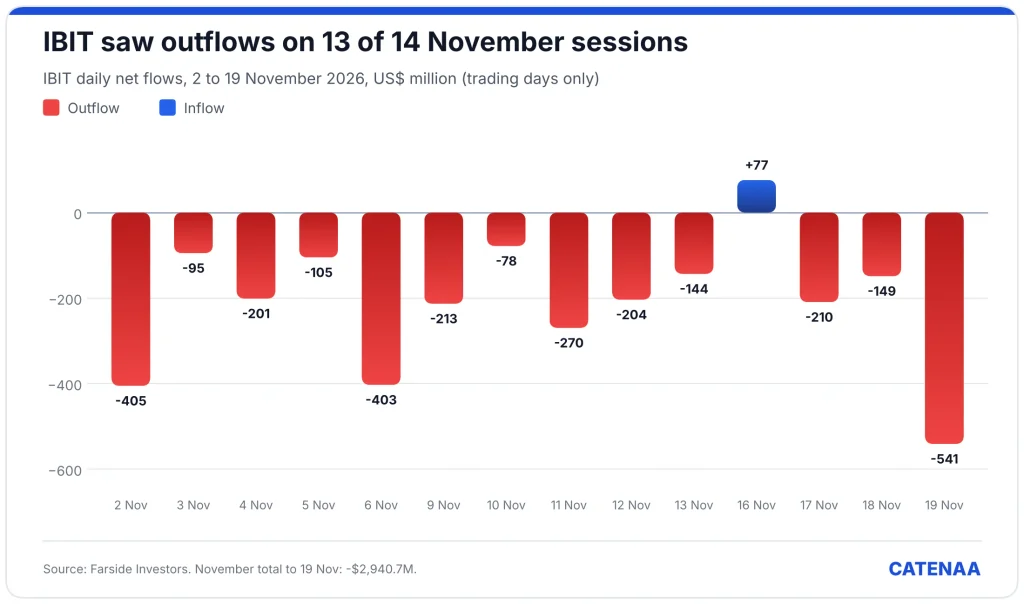
The record beat IBIT’s previous worst day, a $528.3 million exit on January 30, 2026. Moreover, the selling has been relentless this month. IBIT saw outflows in 13 of 14 November sessions, totalling $2.94 billion. That equals about 85% of the $3.47 billion that left all funds.
Exit or rotation?
The figures do not show investors moving straight from BlackRock to Morgan Stanley. By Catenaa calculations, MSBT’s inflow offset only 9.2% of IBIT’s loss. Instead, money left the sector as bitcoin slid. Daily Kraken prices show bitcoin closed at $61,914 on November 19. That sat 20% below its October 31 close of $77,437.
Still, fees offer one plausible reason for MSBT’s steady demand. MSBT charges 0.14% a year, its Morgan Stanley fund page shows. IBIT charges 0.25%, according to iShares. On a $10 million holding, that means $14,000 against $25,000 a year. In other words, MSBT costs 44% less.
Distribution may matter too, because Morgan Stanley can offer its own fund through its adviser network. However, that link is an inference, not a disclosed fact. Neither firm has disclosed which clients bought or sold.
What issuer data show
Issuer records help confirm the scale. IBIT’s net asset value stood at $35.13 on November 19, based on iShares data. At that price, $541.1 million equals about 15.4 million shares. That is roughly 385 redemption baskets of 40,000 shares each. At the latest basket size of 22.63 bitcoin, the exit released about 8,700 coins. iShares converts each basket into bitcoin using the CME CF Bitcoin Reference Rate.
Even so, IBIT remains a giant. It reported $44.99 billion in net assets on November 20. MSBT held $722.8 million on November 19, so IBIT is about 62 times larger.
A longer view of flows
Bitcoin ETF outflows look less extreme across 2026 as a whole. IBIT still shows $1.28 billion of net inflows this year. Its June outflows of $3.55 billion also exceeded this month’s total. By contrast, MSBT has gathered about $919 million since its April debut, with no negative month. Across all 12 funds, net inflows since January 2024 still total about $53.5 billion. This year, however, the group shows a net loss of about $3.1 billion.
Timing matters as well. Early dashboards often print partial totals before every issuer reports. For example, Farside still lists IBIT’s November 20 flow as pending. Therefore, single-day totals can shift as late data arrive.
What to watch next
The key test is whether Bitcoin ETF outflows ease once bitcoin finds a floor. So far, it has not. Bitcoin closed at $58,806 on November 20, extending the slide.
Traders will also watch MSBT’s daily creations closely. If its inflows grow while IBIT keeps bleeding, the case for rotation gets stronger. Until then, the evidence favours a wider retreat from bitcoin. For now, a cheaper rival gains only at the margin.