


September 26, 2026 – US spot bitcoin funds drew nearly $2.3 billion between Monday and Thursday. The buying followed heavy redemptions around the Federal Reserve decision.

In Summary
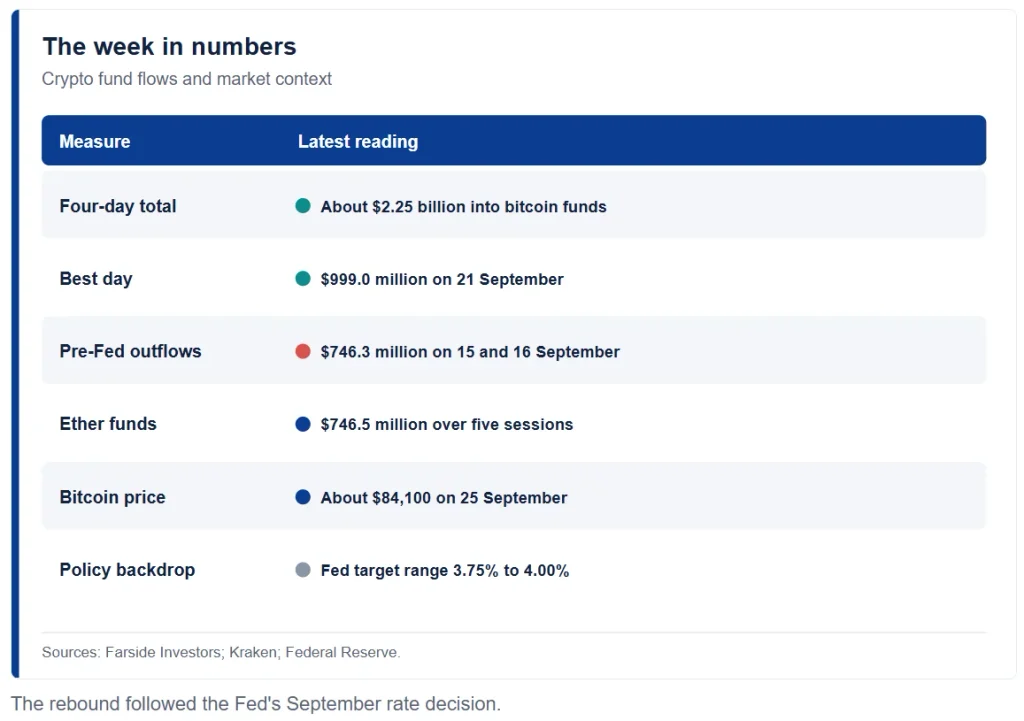
US spot bitcoin ETFs took about $2.25 billion between 21 and 24 September.
Monday’s $999.0 million was the strongest single session of the run.
Flows had been negative around the Fed decision, with $746.3 million leaving on 15 and 16 September.
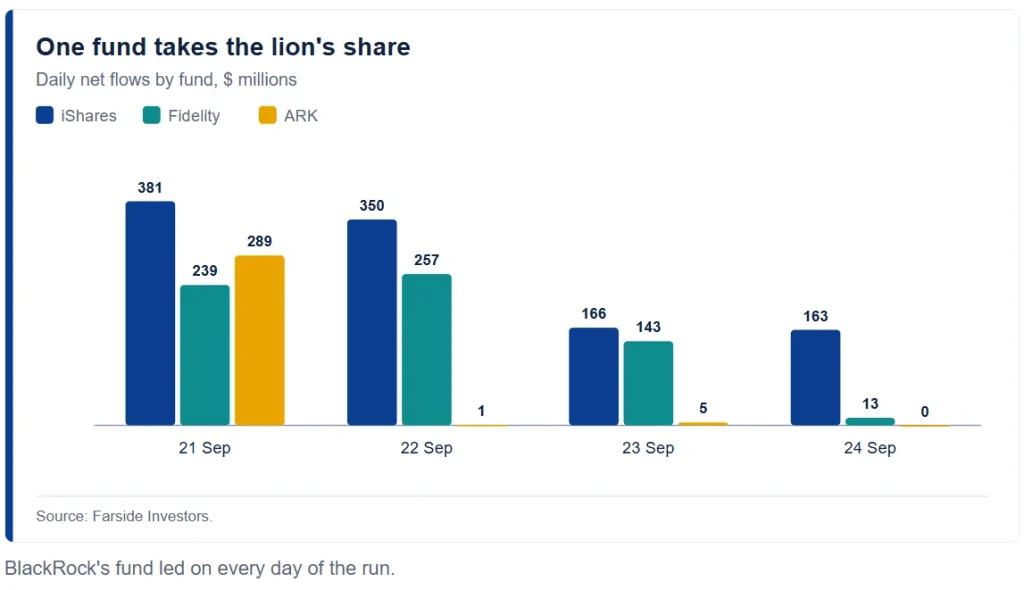
BlackRock’s fund led every day, taking $381.4 million on Monday alone.
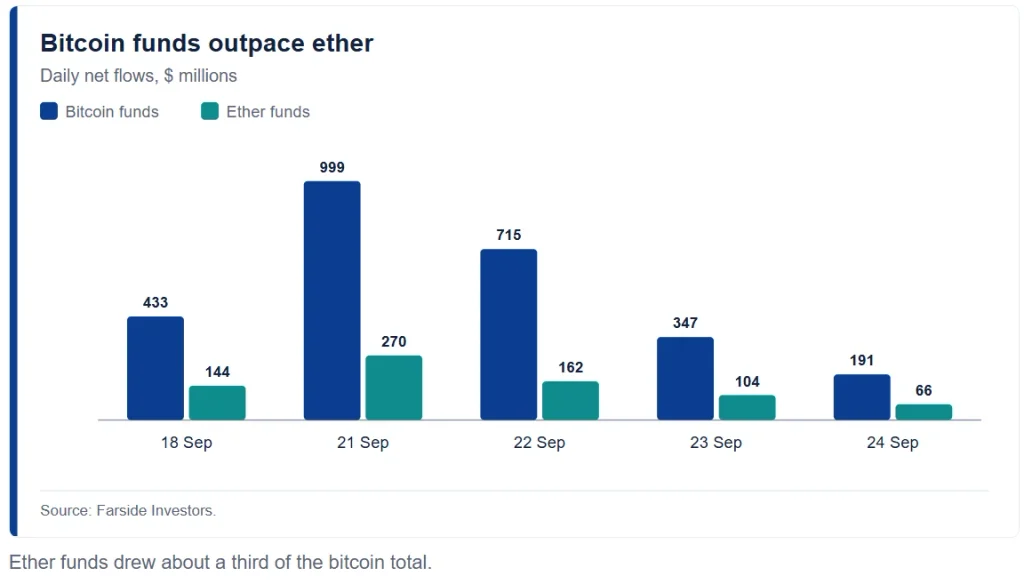
Ether ETFs added $746.5 million over five sessions, roughly a third of the bitcoin total.
Money is pouring back into American bitcoin funds. Spot bitcoin ETF inflows reached about $2.25 billion across four sessions to 24 September, Farside Investors data show. Monday alone brought $999.0 million.
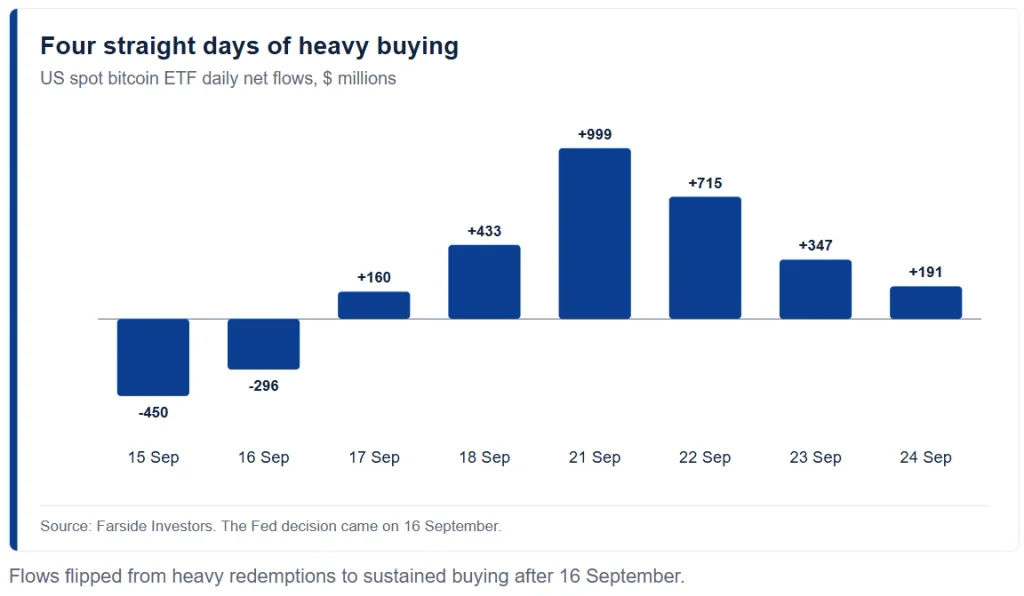
That marks a sharp turn from the previous week. Funds lost $450.4 million on 15 September and $295.9 million on 16 September, as traders braced for the Fed. Buyers returned once the decision landed.
How the Bitcoin ETF Inflows Built
The rebound came in stages. Flows turned positive on 17 September with $159.5 million. They then jumped to $433.0 million on 18 September.
Monday, 21 September, produced the peak. Investors added $999.0 million, the strongest single day since early in the year. Tuesday followed with $714.7 million.
Momentum eased after that. Wednesday brought $346.9 million, and Thursday $190.7 million. Even so, every session since 17 September has delivered net buying, which is unusual in a volatile month.
BlackRock Leads, as Usual
Concentration remains striking. The iShares fund took $381.4 million on Monday and $350.3 million on Tuesday. It added $166.3 million and $162.6 million over the next two days.
Fidelity’s fund ran second through the week. It gathered $238.8 million on Monday and $257.4 million on Tuesday. Flows then slowed to $12.9 million by Thursday.
Smaller funds saw uneven demand. The ARK product took $289.1 million on Monday, then almost nothing afterwards. Grayscale’s older trust barely moved either way.
That pattern is familiar. Advisers and institutions tend to buy the most liquid product, which deepens its advantage. Smaller funds therefore depend on a handful of large tickets.
Why Buyers Returned After the Fed
The timing points to macro relief. The Federal Reserve raised its target range to 3.75% to 4.00% on 16 September. Once the decision passed, uncertainty faded.
Price action reinforced the move. Bitcoin climbed from $75,585 on 15 September to $86,593 by 21 September, Kraken data show. It has since eased to about $84,100.
Traders often chase such moves. Flows into passive funds usually follow price rather than lead it. This week fits that rule closely.
Quarter-end also matters. Allocators rebalance in late September, and several have been raising crypto weightings all year. Consequently, flows often cluster in the final fortnight.
Options expiry adds noise as well. Dealers hedge large positions into the last Friday of the quarter. That activity can amplify moves in both directions.
Ether Funds Followed the Same Path
Bitcoin was not alone. Ether ETFs collected $746.5 million over the same five sessions, Farside data show. Monday brought $270.0 million of that total.
The pattern matters for market structure. When both sets of funds buy together, spot demand rises across venues. Market makers then need more inventory.
Still, Bitcoin dominates the flow story. Its funds took roughly three times as much as ether products this week. That ratio has held for most of the year. Solana funds, by comparison, drew far smaller sums.
What This Means for Prices
Fund flows do not move prices one for one. Creations settle in cash, and authorised participants source coins in the spot market. That process can lag by a day or two.
The direction still matters. Sustained inflows absorb supply from miners and long-term holders. Over a week, $2 billion represents a meaningful share of daily spot volume. Buyers must therefore tempt sellers with higher prices when demand persists.
Investors should watch three things next. First, whether inflows survive past quarter end. Second, whether the largest fund keeps taking most of the money. Third, how prices react if flows stall.
A fourth question sits behind those. Bitcoin still trades about a third below its October 2025 record. Fresh money has yet to close that gap.
The Longer Backdrop
This year has been uneven for these products. Heavy redemptions in the first half left cumulative flows near break-even. The recent run has repaired much of that damage.
Fees continue to shape the league table. The iShares fund holds the largest asset base among the group. Scale tends to attract more scale in passive products.
Competition has not changed that order. The first spot funds launched together in January 2024, yet the ranking has barely shifted since. Distribution, not design, explains most of the difference.
For now, the bitcoin ETF inflows tell a simple story. Institutions bought the dip around the Fed decision and kept buying into strength. The test comes when the next macro shock arrives, and those moments rarely announce themselves in advance.