


November 16, 2026 – Ether has fallen 34% since September 30, while Bit Digital’s staked tokens back a loan that funds WhiteFiber’s data centers. A Catenaa stress test shows how much cushion remains.
In Summary
Bit Digital pledged 64,000 LsETH across September and October to back roughly $100 million borrowed from Galaxy.
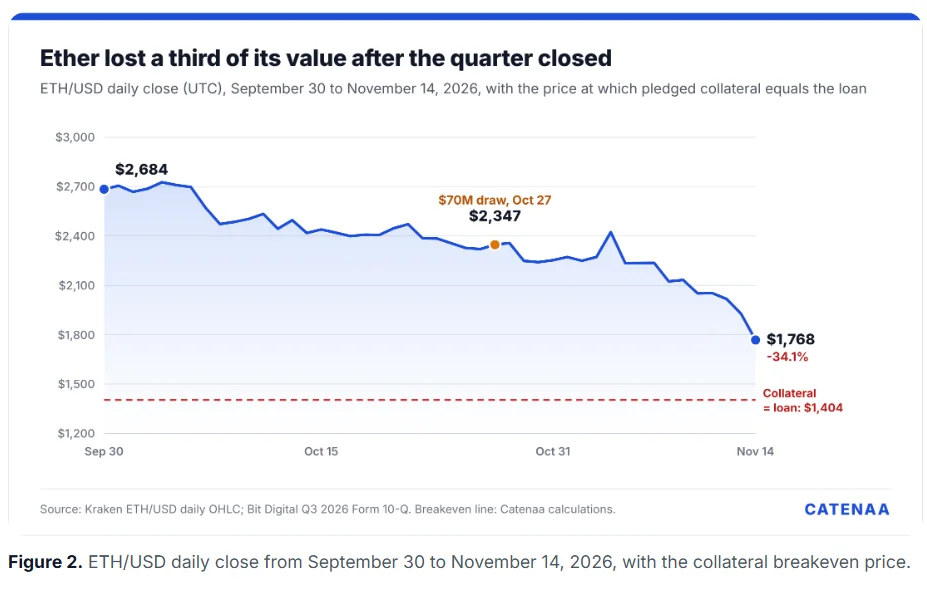
Ether closed at $1,768 on November 14, down 34.1% from the $2,684 quarter-end price.
By Catenaa estimates, pledged tokens covered the loan 1.26 times on November 14, versus 1.91 times on September 30.
The pledged collateral alone would match the loan near $1,404 per ETH, about 21% below the November 14 close.

Bit Digital has turned part of its ether treasury into a funding source for AI data centers. Its latest SEC filings show how that link works. They also show how a falling ether price could strain it.
How the Bit Digital loan works
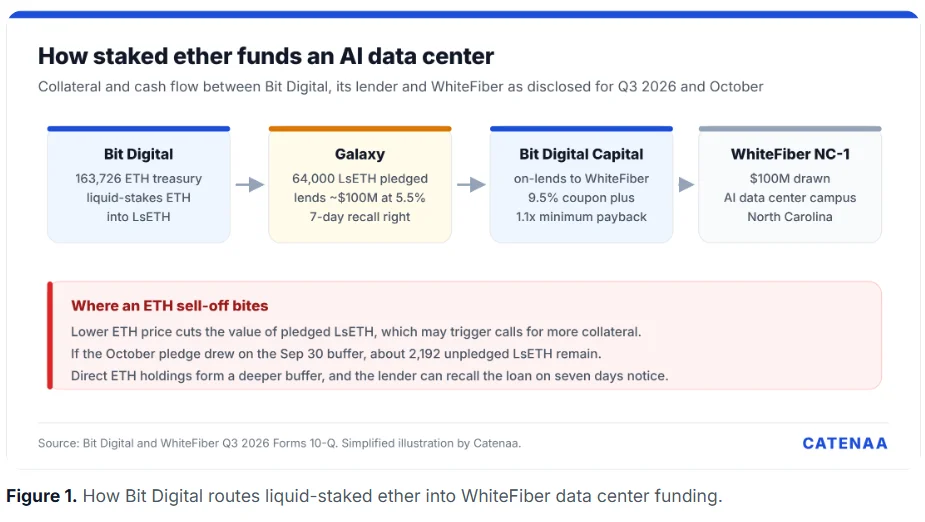
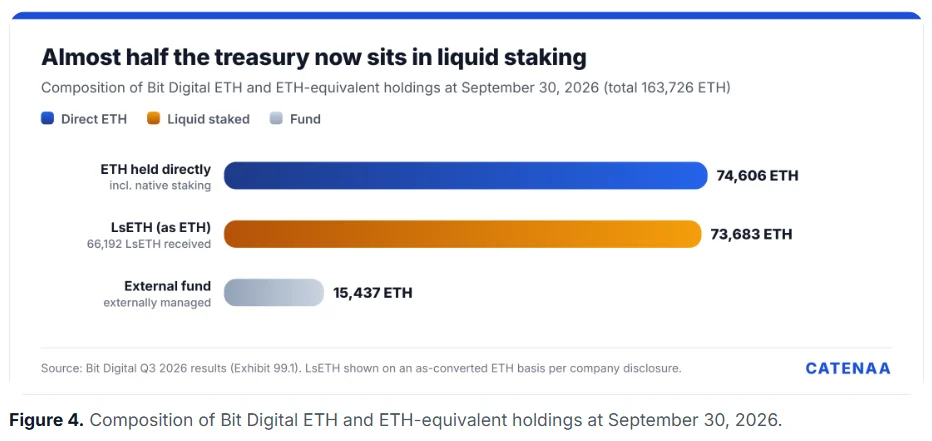
The company held about 163,726 ETH and ETH equivalents on September 30, according to its third-quarter results. During the quarter, it liquid-staked 73,683 ETH and received 66,192 LsETH. That token comes from the Liquid Collective protocol.
Bit Digital then pledged 19,000 LsETH to Galaxy Digital to secure dollar borrowings. After the quarter, it pledged another 45,000 LsETH alongside a $70 million draw. That brings the disclosed pledges to 64,000 LsETH.
Its quarterly report says the Galaxy loan carries 5.5% annual interest. The balance stood at $30 million on September 30, before the October draw. The lender can also recall the loan on seven days’ notice. Furthermore, Bit Digital may need to post more collateral if values fall below a maintenance threshold. The filing does not disclose that threshold.
Where the money goes
The cash flows on to WhiteFiber, the AI infrastructure company in which Bit Digital owns 59.7%. WhiteFiber’s own 10-Q records a $70 million advance on October 27 from Bit Digital Capital. That lifted the balance to $100 million. The facility pays an initial 9.5% a year plus a minimum 1.1 times payback on each advance.
The money supports WhiteFiber’s data center and cloud growth. Its NC-1 campus in North Carolina has started generating revenue from a first 20 MW of contracted capacity.
As a result, Bit Digital earns a wide spread on paper between its Galaxy cost and WhiteFiber’s rate. However, the structure works only while the collateral holds its value.
The ETH stress test
Ether closed at $1,768 on November 14, based on Kraken daily prices. That is 34.1% below the $2,684 quarter-end price the company used.
Catenaa converted the 64,000 pledged LsETH at the company’s implied September rate of about 1.113 ETH per token. That gives roughly 71,243 ETH of collateral. At quarter-end prices, it was worth about $191 million against roughly $100 million borrowed.
A 15% drop from quarter-end cuts that cover to about 1.6 times. A 30% drop leaves about 1.34 times. At the November 14 price, cover stands near 1.26 times. Meanwhile, a 50% fall would leave the pledged tokens worth about $96 million, below the loan.
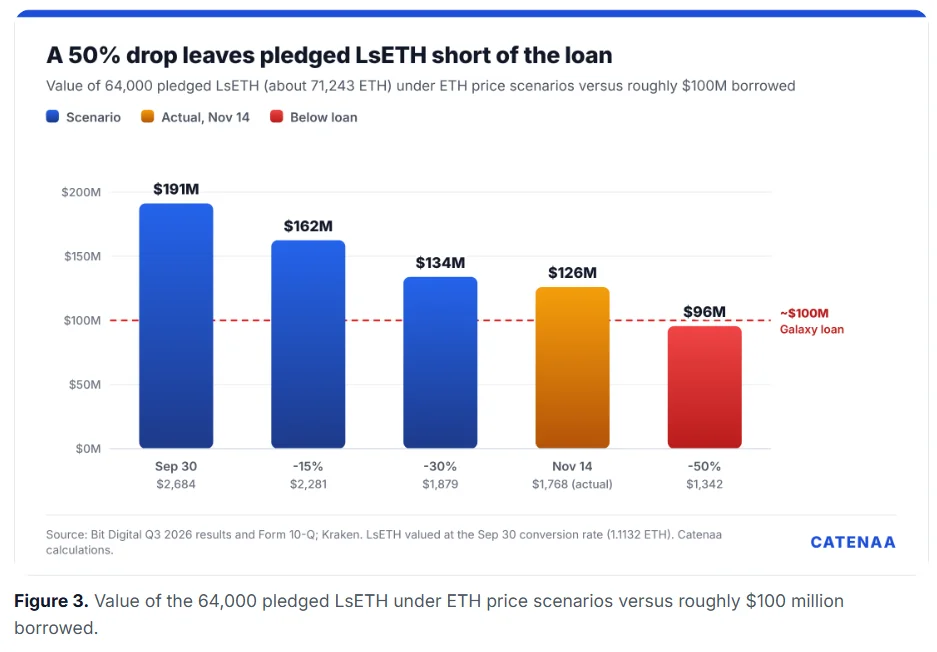
In other words, the pledged collateral alone would match the loan near $1,404 per ETH. That price sits about 21% below the November 14 close.
The buffer behind the pledge
Bit Digital kept 47,192 unpledged LsETH at September 30 as a buffer against margin requirements. If the October pledge came from that pool, only about 2,192 remain. Still, the company also held 74,606 ETH directly at quarter-end. At the November 14 price, that stake was worth about $132 million.
That deeper reserve matters, although part of it sits in native staking that can take time to unwind. Moreover, selling ether to meet calls would cut staking income. For scale, ETH staking brought in $1.0 million of revenue in the third quarter. Interest on $100 million at 5.5% runs about $1.4 million a quarter.
The filings do not say whether any collateral calls followed the November slide. They also omit valuation haircuts and covenant detail. Until those terms appear, investors can only bracket the risk. On the disclosed numbers, the cushion has thinned but has not vanished.