

November 03, 2026 – Onchain data show stablecoins draining fastest as Binance reopens withdrawals and publishes a fresh proof of reserves after the record theft.

In Summary
Binance reported a $3.64 billion net outflow in the first nine and a half hours after withdrawals resumed on November 1.
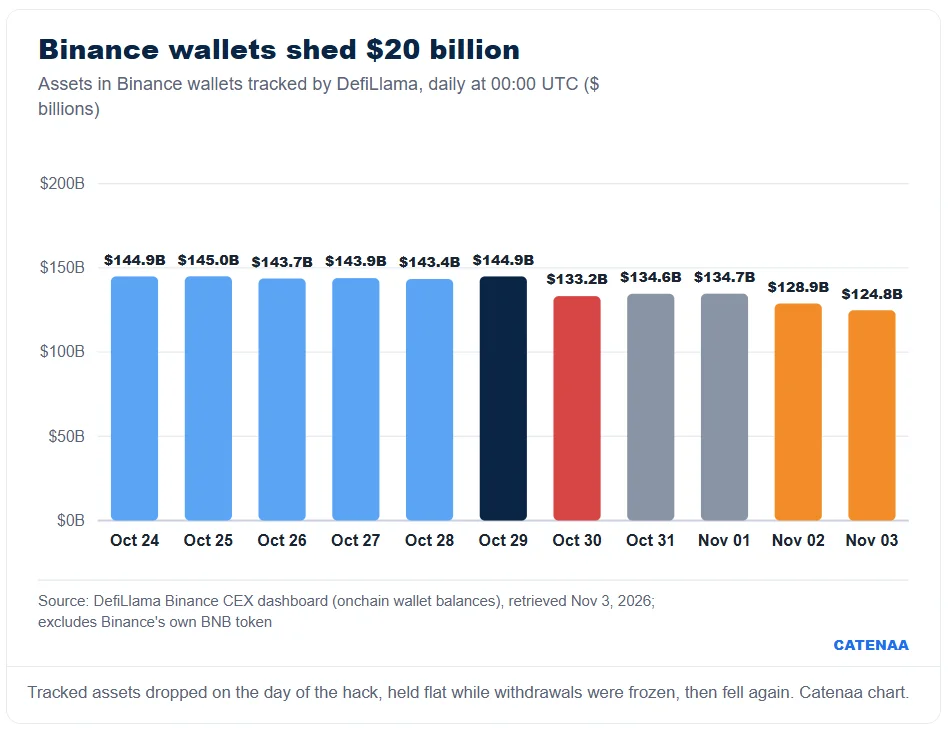
DefiLlama data show tracked assets in Binance wallets fell to $124.8 billion on November 3 from $144.9 billion on October 29.
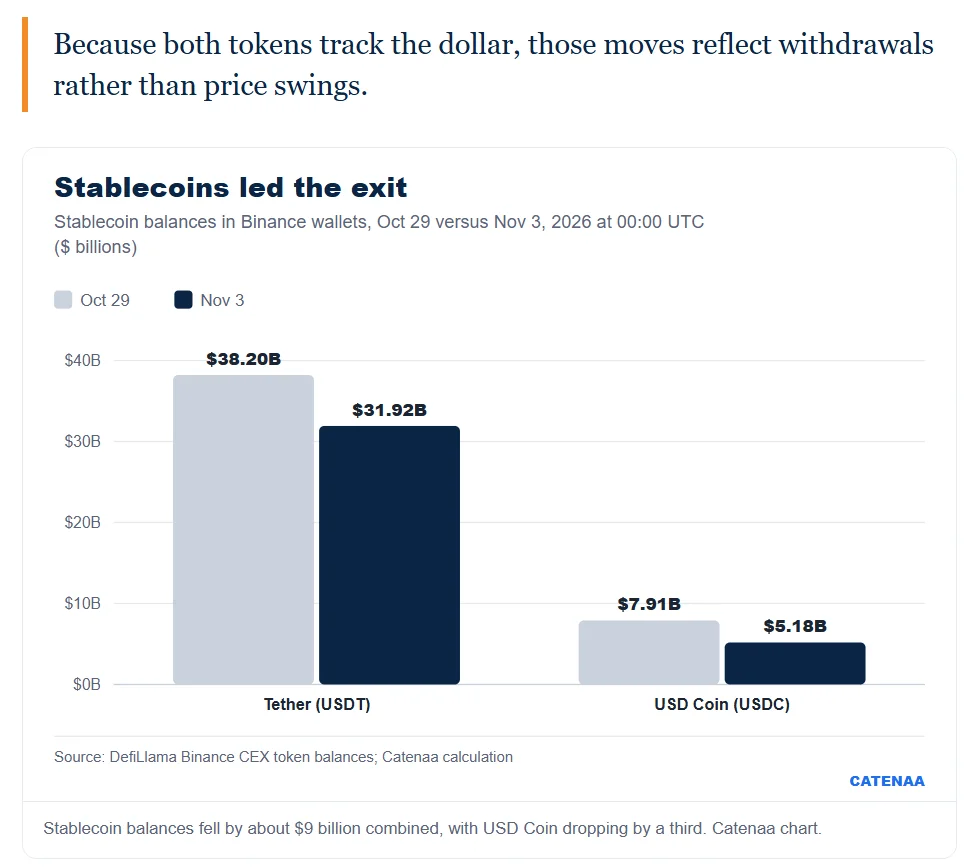
Stablecoins drained fastest: Tether balances fell $6.28 billion and USD Coin balances fell $2.73 billion over that span.
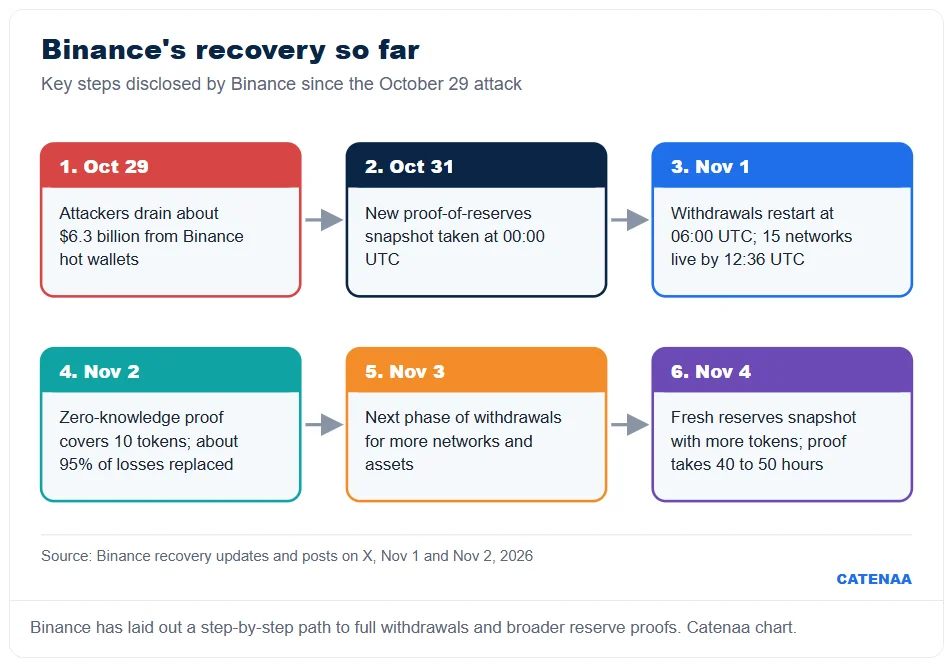
Binance says it has replaced about 95% of the stolen funds and published a zero-knowledge proof of reserves for 10 tokens.
Binance outflows surge as the doors reopen
Binance outflows jumped as soon as users could pull funds again. Many did not wait. The exchange restarted withdrawals in phases at 06:00 UTC on November 1, three days after the record hack. Between 06:00 and 15:30 UTC, it processed $4.649 billion in withdrawals and $1.01 billion in deposits. That left a net outflow of about $3.64 billion.
Binance put that figure at 2.1% of its $171 billion in assets under management, based on October 28 reserve data. It also said withdrawal volumes eased after an early spike. Still, the onchain record shows the exit kept going through Monday. In other words, the first day’s tally was only the start.
What the onchain data show
Wallet data tell a fuller story. Assets in Binance wallets tracked by DefiLlama fell to $124.8 billion at 00:00 UTC on November 3. On October 29, before the attack, they stood at $144.9 billion. That is a drop of $20.1 billion, or 13.8%, Catenaa calculates.
Part of that decline reflects the theft itself and weaker crypto prices. However, the moves since withdrawals reopened are mostly users leaving. Tracked assets fell by $9.85 billion between November 1 and November 3 alone. Notably, DefiLlama does not count Binance’s own BNB token, so its total sits below the exchange’s figure.
Stablecoins leave first
Dollar tokens led the way out. That is a clear sign of who moved first. Tether balances in Binance wallets fell to $31.92 billion from $38.20 billion over the period. USD Coin balances dropped to $5.18 billion from $7.91 billion, a 34.6% decline. Because both tokens track the dollar, those moves reflect withdrawals rather than price swings.
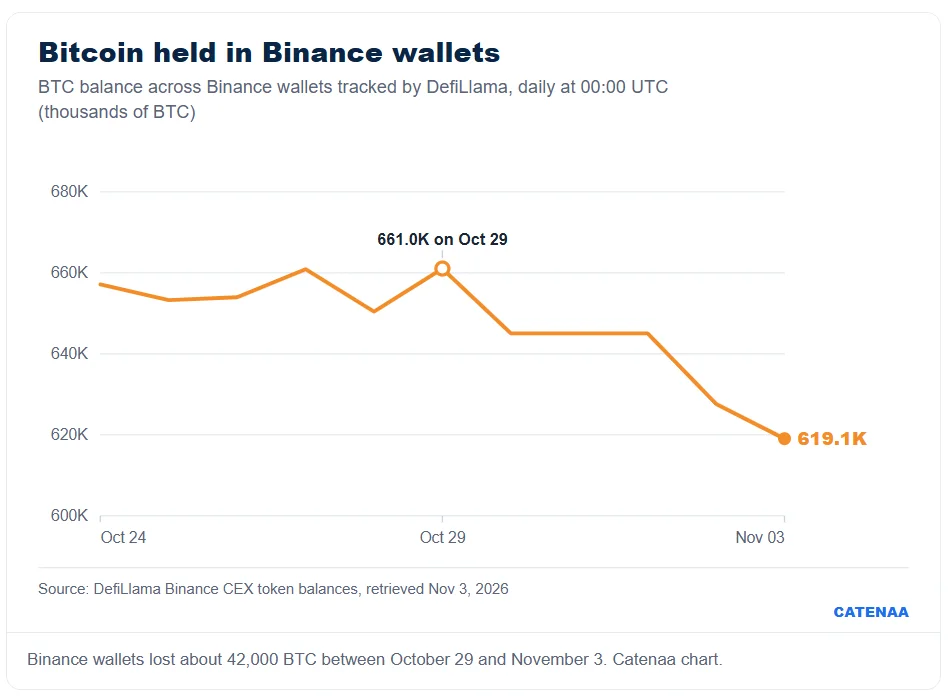
Bitcoin followed a similar path. Binance wallets held about 619,050 BTC on November 3, down roughly 42,000 BTC from October 29. In addition, about 26,000 BTC left after withdrawals resumed. Meanwhile, bitcoin traded near $76,900 on Kraken early on November 3.
Proof of reserves and the 95% mark
Binance is trying to rebuild trust with math. On November 2, it said a zero-knowledge proof now lets users verify 1:1 backing for 10 tokens. Those tokens include bitcoin, ether, Tether, BNB, Solana and USD Coin. It rests on a snapshot taken at 00:00 UTC on October 31.
The exchange said it has covered about 95% of the stolen amount with its own funds. According to Binance, the last 5% consists of less liquid tokens that take longer to buy. Next, Binance plans a wider reserves snapshot on November 4. The new proof should take 40 to 50 hours to compute.
What comes next for Binance
More withdrawals should reopen this week. The pace will tell a lot. Binance said the next phase for additional networks and assets would start on November 3. Published reports say the FBI has linked the theft to North Korean hackers, though Binance has not named the attackers.
For traders, two signals matter most. First, watch whether daily Binance outflows keep shrinking as more assets reopen. Second, check whether the November 4 proof covers more tokens at full backing. Until then, rivals may keep winning deposits from nervous users.
The episode also tests the wider market. Binance is one of the biggest crypto exchanges, so its health matters for prices. So far, bitcoin has held near $77,000 despite heavy Binance outflows. Even so, mood is weak. A popular crypto fear and greed gauge fell to 26 on November 3, from 51 on October 29.