

November 04, 2026 – Binance’s initial findings trace the $6.34 billion theft to a five-month campaign built on fake recruiters, poisoned developer tools and an internal AI tool.

In Summary
Binance says the theft started with a tampered tool download in June and a fake job interview in September.
Attackers used an internal AI tool on 20 October to take over more engineer accounts.
On 29 October, a malicious container and EIP-7702 delegations drained hot wallets in under seven hours.
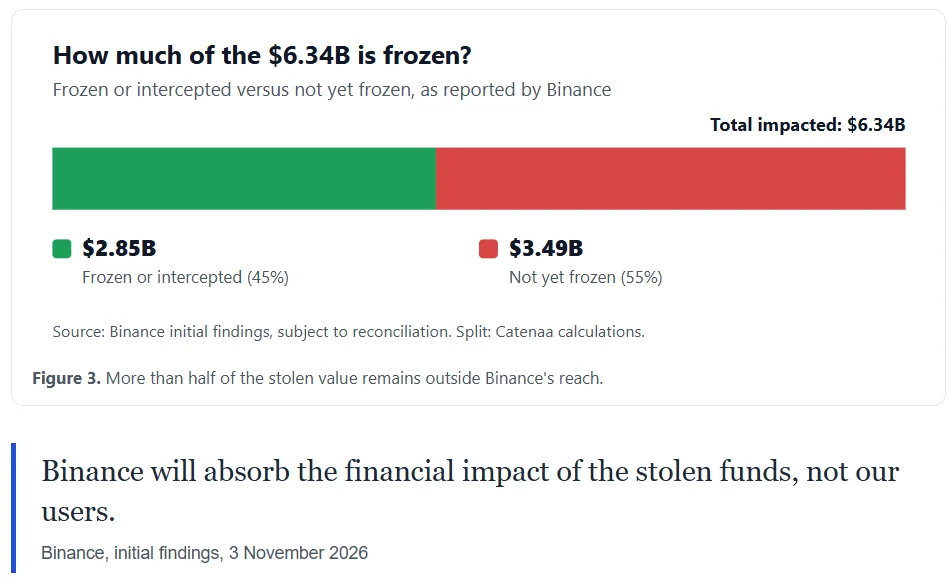
Binance has frozen or intercepted about $2.85 billion and says it will absorb the loss, not users.
The five transfers the report names were worth about $1.81 billion, roughly 29% of the total.
The Binance hack began with a job offer, not a code bug. Binance published its initial findings on 3 November, five days after attackers drained about $6.34 billion in digital assets. The report describes months of social engineering, malware and a hijacked in-house AI tool.
How the Binance hack unfolded
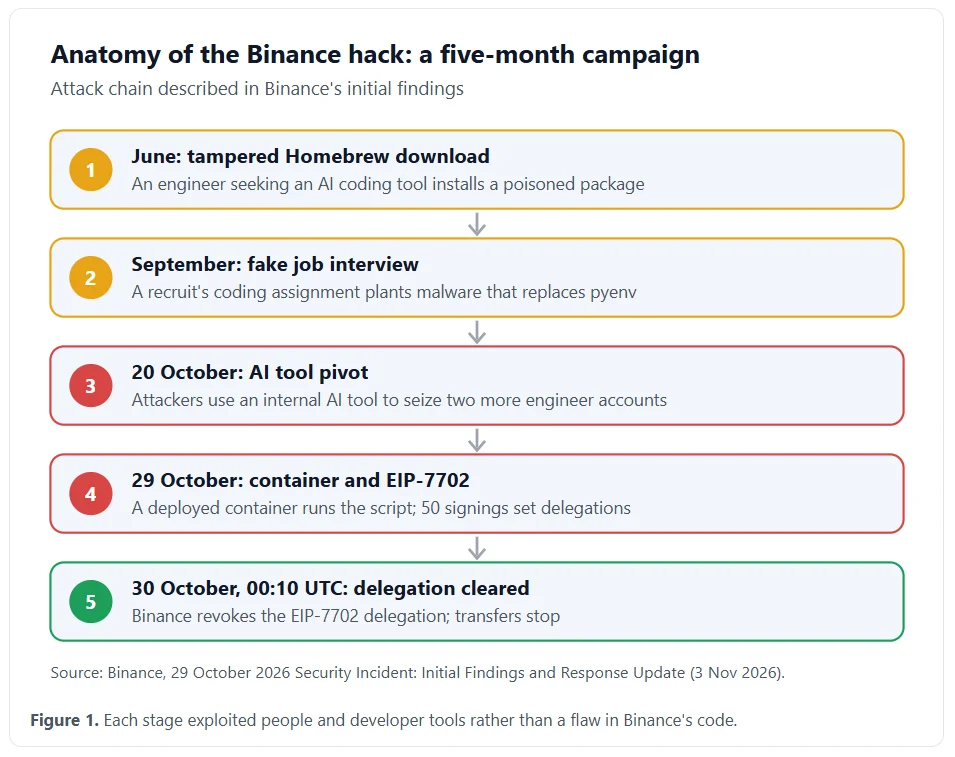
First contact came in June. A wallet DevOps engineer looked for an AI coding tool and downloaded a tampered Homebrew install. Binance replaced the device and rotated credentials. However, the attackers had already learned about the engineer’s role and colleagues.
In September, a fake recruiter approached a second engineer through a job-hunting platform. The engineer then ran a coding “assignment” on his work computer. That malware swapped a real pyenv component for a malicious one and slipped past endpoint protection. As a result, the attackers gained control of his work computer.
On 20 October, the attackers used that computer and an internal AI tool to take over two more engineers’ accounts. One of them held a container deployment token. Nine days later, they deployed a container and triggered a malicious script.
Inside the 29 October drain
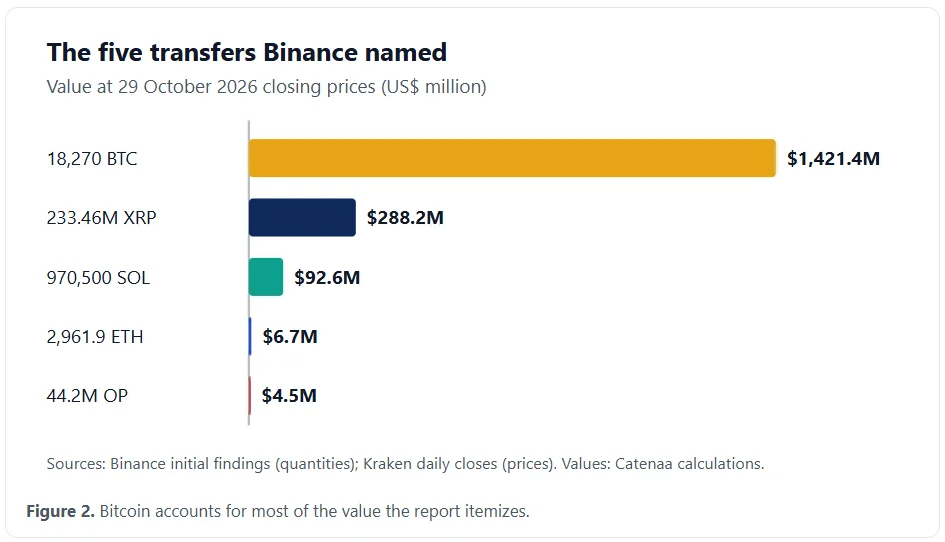
The theft itself took under seven hours. Between 17:15 and 19:56 UTC, the attackers worked from a third engineer’s computer with stolen credentials. From 20:05 to 20:09 UTC, five hot wallets sent 233.46 million XRP to an attacker address. Solana and Optimism wallets followed, and a Bitcoin hot wallet sent 18,270 BTC.
Ethereum required a different trick. The attackers sent 50 signing transactions to steer the account nonce and set malicious EIP-7702 delegations. That standard lets a regular account point to smart contract code. The hot wallet split its key across several parties, so no single key could cancel the delegation.
Instead, Binance had to build a special way to revoke it. The last unauthorized transfer, 2,961.9 ETH, settled at 23:56 UTC. Binance finally cleared the delegation at 00:10 UTC on 30 October.
Catenaa valued the five named transfers at 29 October closing prices from Kraken. Together, they come to roughly $1.81 billion, or about 29% of the total. The report does not itemize the remaining assets.
Losses, freezes and reserves
Binance says it has frozen or intercepted about $2.85 billion, pending final checks. That equals roughly 45% of the loss. The exchange also set aside more than 100% of the shortfall and says it will absorb the hit itself. Furthermore, it had replenished 98% of affected token assets by 31 October. Users can check that claim on its Proof of Reserves page.
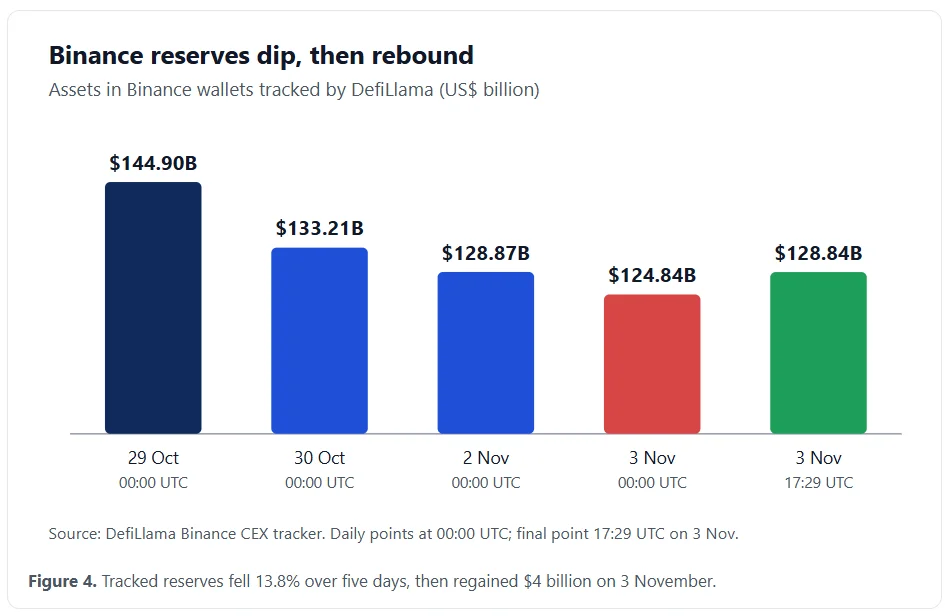
Even so, the exchange’s balance sheet took a visible hit. DefiLlama data shows tracked Binance reserves fell from $144.90 billion on 29 October to $124.84 billion on 3 November. That span covers the theft, price swings and withdrawals. By 17:29 UTC that day, they had climbed back to $128.84 billion.
What the Binance hack means for the industry
Binance cites an FBI statement that blames North Korea for the attack. Its team also detected and stopped 57 suspected North Korea-linked cases this year. Still, one campaign got through, and it rode on developer tools and an AI system.
The repair list is long. Binance rebuilt the wallet system and the AI tool, replaced devices and widened AI-based checks for unusual behavior. An independent review by outside experts comes next. Binance also plans a security research fund and joint work with AI and security firms. Some technical details will stay private while the probe goes on. For other exchanges, the Binance hack carries a clear lesson. Hiring channels and coding tools now sit inside the attack surface.