

September 25, 2026 – The exchange takes an equity stake in the USDC issuer and wins a five-year promotion deal. Circle pays a monthly fee tied to balances held on its wallet service.

In Summary
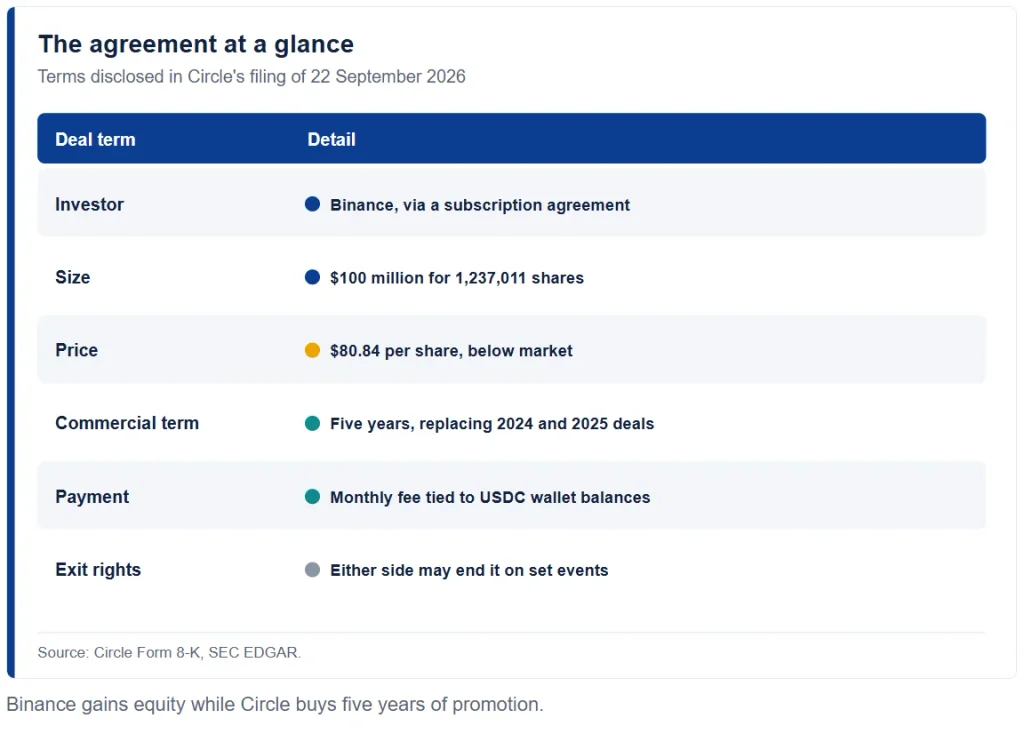
Binance bought 1,237,011 Circle shares for $100 million at $80.84 each, a discount to the market price.
The two firms signed a five-year deal under which Circle pays a monthly incentive fee tied to USDC balances.
The agreement replaces earlier arrangements from November 2024 and August 2025
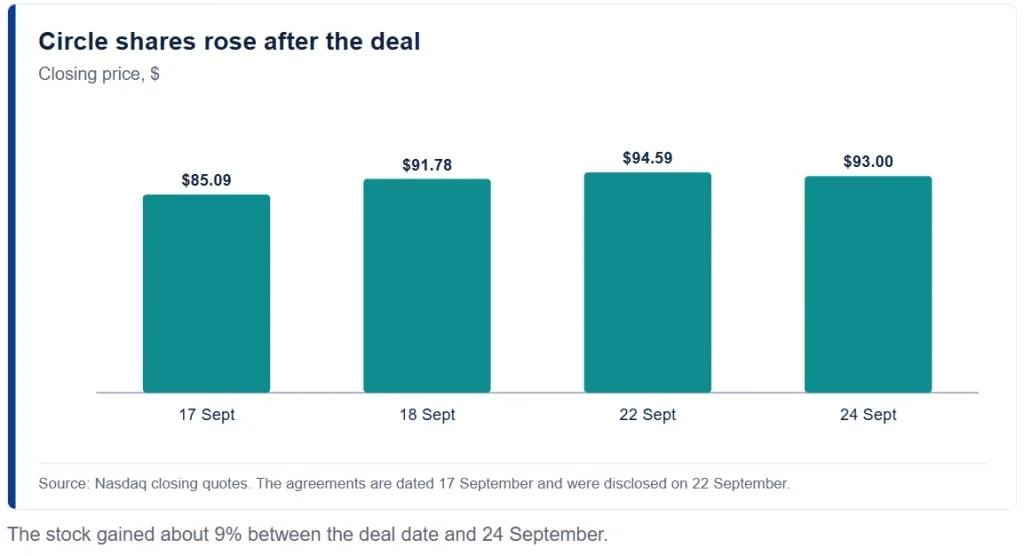
Circle shares closed at $93.00 on 24 September, about 9% above the level on the deal date.
USDC circulation stood at $73.3 billion at the end of June and about $76 billion this week.
The world’s largest crypto exchange has bought a slice of the second-largest stablecoin issuer. Binance paid $100 million for 1,237,011 Circle shares, a filing shows. The two firms also signed a five-year commercial deal.
Circle sold the stock at $80.84 per share. That price sat below the market level just before closing. Circle shares had closed at $85.09 on 17 September, the day of the agreement.
Investors liked the news. The stock reached $91.78 on 18 September and $93.00 on 24 September, Nasdaq data show. That is a gain of about 9% from the deal date.
What Circle and Binance Agreed
The commercial part matters more than the equity. Circle will pay Binance a monthly incentive fee, based on USDC balances held through its Modular Smart Contract Wallet service. Binance will promote USDC across its platform in return.
The deal replaces earlier agreements from November 2024 and August 2025. It runs for five years, with termination rights on both sides. So the relationship deepens rather than begins.
Payment flows one way here. Circle pays for distribution, much as an asset manager pays a platform. Binance, meanwhile, gains an equity stake in a partner it helps grow.
The structure also aligns incentives. If USDC balances rise on Binance, both sides benefit. Circle earns reserve income, while Binance collects fees and holds appreciating stock.
Why Distribution Decides the Stablecoin Race
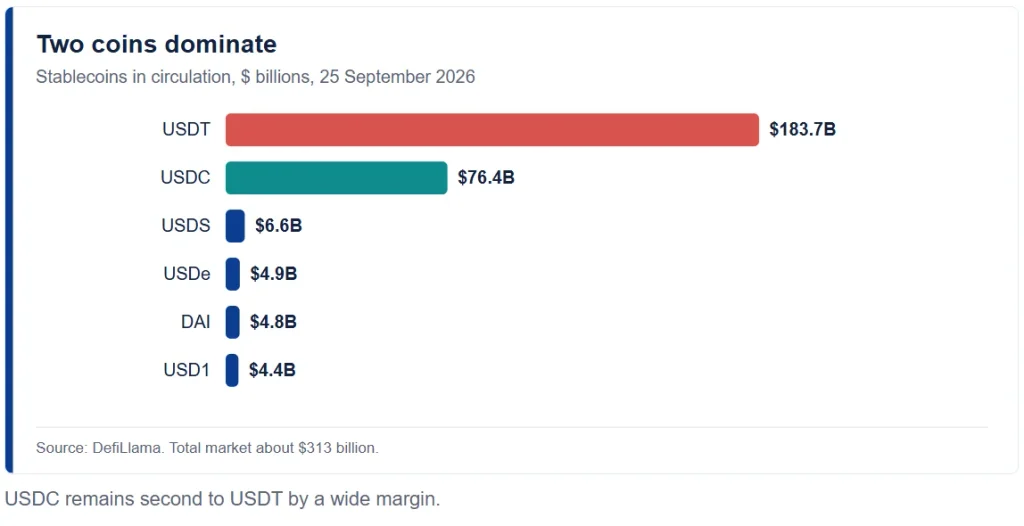
Stablecoins compete on reach, not technology. Tether’s USDT leads with about $184 billion in circulation, DefiLlama data show. USDC follows with roughly $76 billion of a $313 billion market.
Exchanges control much of that reach. Traders hold balances where they trade, so listing and default-pair decisions shape supply. Consequently, a distribution deal can move billions.
Circle already pays for such reach elsewhere. Distribution costs sit near the top of its cost base. The trade-off is simple: lower margins, larger float, more reserve income.
Rivals follow the same playbook. Issuers court wallets, brokers and payment firms with revenue shares. Distribution, in short, has become the main battleground.
The Numbers Behind Circle
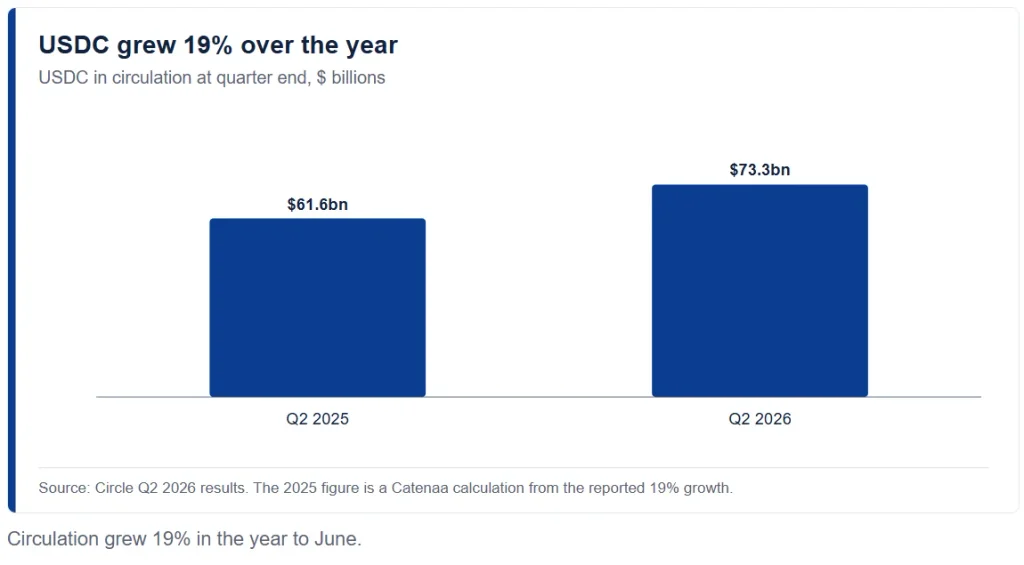
Second-quarter results show the model at work. USDC in circulation reached $73.3 billion at the end of June, up 19% year on year, Circle reported. Onchain transaction volume hit $14.8 trillion, up 151%.
Revenue and reserve income came in at $701 million, a 7% increase. Net income from continuing operations reached $48 million. Adjusted earnings before interest, tax, depreciation and amortisation stood at $143 million.
Circulation has kept growing since then. The DefiLlama figure of about $76 billion implies further expansion during the third quarter. Reserve income tracks that balance closely, alongside interest rates.
A Second Deal in the Same Month
Circle has been busy elsewhere. On 4 September, it agreed to buy Tazapay, a Singapore payments company, another filing shows. The purchase uses Circle stock as consideration.
That deal points to cross-border payments. Tazapay handles collections and payouts across Asian corridors. Combining those rails with USDC could shorten settlement for merchants, which is where stablecoins claim their clearest advantage.
Circle also runs Arc, its own blockchain network. Validators announced for Arc include BlackRock, DTCC, Mastercard, Standard Chartered and Visa. The public mainnet launched on 16 September.
Those names signal institutional intent. Banks and card networks rarely lend their brands to experiments. Their involvement suggests they expect tokenised settlement to scale.
What Investors Should Watch
Three questions follow. First, how much does the Binance fee cost? The filing does not disclose the percentage, so margins may compress before volumes rise.
Second, does USDC gain share? Tether still holds roughly 60% of the market. Winning share from that base takes years, not quarters.
Third, what happens to reserve income if rates fall? Circle earns most of its revenue on short-dated assets backing USDC. Lower policy rates would therefore squeeze the core business.
The Wider Picture
Regulated stablecoins are moving into mainstream finance. Central banks are building settlement rails for tokenised assets, as our report on the ECB’s new settlement platform explains. Payment firms and exchanges want a seat at that table.
Concentration remains a risk. Two issuers control more than four fifths of the market. A shock at either would ripple through crypto trading and, increasingly, through payments.
For now, Circle has bought reach and sold a stake to do it. Whether that trade pays off depends on how much USDC the partnership adds. The next quarterly report will show the first evidence.