

November 04, 2026 – Aztec’s Alpha V6 upgrade patches a critical proving flaw, halves proof times and cuts Ethereum deposit messages to seconds.

In Summary
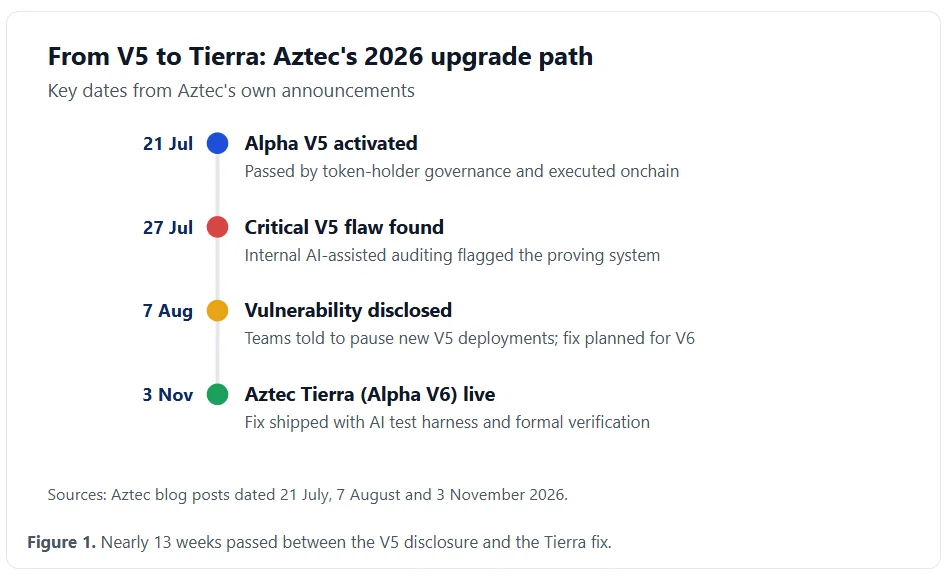
Aztec Tierra (Alpha V6) went live on 3 November 2026 and fixes a critical flaw found in V5.
Contributors could not rule out past exploitation of the V5 flaw, so the fix shipped as a network upgrade.
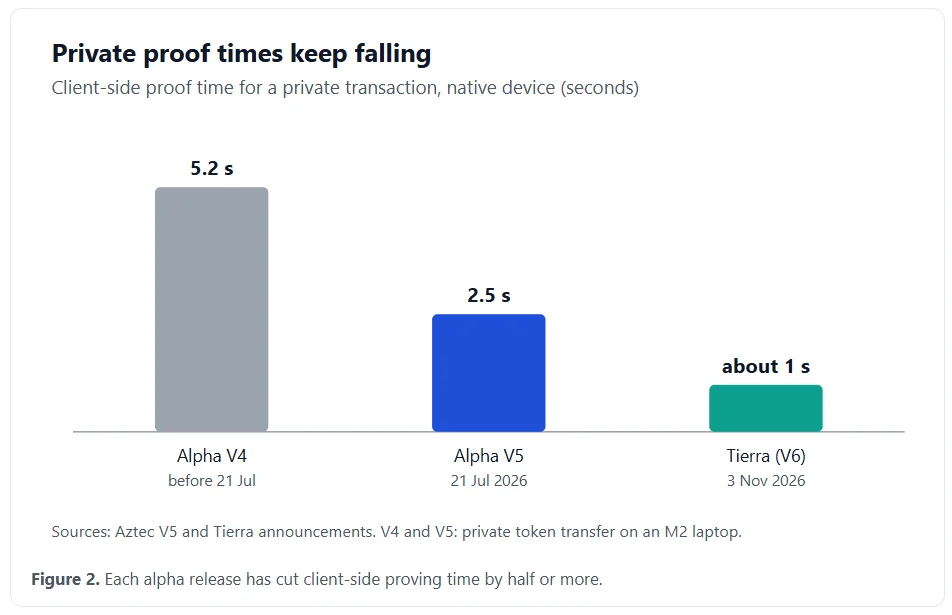
Client-side private proofs now take about one second, down from 2.5 seconds on V5 and 5.2 seconds on V4.
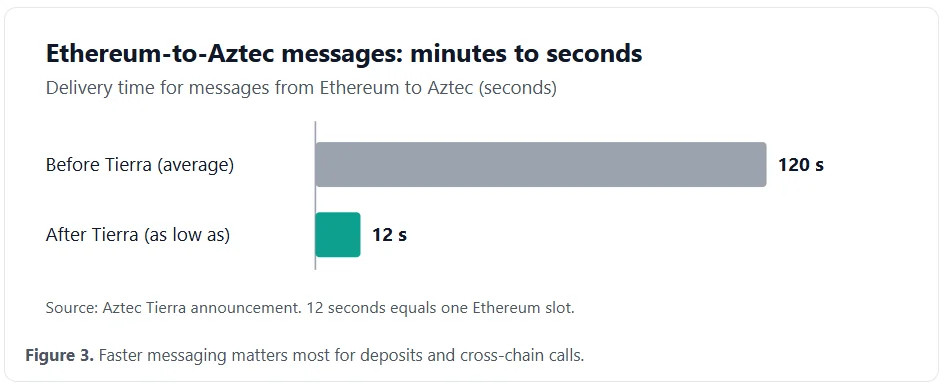
Ethereum-to-Aztec messages drop from an average of two minutes to as low as 12 seconds.
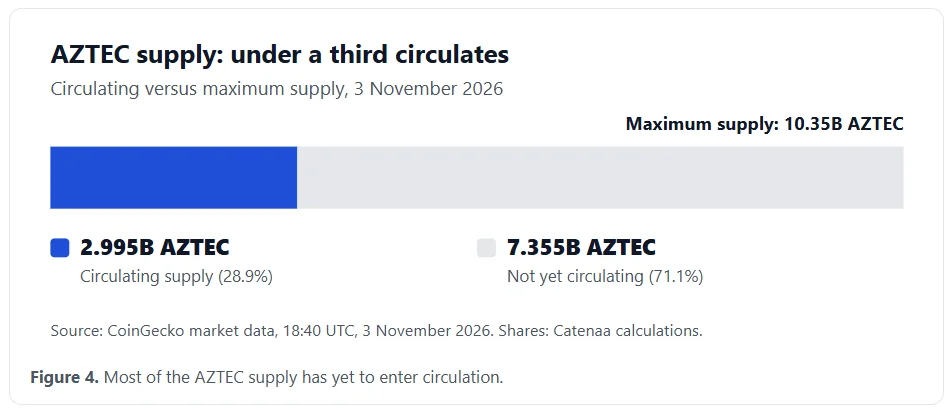
AZTEC trades about 64% below its February peak, with roughly 29% of maximum supply circulating.
Aztec Tierra went live on 3 November 2026, giving Ethereum’s privacy-focused layer 2 its first major upgrade since July. The Aztec Foundation announced the Alpha V6 upgrade around three goals: security, speed and stability. It also unveiled a new brand and a slate of private apps.
Aztec Tierra fixes a critical V5 flaw
Security comes first in this release. In August, Aztec disclosed a critical vulnerability in its V5 proving system. Core contributors found it on 27 July through internal AI-assisted auditing. In short, an attacker could craft a proof that passed checks for a transaction the network should reject.
The disclosure was unusually blunt. Contributors said they could not tell whether anyone had exploited the flaw. Their system lacked the data to separate normal transactions from those accepted through the faulty path. Consequently, the team asked builders to pause new V5 deployments.
Tierra resolves that issue along with earlier known bugs. It also adds an AI-powered security testing harness and formal verification of core cryptographic parts. Meanwhile, Aztec says the network runs more than 3,000 validators, with no centralized sequencer or privileged viewing keys.
Faster proofs and faster deposits
Aztec’s design explains why proof speed matters so much. Developers choose which functions in an app stay private and which run in public. Private functions execute and generate proofs on the user’s device, so the network never sees the inputs. Public functions, by contrast, run on the network itself.
Speed is the second headline. On Aztec, users prove private transactions on their own devices, so proof time shapes the whole experience. Tierra cuts client-side proofs to about one second on a native device. Aztec calls that a 2x speedup over the previous network.
These gains stack on top of V5. When Aztec activated V5 on 21 July, proving a private token transfer took about 2.5 seconds on a laptop. That was down from 5.2 seconds on V4. V5 also cut average block time from 14 to 6 seconds. In addition, it lowered the cost of a fully private transaction by roughly 50%.
Deposits should feel quicker too. A new design cuts Ethereum-to-Aztec message delivery from an average of two minutes to as low as 12 seconds. Notably, that floor equals a single Ethereum slot, the network’s 12-second block interval.
Apps, token and the road ahead
Aztec paired the upgrade with eight apps that are live or preparing to deploy. They cover private payments, perpetuals trading, AI inference, wallets and liquid staking. Aztec Labs’ zk.money leads the push, letting users deposit straight from any Ethereum wallet.
The rest of the list shows where builders see demand. Galactica targets private AI inference, while Nemi offers private perpetuals trading. Nulo is a private browser wallet, and Xochi handles private intents. Nyx sends private payments to any Ethereum wallet. Finally, Olla offers liquid staking for AZTEC, and Rolling Chat runs a private message board.
Market reaction stayed muted. The AZTEC token traded near $0.0144 on 3 November, according to CoinGecko data. That implies a market value of about $43 million. The price sits roughly 64% below its February peak of $0.0399. Even so, it holds about 27% above its 18 August low of $0.0113. Only about 29% of the 10.35 billion maximum supply circulates today.
Still, Tierra remains alpha software. Aztec’s own V5 notice described alpha as the period for finding faults before production. Therefore, the real test for Aztec Tierra is whether V6 stays clean as apps bring in users and value.