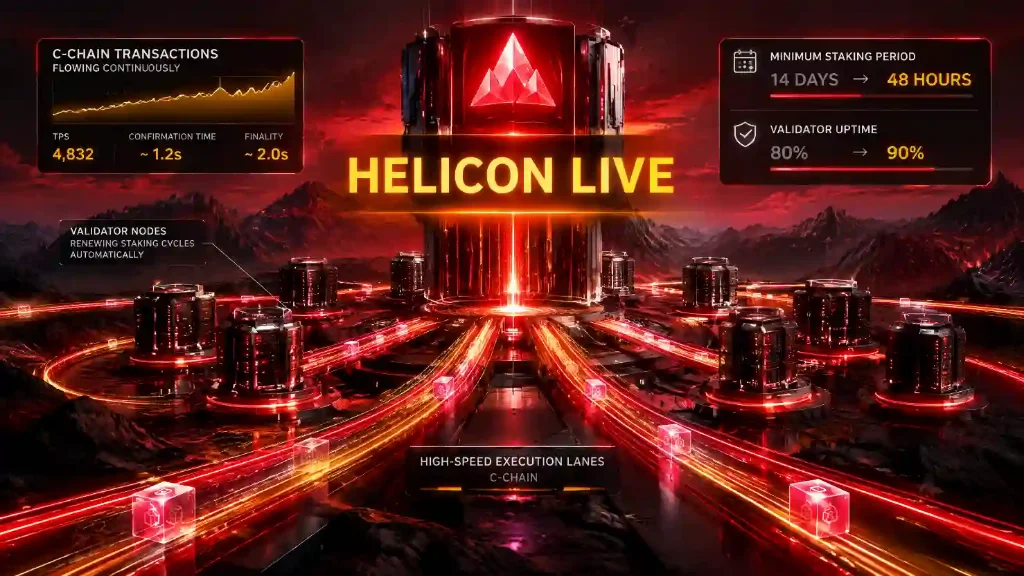


Catenaa, Tuesday, September 22, 2026- Avalanche activated its Helicon network upgrade on mainnet at 15:00 UTC Tuesday, introducing continuous C-Chain execution and sweeping changes to staking, validator requirements and gas pricing.
The upgrade went into effect through AvalancheGo v1.15.0 after node operators were instructed to install the compatible software before activation.
Nodes that remained on older versions after the change could no longer correctly follow the upgraded network rules.
Helicon bundles six Avalanche Community Proposals, or ACPs, covering both the C-Chain and the Primary Network’s staking system.
One of the most significant changes is Continuous Execution under ACP-194.
Previously, transaction execution was more closely tied to the consensus process that accepted blocks.
Helicon separates those functions through a queue, allowing execution work to continue independently as consensus progresses.
The change is intended to make better use of processing time and improve the C-Chain’s ability to handle transaction workloads.
For users, the upgrade should largely operate beneath the surface.
Developers and infrastructure operators face more immediate changes because Continuous Execution alters when blockchain state becomes available relative to block acceptance.
Several C-Chain RPC functions are also affected or deprecated under the new architecture.
Helicon also introduces a dynamic minimum gas price through ACP-283.
Before the upgrade, the C-Chain operated with a minimum gas-price floor established by protocol rules.
Validators can now express their preferred minimum gas prices, with the network deriving the effective floor from stake-weighted preferences.
The minimum begins at the existing 1 wei level and can change if validator preferences move.
That gives the network another mechanism for adapting transaction-fee policy as conditions change.
The other four Helicon proposals concentrate on staking.
ACP-273 cuts the minimum Primary Network validator staking period from 14 days to 48 hours.
The change significantly reduces the minimum period for which validators must commit capital.
Avalanche’s maximum staking period remains one year.
Shorter commitments may give professional operators greater flexibility in managing AVAX holdings and validator infrastructure.
Helicon also introduces auto-renewed staking under ACP-236.
Validators can now establish a staking cycle that automatically renews rather than allowing the validation period to expire and requiring a new staking transaction.
At each cycle boundary, rewards can be settled and another cycle started automatically if the validator remains eligible and has not been configured to exit.
The system can also automatically compound a specified portion of staking rewards.
Auto-renewal applies to validators rather than conventional delegators.
The upgrade simultaneously raises the performance standard validators must meet to qualify for rewards.
Under ACP-267, the required uptime rises from 80% to 90% for validation periods beginning after Helicon activation.
Existing validation periods that began before activation continue under the previous 80% requirement.
The higher threshold is intended to reward more consistently available validators and strengthen network reliability.
It also increases the consequences of poor node performance.
A validator can remain part of the network while failing to meet the required uptime, but it may lose eligibility for staking rewards.
ACP-285 changes another part of Avalanche’s staking economics.
The minimum consumption rate used in the staking reward formula will fall from 10% to 7.5%.
That change does not occur immediately.
Avalanche is phasing it in linearly over 90 days following Helicon’s mainnet activation.
A staking period beginning halfway through that transition would therefore use a rate between the old and new levels.
The maximum consumption rate remains unchanged.
The adjustment primarily affects reward calculations for shorter staking commitments and works alongside the new 48-hour minimum duration.
Together, the changes make validator capital more flexible while tightening the uptime standard needed to receive rewards.
Helicon had already undergone a mainnet-style test on Avalanche’s Fuji testnet.
The upgrade activated there on July 28, giving developers, validators and infrastructure providers nearly two months to test the new rules before the mainnet change.
Ava Labs released AvalancheGo v1.15.0 on September 8 with the mainnet activation programmed for September 22.
The software also raises Avalanche’s plugin compatibility version to 46.
Applications relying on AvalancheGo plugins were required to move to compatible versions alongside node operators.
The upgrade represents more than a routine software release because it alters consensus-level network behavior.
Avalanche coordinated activation at a predetermined time so participating nodes would begin enforcing the new rules together.
Exchanges and infrastructure providers also prepared for the transition.
Some trading platforms temporarily suspended Avalanche deposits and withdrawals around the activation while keeping trading available.
Such precautions are common during blockchain network upgrades because exchanges typically wait to confirm that an upgraded chain is operating normally before reopening transfers.
Avalanche’s public status system showed its mainnet API services operational after the scheduled activation, with no Helicon-related network incident listed at the time of checking.
Helicon follows a series of named Avalanche upgrades aimed at changing both network performance and the economics of operating infrastructure.
Its most immediate effects will be felt by validators.
They can now operate with shorter minimum commitments and use automatic renewals, but new validation periods must meet the higher 90% uptime threshold to qualify for rewards.
Developers face a different adjustment as Continuous Execution changes assumptions about when state becomes available after consensus accepts a block.
For ordinary AVAX holders who neither operate nor directly manage validators, the transition should be less visible.
Applications, wallets and exchanges continue to interact with the network while the underlying infrastructure adopts the new execution and staking rules.
The broader importance of Helicon lies in combining performance changes with an overhaul of validator incentives in a single activation.
Avalanche is attempting to make staking capital more flexible while demanding higher operational reliability from the infrastructure securing the network.
At the same time, Continuous Execution and dynamic gas pricing alter how the C-Chain processes transactions and responds to changing network conditions.
With Helicon now activated, attention shifts from the September 22 deadline to how those changes perform under normal mainnet traffic.