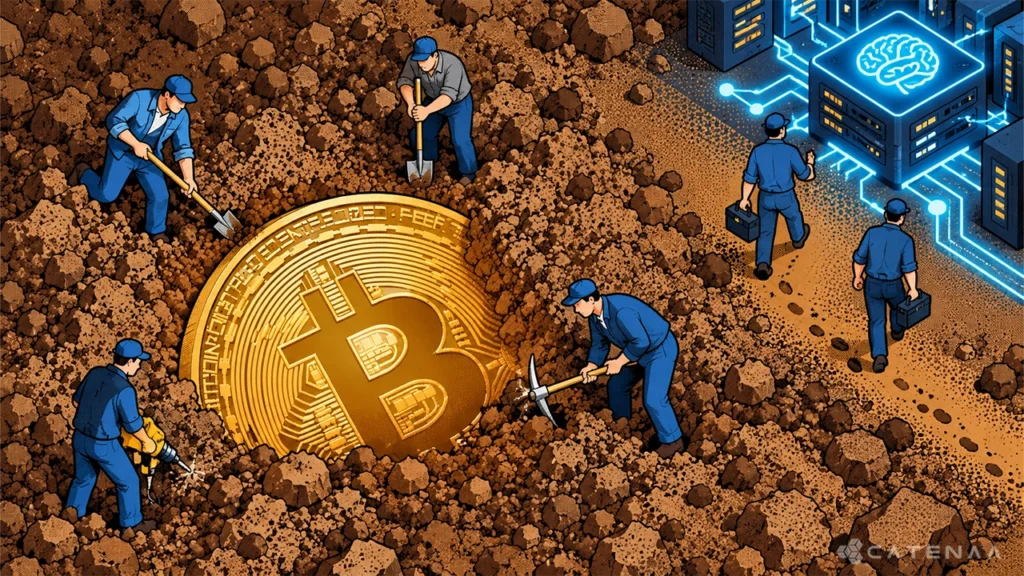


Catenaa, Monday, September, 21, 2026-Publicly traded bitcoin miners that have shifted capacity to artificial intelligence are unlikely to reverse course even if bitcoin prices recover, according to a new CoinShares report.
The asset manager said long-term contracts, equipment decisions and stronger returns from AI and high-performance computing have made the transition increasingly difficult to unwind.
At least 35 exahashes per second of mining capacity is scheduled to leave publicly listed miners, equal to about 4.7% of Bitcoin’s current network hashrate of roughly 750 EH/s.
Core Scientific provides one example. The company paid $41.9 million to cancel an agreement covering 15 EH/s of next-generation mining hardware as it expanded its data-center business.
Several miners have also committed sites to AI and high-performance computing leases lasting 15 years or more.
Keel, formerly Bitfarms, stopped mining in June. IREN plans to substantially complete its mining exit by the end of 2026, while Cipher Digital could leave the sector by the end of 2027.
TeraWulf is also winding down 145 megawatts of remaining mining capacity.
Economics help explain the shift.
CoinShares estimates AI infrastructure can generate annualized profits of about $1.5 million per megawatt, compared with roughly $500,000 from bitcoin mining.
Bitcoin miners faced severe pressure during the second quarter. The average cash cost of producing one bitcoin among listed miners reached about $75,500, while bitcoin ended June near $58,400.
Hash price, a measure of revenue earned from mining computing power, fell to a record monthly low of $27.70 per petahash per second per day in June.
Conditions have since improved. Bitcoin’s recovery to around $77,000 lifted hash price to roughly $38 and returned most operators above cash breakeven.
Bitcoin mining has historically been highly sensitive to price, electricity costs, mining difficulty and the block reward. The 2024 halving reduced the reward paid to miners, increasing pressure on operators to find cheaper power or alternative uses for their data-center infrastructure.
The rapid growth of AI has offered another option. Mining companies already control large power connections, land and data-center facilities that can be adapted for high-performance computing.
CoinShares said a stronger bitcoin market could encourage additional mining investment, particularly from companies such as Riot, MARA, HIVE and Bitdeer that have retained flexibility.
But miners already committed to long-term AI contracts are unlikely to return.
The result could leave Bitcoin mining increasingly concentrated among companies that still view mining as their core business, while others evolve into AI data-center operators.