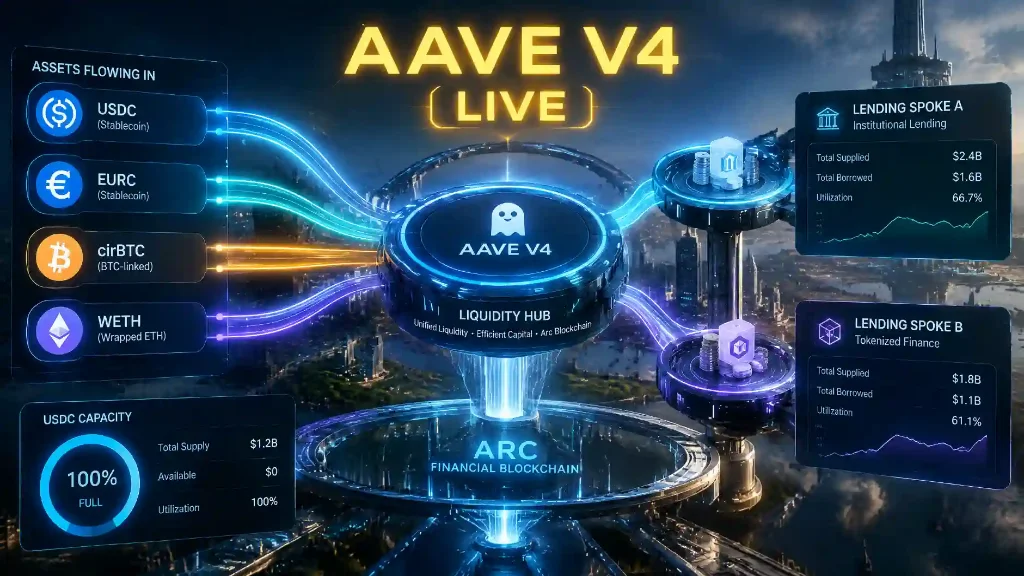


Catenaa, Tuesday, September 29, 2026- Aave V4 has gone live on Circle’s Arc blockchain with four initial assets, as demand pushed its first USDC capacity limits to full utilization within hours of launch.
Aave Labs activated the market September 16 alongside Arc’s public mainnet launch after the Aave Protocol Security Council removed a temporary deployment halt.
USDC, EURC, Circle Wrapped Bitcoin, or cirBTC, and WETH were available as reserves from launch.
Aave’s risk adviser LlamaRisk reported later that the initial USDC capacity on the Arc Core Main Spoke had already filled.
About $56 million in USDC flowed into that part of the market shortly after launch, prompting a proposal to increase its capacity.
The early inflow provides one of the first indications of demand for decentralized lending on Circle’s new Layer 1 network.
Arc was designed around stablecoins, tokenized assets, payments and institutional financial applications.
That positioning makes Aave’s deployment particularly centered on dollar and euro liquidity rather than launching with a broad collection of speculative tokens.
USDC and EURC are both issued by Circle.
CirBTC provides Bitcoin exposure, while WETH brings an Ethereum-linked asset into the initial lending market.
Aave V4 introduces a different architecture from earlier versions of the lending protocol.
Instead of each lending market maintaining an entirely separate pool of liquidity, V4 uses a hub-and-spoke design.
The Arc deployment launches with a single Core Liquidity Hub connected initially to two spokes.
The Main Spoke supports cirBTC, WETH and USDC as collateral and allows borrowing across USDC, EURC, cirBTC and WETH.
A separate Forex Spoke is focused on the two stablecoins, with USDC and EURC serving as collateral and borrowable assets.
The structure allows different lending markets to share underlying liquidity while maintaining separate risk settings.
That is intended to reduce liquidity fragmentation.
A specialized market can draw from a common hub without requiring all capital to be locked into a separate pool created solely for that use.
It also gives Aave greater flexibility to create additional spokes for different types of assets or borrowers.
Future Arc markets could potentially include tokenized real-world assets if approved through Aave governance.
Aave deliberately launched the Arc market with conservative capacity limits.
Arc is a new blockchain, meaning its liquidity conditions, market depth and behavior under stress have relatively little mainnet history.
Risk parameters can be expanded as liquidity develops and the network produces more observable data.
The speed at which the initial USDC limit filled has already triggered that process.
LlamaRisk subsequently proposed adding about $94 million in additional USDC capacity to the Arc Core Hub as part of a broader round of Aave V4 cap adjustments.
The launch process itself differed from a normal Aave deployment.
The Arc market had already been deployed before mainnet activation but remained halted, preventing users from supplying, borrowing or moving liquidity.
Because Arc’s cross-chain Aave governance infrastructure was not yet available at launch, activation could not initially proceed through the standard Aave Improvement Proposal execution system.
Instead, the Protocol Security Council directly removed the temporary halt after governance had already approved the deployment through an earlier Snapshot process.
Aave Labs said the activation followed the same logic as a normal V4 deployment.
The company also said the configuration underwent technical review with Certora before activation.
Future governance changes on Arc are expected to move through standard cross-chain governance once the necessary infrastructure is operating.
The four launch assets carry different risks despite sharing the same liquidity architecture.
USDC and EURC are fiat-backed stablecoins controlled by Circle and designed to track the US dollar and euro respectively.
CirBTC is a tokenized representation of Bitcoin issued through Circle’s infrastructure.
Aave’s technical assessment classified cirBTC as carrying medium technical risk.
The review highlighted Circle’s privileged administrative controls and aspects of the infrastructure used to mint and bridge the asset.
WETH follows a different model on Arc.
It is not natively issued there, and the underlying ETH backing is escrowed on Ethereum.
These differences matter in a lending system because collateral risk depends not only on price movements but also on how tokens are issued, bridged and administered.
Aave’s risk framework therefore evaluates assets individually rather than treating all four as equivalent simply because they trade on the same network.
The Arc deployment also carries a commercial incentive for Aave DAO.
The governance proposal supporting the launch said the DAO is expected to receive at least $2 million annually in protocol revenue from the Arc deployment.
Under the proposed arrangement, specified Arc ecosystem participants would cover any shortfall against that minimum during the first five years.
That commitment was designed to reduce the economic risk of deploying onto a newly launched blockchain whose long-term lending volumes remain unknown.
The more important test will still be sustained activity.
A lending protocol can accumulate deposits quickly while borrowing demand develops more slowly.
Protocol revenue ultimately depends on how much capital is borrowed, utilization rates, interest-rate conditions and the fees captured by Aave.
Arc itself is also at an early stage.
Circle has positioned the network as infrastructure for financial institutions, stablecoin settlement and tokenized markets, but adoption will depend on whether developers and capital continue moving onto the chain after launch.
For Aave, arriving at the beginning gives the protocol a chance to establish itself as Arc’s primary lending layer before competing markets mature.
The deployment also demonstrates how Aave V4’s architecture can be adapted to specialized financial environments.
A shared liquidity hub can support general borrowing through one spoke and foreign-exchange-oriented stablecoin activity through another.
Additional spokes can later be added without rebuilding the entire liquidity base.
That design could become increasingly important if blockchain lending expands beyond conventional crypto collateral into tokenized securities, credit products and other real-world assets.
For now, Arc begins with four familiar digital assets and cautious limits.
The first reaction has been strong enough to fill the initial USDC capacity within hours.
Whether that early liquidity turns into sustained borrowing and meaningful protocol revenue will provide the more important measure of Aave V4’s success on Circle’s new network.