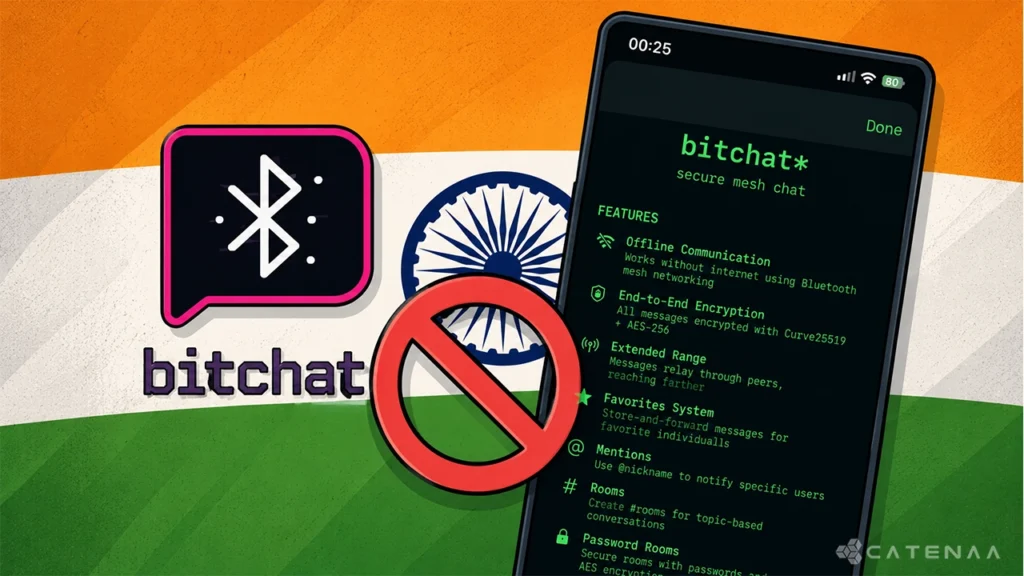


Catenaa, Thursday, July 30, 2026-India’s cybercrime agency has ordered GitHub to remove repositories associated with Bitchat, the decentralized messaging application created by Block CEO Jack Dorsey, as authorities seek to limit the use of offline mesh-network technology during anti-government protests in New Delhi.
The order, issued by the Indian Cyber Crime Coordination Centre (I4C) under Section 79(3)(b) of India’s Information Technology Act, targets three GitHub repositories linked to the open-source application and reportedly gave the platform three hours to disable access.
Unlike conventional messaging platforms, Bitchat allows encrypted messages to travel directly between nearby smartphones using Bluetooth mesh networking.
The application operates without internet connectivity, mobile networks, user accounts or centralized servers, enabling messages to move from device to device until they reach their destination or connect to the broader internet.
The software also supports relaying Bitcoin transactions through the same mesh network, allowing transactions to be broadcast once a connected device regains internet access.
According to the government notice, officials argue that Bitchat’s decentralized architecture makes lawful interception and criminal investigations significantly more difficult because it does not require registration, phone numbers or centralized logging.
The reported action comes amid ongoing demonstrations in New Delhi, where protesters have faced repeated internet shutdowns imposed around protest locations.
Researchers monitoring the demonstrations have reported that some participants turned to Bluetooth mesh applications, including Bitchat, to maintain communications when internet access was unavailable.
At the time of publication, it remained unclear whether GitHub had complied with the takedown request. The application also continued to be available through major mobile app stores.
The case illustrates a growing challenge for regulators as communication technologies become increasingly decentralized.
Traditional online platforms generally rely on centralized servers that can be regulated or restricted through legal orders.
Mesh-network applications operate differently, allowing nearby devices to communicate directly without relying on conventional telecommunications infrastructure.
Even if source code is removed from one hosting platform, open-source software is often replicated across multiple repositories, making complete removal difficult.
The dispute highlights an emerging policy debate over decentralized communication technologies.
Governments increasingly view encrypted, serverless applications as potential obstacles to law enforcement during periods of civil unrest, while privacy advocates argue such tools provide resilient communications during disasters, infrastructure failures and internet shutdowns.
The case may also influence future regulatory approaches toward decentralized applications that combine encrypted communications with blockchain-based financial capabilities.
Bitchat was released as an open-source project by Block CEO Jack Dorsey in 2025. The application uses Bluetooth mesh networking to transmit encrypted messages directly between nearby smartphones without requiring internet access, centralized servers or user registration. The software also includes functionality for relaying Bitcoin transactions across the mesh until a connected device can broadcast them to the Bitcoin network. Mesh-network applications have gained attention in recent years for their ability to maintain communications during natural disasters, network outages and government-imposed internet restrictions, while simultaneously raising new legal and regulatory questions about oversight and lawful access.