


October 07, 2026 – The New York startup raised $150 million at a $2.3 billion valuation after selling its own servicing arm to focus on software.

In Summary
Valon raised $150 million at a $2.3 billion valuation, double its last mark, with Ribbit Capital joining.
ValonOS signed more than $200 million in contracted annual recurring revenue within six months.
One in six outstanding US mortgages is under contract to run on the platform.
Carrington bought Valon’s servicer and its roughly 810,000 loans in August; Newrez begins its switch in 2027.
US mortgage debt stands at $13.1 trillion, about 70% of household debt, while serious arrears are up 74% since mid-2024.
The Valon Series D raised $150 million at a $2.3 billion valuation, the New York company said on October 5. That doubles its last valuation. Ribbit Capital joined as a new investor, while Andreessen Horowitz backed the company again.
The money will help Valon move the largest US mortgage servicers off legacy systems and onto its software, ValonOS. Its AI agents answer homeowner emails, allocate payments, and run escrow analyses.
Why the Valon Series D Stands Out
The numbers behind the deal are striking. Within six months of offering ValonOS to the industry, Valon signed more than $200 million in contracted annual recurring revenue. On that basis, the new valuation equals at most 11.5 times contracted revenue. Valon plans to use the cash to speed up product work and expand its teams.
Scale matters too. One in six outstanding US mortgages is under contract to run on the platform, according to the company’s announcement. Two of the ten largest servicers are already live on it. They are ServiceMac, the fourth-largest residential subservicer, and Carrington Mortgage Services.
One client describes the switch as a big call. ServiceMac chief operating officer Rod Hatfield said replacing core servicing technology “is a significant decision.” Meanwhile, Valon president Linda Du says the bottleneck for AI agents in regulated industries is “context, not intelligence.”
From Servicer to Software Seller
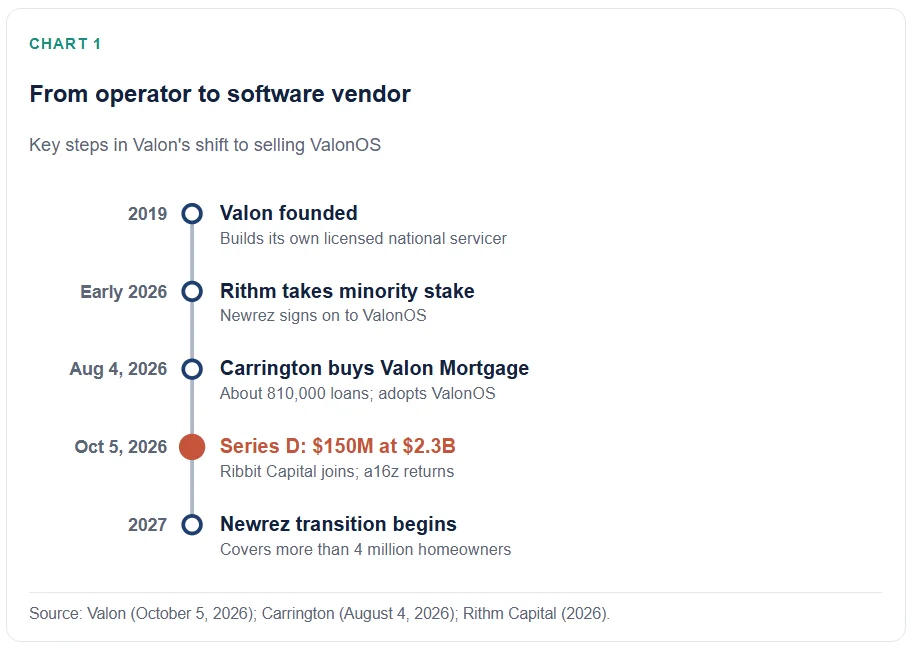
Valon took an unusual route. Founded in 2019, it built and ran its own licensed national servicer to prove the technology worked. Then, in August, Carrington completed its purchase of that business, Valon Mortgage. The plan, Du said, was to “operate a mortgage servicer, prove the technology in production” and then scale it.
That sale moved about 810,000 loans to Carrington, lifting its platform toward roughly 2 million loans. Crucially, Carrington will adopt ValonOS as its core servicing platform. The combined platform will cover conventional, Ginnie Mae, non-QM and private-label securities, plus closed-end second liens. As a result, Valon swapped a servicing book for a large software customer.
Rithm Capital signed on earlier this year. The asset manager took a significant long-term minority stake in Valon. Its servicer, Newrez, will deploy ValonOS for more than 4 million homeowners, starting in 2027. Rithm chief executive Michael Nierenberg said the tie-up aims to “modernize the $13 trillion mortgage servicing industry.”
A $13 Trillion Market on Old Rails
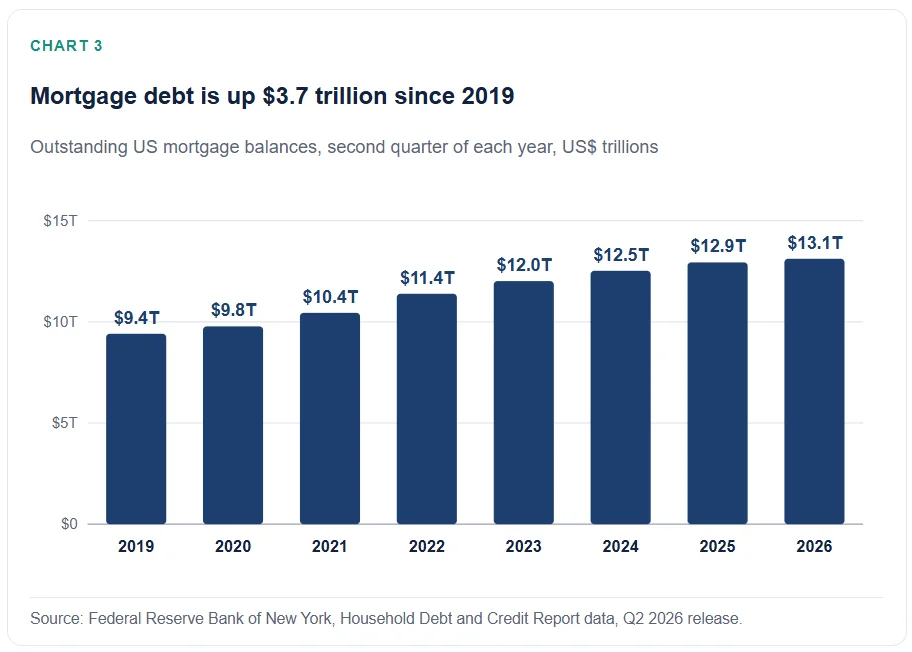
The prize is large. US mortgage balances stood at $13.1 trillion in the second quarter, the New York Fed reported. That is about 70% of all household debt of $18.8 trillion. Balances slipped $74 billion in the quarter but sat $182 billion above a year earlier. Lenders also originated $505 billion of new mortgages.

Each of those loans needs servicing for years. Servicers collect payments, manage escrow for taxes and insurance, and work with borrowers who fall behind. According to chief executive Andrew Wang, much of that work still runs on aging mainframe systems. Ribbit founder Micky Malka put it more simply: “A mortgage is the biggest bill most families will ever have.”
Complaints and Arrears Show the Pain
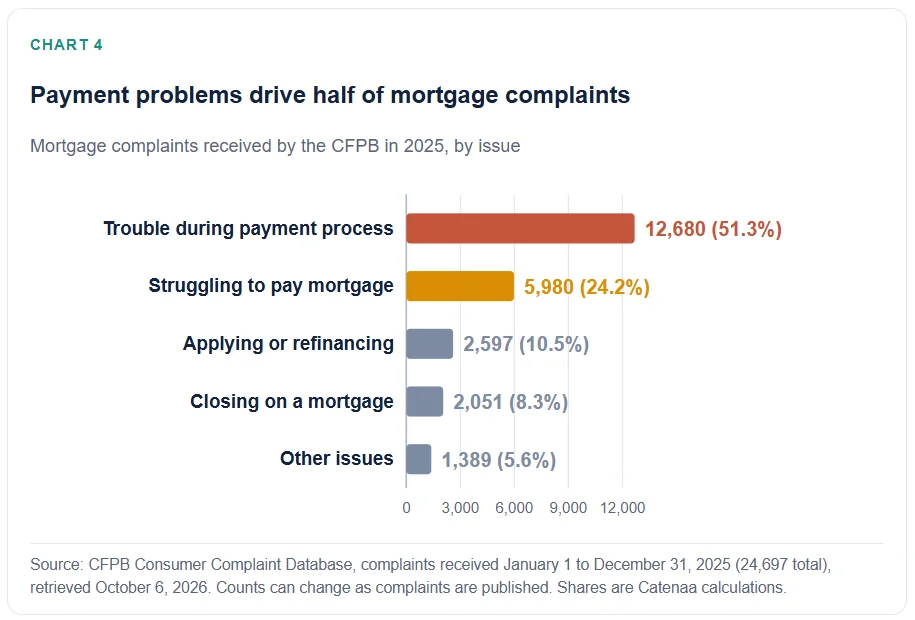
Consumer data shows where the friction sits. The CFPB’s complaint database logged 24,697 mortgage complaints received in 2025. “Trouble during payment process” was the top issue, with 12,680 complaints, or 51%. “Struggling to pay mortgage” came next with 5,980, roughly 24%. Notably, annual mortgage complaints have stayed between about 21,000 and 27,000 since 2019.
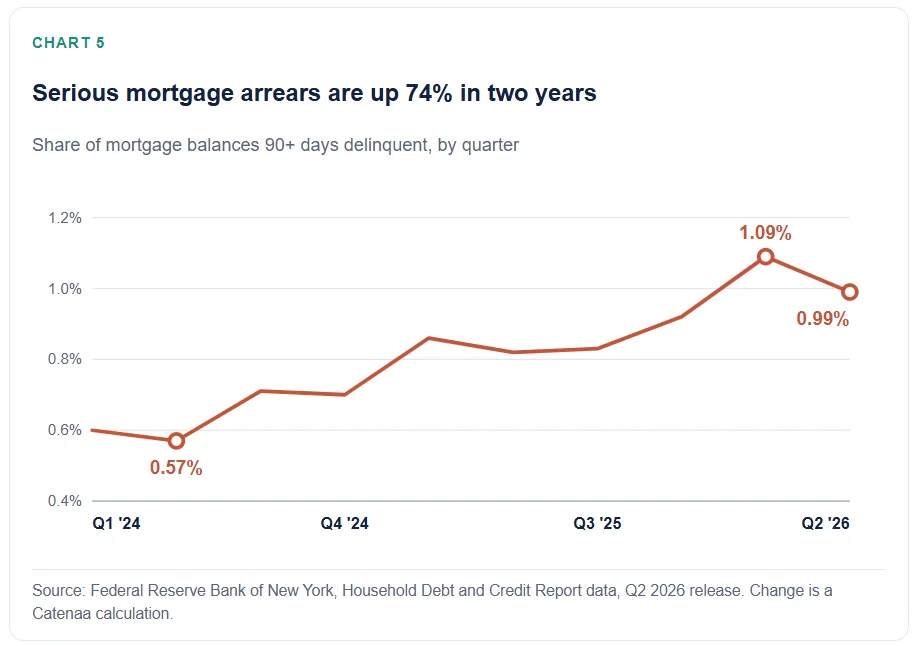
Arrears are also rising from a low base. The share of mortgage balances at least 90 days late reached 0.99% in mid-2026, New York Fed data show. Two years earlier, it was 0.57%. Late loans require calls, letters, and workout plans, so rising arrears add work for servicers.
What Could Slow It Down
Execution is the main risk. Moving millions of loans between systems is complex, and Newrez will not begin its switch until 2027. In addition, contracted revenue differs from revenue already earned, so the next year will test delivery. The announcement names only three clients outright: Newrez, Carrington and ServiceMac.
Even so, backers sound confident. Angela Strange of Andreessen Horowitz called servicing “the hardest, but also the stickiest” way into a major debt market. She added that Valon now stands ready to do the same in other asset classes.
For now, the Valon Series D gives the company cash and credibility. The real test is whether its biggest clients migrate on time. Investors will judge it on live loans, not signed contracts.