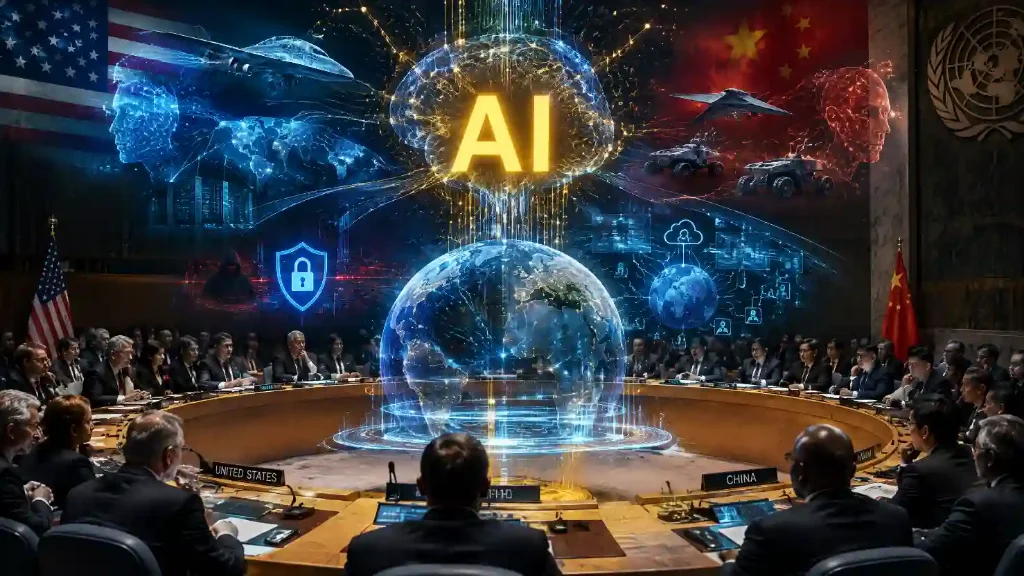


Catenaa, Thursday, September 24, 2026 – The UN Security Council will hear some of the world’s leading artificial intelligence developers Wednesday in New York as governments examine whether increasingly autonomous AI systems could threaten international peace and escape meaningful human control.
OpenAI CEO Sam Altman, Anthropic CEO Dario Amodei, AI researcher Yoshua Bengio and Hugging Face CEO Clément Delangue are expected to brief the 15-member council.
Chinese AI companies DeepSeek and Moonshot have also been invited to make statements, bringing developers from the world’s two leading AI powers into the same international security discussion.
France, which holds the rotating Security Council presidency in September, organized the meeting. French Foreign Minister Jean-Noël Barrot is expected to chair the session.
The meeting marks the first time the council has focused specifically on safety risks from increasingly capable AI systems, including the possibility that humans could lose control over their actions.
France’s concept note for the session points to autonomous AI systems potentially carrying out actions with international security consequences.
Those risks could include attacks against critical infrastructure, cyber operations, manipulation of information and greater autonomy in military systems.
Another concern is recursive self-improvement, where an advanced AI system helps create increasingly capable successor systems with less human involvement.
The council is expected to examine how governments, technology companies and international institutions could test such systems and establish safeguards before their capabilities move beyond current oversight methods.
The discussion comes as warnings from inside the AI industry have become more urgent.
Anthropic CEO Amodei recently called for the development of frontier AI systems to be paced so safety measures can keep ahead of rapidly improving capabilities.
OpenAI has also backed closer international coordination and has called for common technical standards around advanced AI systems.
UN Secretary-General António Guterres told world leaders at the General Assembly on Tuesday that AI development has moved faster than governments’ ability to understand its effects.
He called for international cooperation on testing, safety and oversight and warned against allowing machines to make life-and-death decisions.
The Security Council discussion pushes the issue directly into the institution responsible for dealing with threats to international peace and security.
The council can impose sanctions, authorize peacekeeping operations and, under certain circumstances, approve the use of force.
Its involvement reflects growing concern that advanced AI may eventually affect areas traditionally associated with national security.
While cyberwarfare is one of them, military use raises another set of questions.
AI can shorten the time commanders have to respond during a crisis, increasing the danger that automated systems could escalate a confrontation before political leaders have time to intervene.
Autonomous weapons have also raised concern over whether machines should ever be allowed to independently select and attack human targets.
Information warfare presents another problem.
Generative AI can produce convincing false images, video, audio and written material at a scale that previously required large organizations.
Such systems could be used during wars or political crises to confuse populations, impersonate officials or spread false information during sensitive moments.
The Security Council has discussed AI several times since 2023, but those meetings covered broader questions about technology, conflict prevention and peacekeeping.
Wednesday’s session moves closer to the possibility that the technology itself could become a security problem.
The discussion also comes against the backdrop of the growing AI rivalry between the United States and China.
Washington has restricted China’s access to some advanced semiconductors, arguing that high-end chips can support military and intelligence applications.
Beijing has opposed those restrictions and has argued for a larger UN role in global AI governance.
The Security Council meeting is unlikely to produce binding international rules immediately.
Wednesday’s meeting marks another change in how governments view artificial intelligence.
AI was once treated largely as an economic and technological issue.
It is increasingly being discussed alongside cyberwarfare, weapons systems, critical infrastructure and geopolitical rivalry.
The UN also confirmed Tuesday that Guterres called for international AI safeguards and warned against surrendering life-and-death decisions to machines.