

November 02, 2026 – Startups in travel raised $2.2 billion through September, and capital is pooling in a handful of companies as buyers chase AI tools.

In Summary
Travel tech funding reached $2.2 billion across 302 rounds in the first three quarters of 2026.
That is on pace for about $2.9 billion, less than a third of 2019’s $10.4 billion, by Catenaa’s estimate.
The five biggest raises, led by Mews at $300 million, took roughly 35% of the money.
Klook withdrew its US IPO filing, while Navan trades about 4% above its $25 offer price.
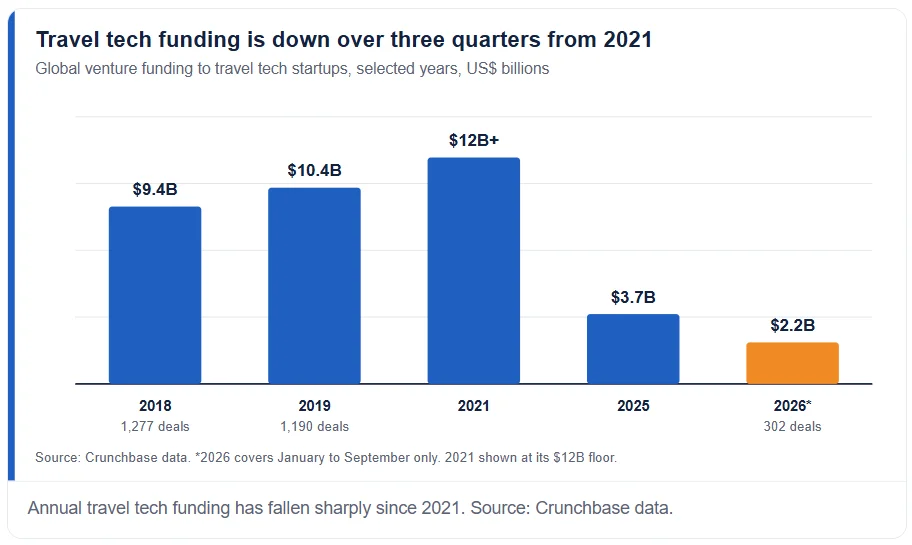
Travel tech funding is on track for its weakest year since at least 2018. Startups in the sector raised $2.2 billion across 302 rounds through September, according to Crunchbase data. That trails the $3.7 billion raised in all of 2025. Moreover, deal volume is heading for a third straight annual drop.
Travel Tech Funding Sits Far Below Its Peak
The gap with earlier years is stark. In 2018, travel startups raised $9.4 billion across 1,277 deals. A year later, the total rose to $10.4 billion from 1,190 deals. Funding then topped $12 billion in 2021.
At the current pace, 2026 would finish near $2.9 billion, by Catenaa’s estimate. That would be less than a third of the 2019 total. Still, the average round has barely moved. It works out to about $7.3 million this year, against $7.4 million in 2018.
Five Companies Took About a Third of the Money
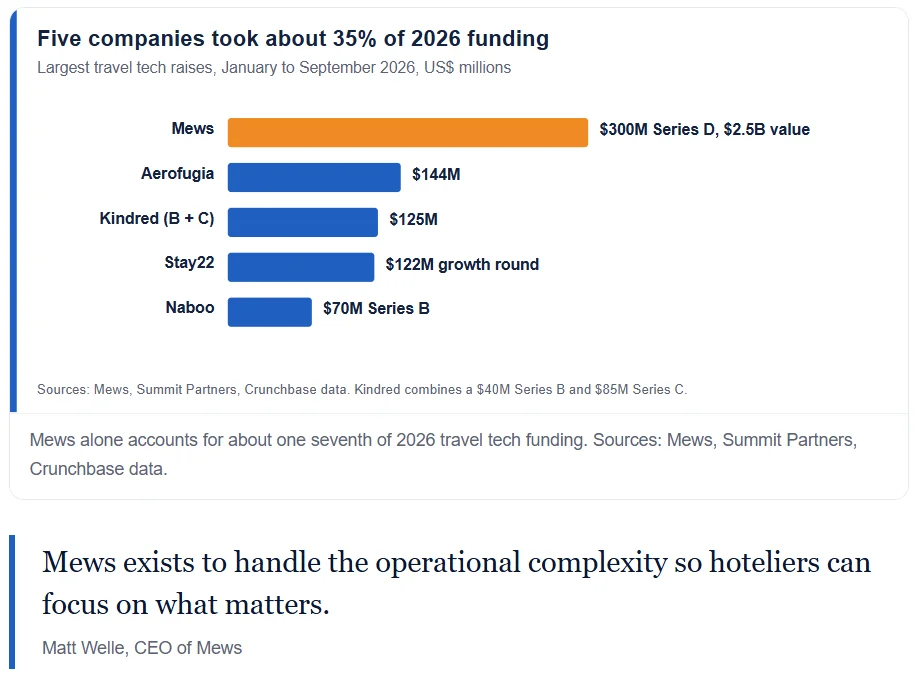
Capital is pooling in a few names. Hospitality software firm Mews raised the year’s largest round, a $300 million Series D at a $2.5 billion valuation. EQT Growth led the January deal. The company says it serves 15,000 customers in 85 countries. Its platform also handled $19.7 billion in transactions during 2025. Mews plans to spend the new money on AI agents, payments and growth in North America and Europe.
Meanwhile, Montreal-based Stay22 took a $122 million growth investment from Summit Partners in February. The firm builds booking tools for creators and publishers. It reported more than $1 billion in yearly transactions for 2025, and over 5,500 creators use its tools. Other large rounds went to electric aircraft maker Aerofugia, home swap platform Kindred and Paris events firm Naboo. Kindred, notably, announced a Series B and a Series C on the same day.
Together, the top five raised about $761 million. That equals roughly 35% of all travel tech funding this year.
AI Deals Arrive Through Buyouts
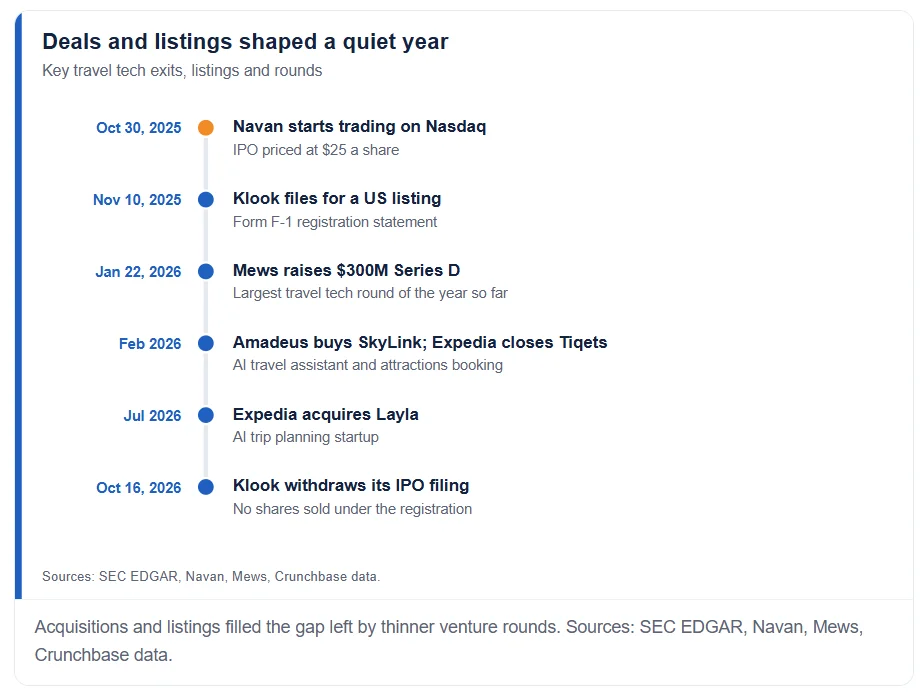
Large travel groups are also buying startups outright, including AI tools. Amadeus acquired corporate travel assistant SkyLink in February. Expedia completed its purchase of attractions booking site Tiqets that same month. In July, Expedia also bought Layla, an AI trip planning startup. That suggests some money for travel AI now arrives through acquisitions, not venture rounds.
Public Markets Send Mixed Signals
The listing window looks uneven. Klook, the Asian activities booking platform, filed for a US IPO on November 10, 2025. However, it asked regulators to withdraw that registration on October 16, 2026. The company said it “does not intend to conduct the public offering at this time.” It also confirmed it sold no shares.
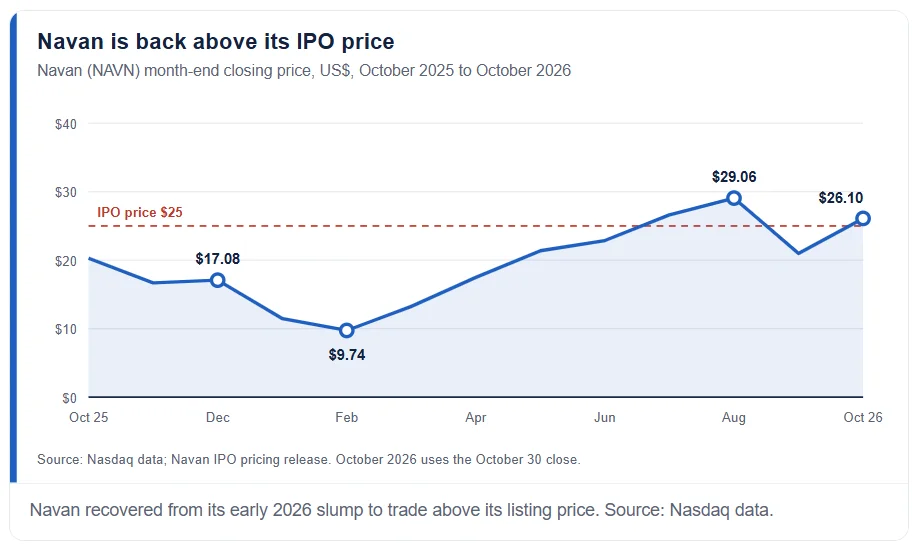
Navan tells a different story. The corporate travel firm priced its IPO at $25 per share in October 2025. Navan itself sold 30 million shares, raising $750 million before fees. Its stock slid to $17.08 by year end. It then hit a closing low of $8.51 on March 24, Nasdaq data show. Since then, the shares have staged a sharp rebound.
Navan closed at $26.10 on October 30. That leaves it up about 53% this year and roughly 4% above its offer price.
What Comes Next for Travel Startups
For founders, the signals point both ways. Investors still back travel firms with scale, payments revenue or a clear AI product. Yet overall deal flow keeps shrinking. On the other hand, the Navan rebound gives late stage firms a public benchmark. A Klook return to the market would show whether that window is truly open. Until more exits return cash to early backers, travel tech funding could stay thin.