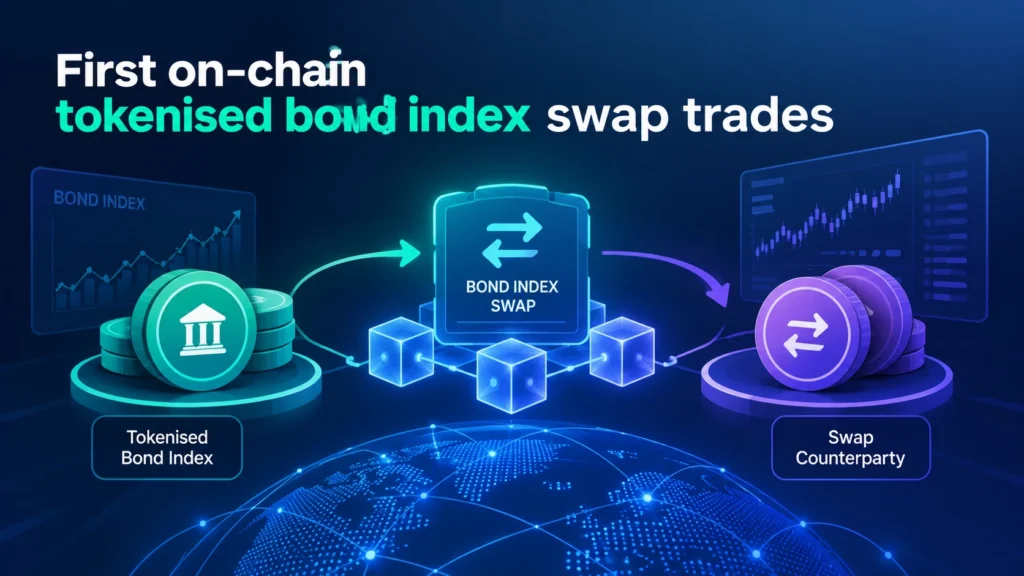


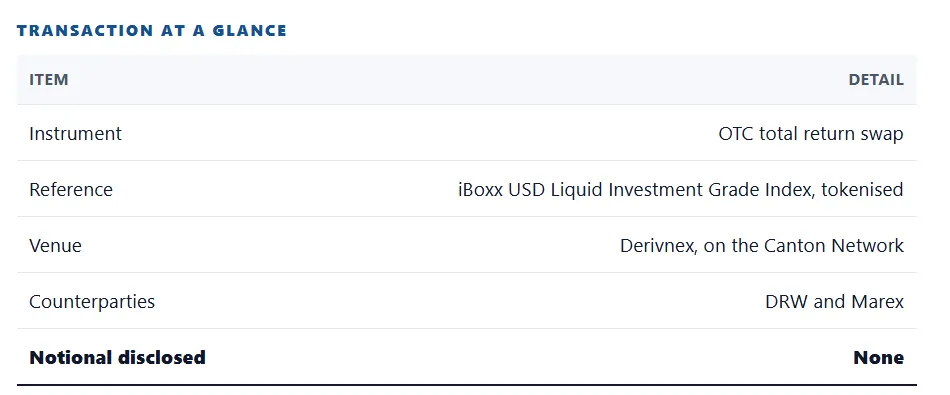
October 15, 2026 – DRW and Marex executed a total return swap on a tokenised iBoxx credit benchmark, with the trade written as a single smart contract on the Canton Network.
In Summary
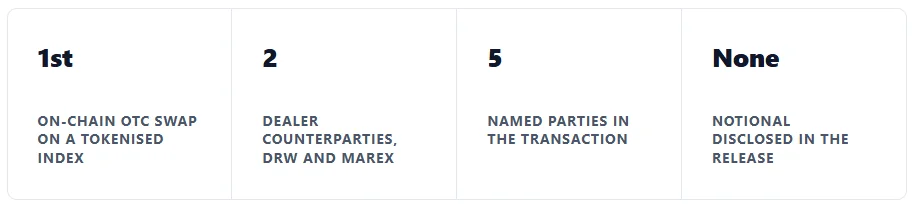
DRW and Marex traded the first OTC swap referencing a fully tokenised index on a distributed ledger.
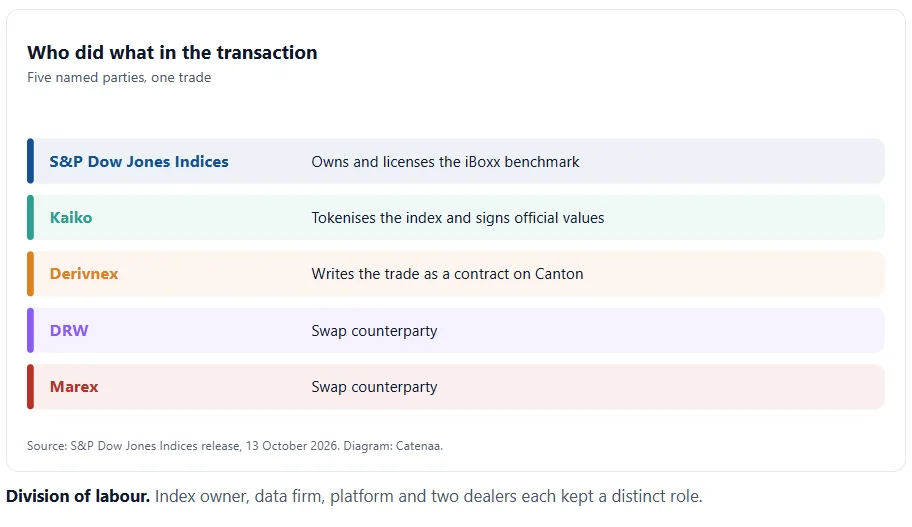
Kaiko tokenised the iBoxx USD Liquid Investment Grade Index on Canton and signs the official values.
Derivnex wrote the trade as one smart contract, so both sides share a single lifecycle record.
The platform uses the Common Domain Model, which eases mapping from existing dealer systems.
No notional, tenor or spread appears in the release, so the economic scale stays unknown.
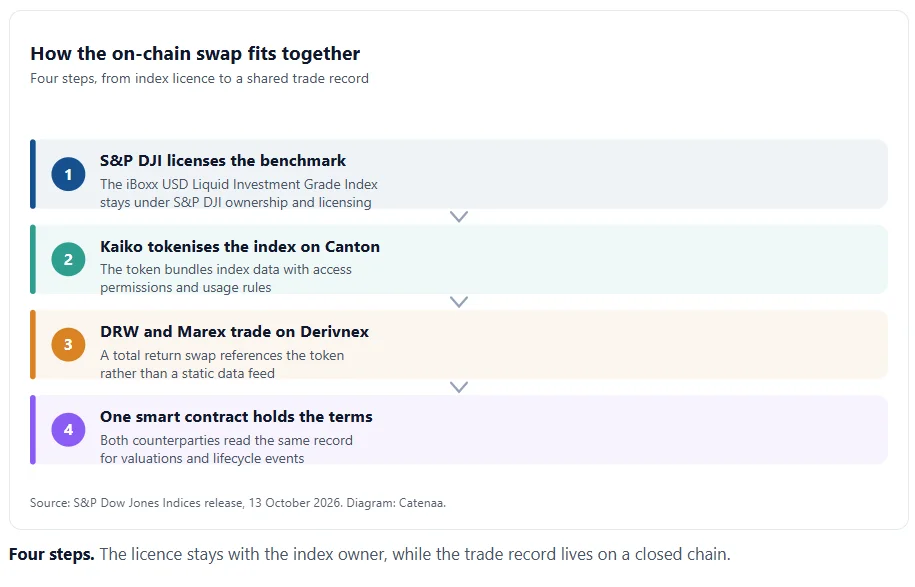
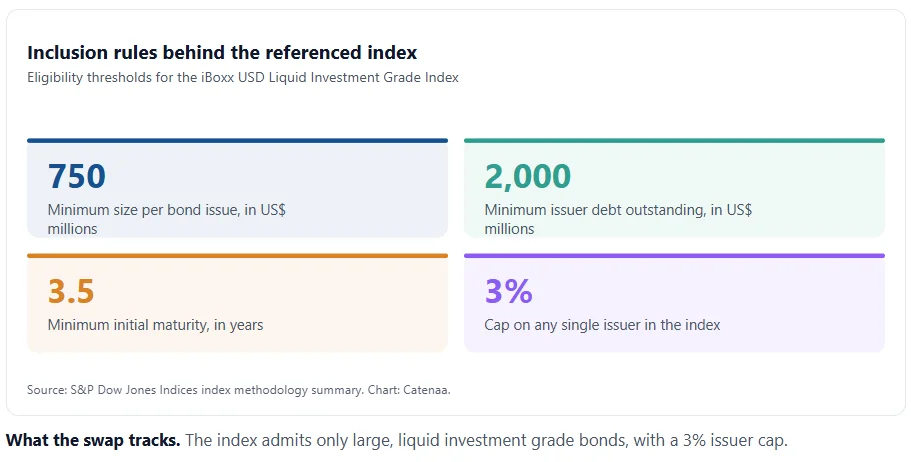
A tokenised bond index swap has traded for the first time on a shared ledger. S&P Dow Jones Indices announced the trade on 13 October 2026. They used Derivnex, a platform built on the Canton Network. The swap tracks the iBoxx USD Liquid Investment Grade Index. Kaiko turned that index into a token on Canton. Even so, S&P Dow Jones Indices still owns and licenses it.
Why this tokenised bond index swap matters
Index data normally reaches traders through feeds and licence deals. Here the index moves as a token. That token holds the data, the access rights and the use rules in one place. So approved users can pull an official level into a digital workflow. Yet the index owner keeps full control of its rights.
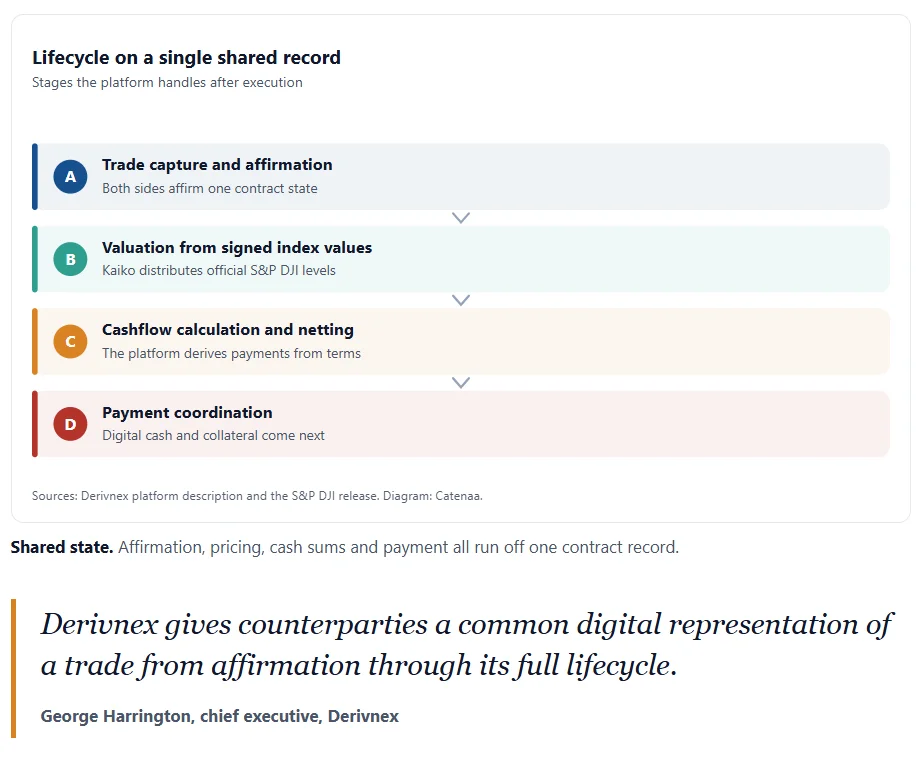
Kaiko also sends out the signed official index levels. Those levels price the trade for its whole life. As a result, both firms read the same numbers. Pricing fights then become much less likely.
One record, not two
Most swaps sit in two sets of books. Each side keeps its own copy of the terms. Matching the two then costs time and money. Derivnex writes the trade as a smart contract on Canton instead. Because the contract holds the terms, it travels with the trade.
The deal uses the Common Domain Model, an open market standard. That choice helps uptake, since firms already map their systems to it. Privacy also holds up. Canton runs as a closed network, so each pair sees only its own trade.
What the parties say
S&P Dow Jones Indices framed the trade as an extension of old plumbing. Its product chief, Cameron Drinkwater, said bond benchmarks can back new market setups. Kaiko chief Ambre Soubiran stressed rules and oversight. Token versions of a benchmark, she said, keep licence and control standards intact.
Marex kept the point practical. Nilesh Jethwa, who runs Marex Solutions, said swaps can run on shared ledgers with the checks big firms demand. Moreover, Marex sits between old and new markets, so the role fits.
The gaps worth watching
The release holds back the key numbers. No notional, no tenor and no spread appear in it. Readers cannot judge the size of the risk shift. One trade also shows that it can work, not that it will scale.
Cash still moves off chain for now. Derivnex says trades will later link to digital cash and collateral on Canton. Margin and payments could then run on the same rails. Until that lands, settlement leans on normal bank accounts.
Still, the drift looks clear. Index firms want a seat in on-chain markets. Dealers want cheaper back office work. Because both aims point the same way, more trades on token benchmarks look likely. For now, though, the market has one data point rather than a trend.




