


September 30, 2026 – The bank-owned operator of RTP and CHIPS picked Quant to link tokenised deposits to its payment rails. Launch is expected in the first half of 2027.
In Summary
The Clearing House selected Quant on 24 September to power its On-Chain Money Initiative.
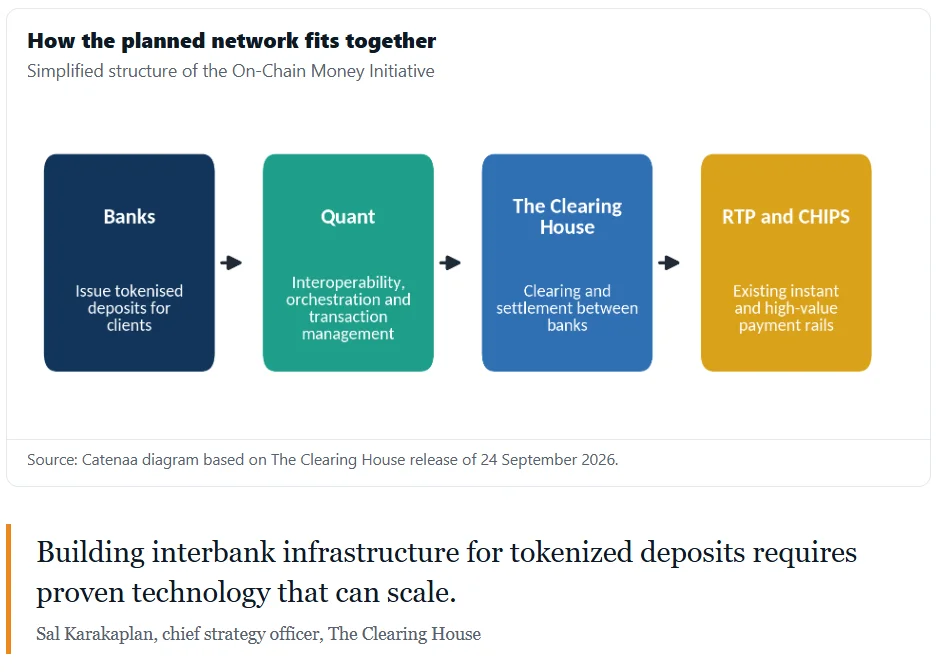
The network will let banks clear and settle tokenised deposits, linked to the RTP and CHIPS networks.
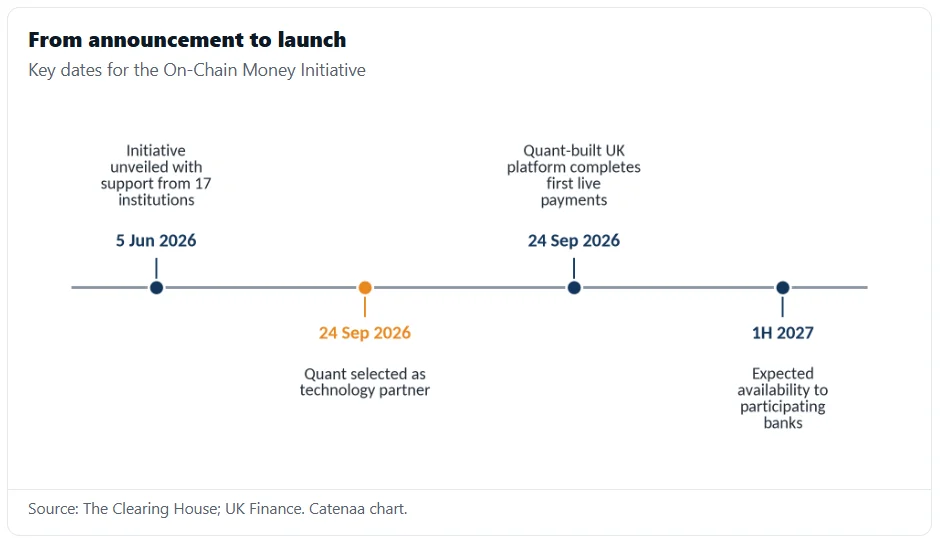
It is expected to open to participating institutions in the first half of 2027.
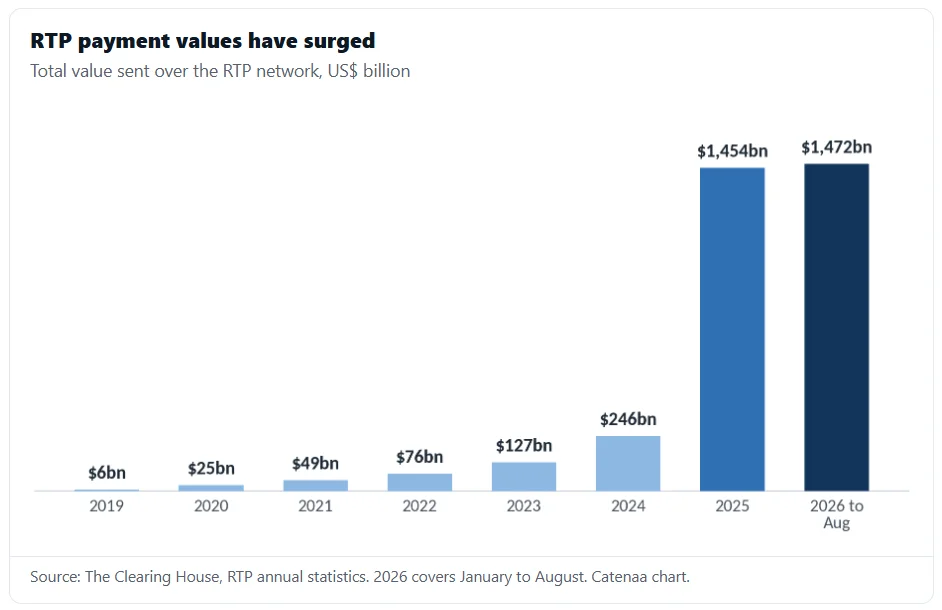
RTP carried $1.47 trillion in January to August 2026, already above its 2025 total.

The Clearing House has chosen Quant to power a new network for tokenised bank deposits in the US. The bank-owned payments company announced the partnership on 24 September.
According to the release, Quant will support the On-Chain Money Initiative. The network aims to let banks of all sizes clear and settle tokenised deposit transactions.
Quant will provide the interoperability, orchestration and transaction management layer. Crucially, it will also connect the system to The Clearing House’s existing RTP and CHIPS networks.
The network is expected to become available to participating institutions in the first half of 2027.
What The Clearing House is building
The initiative is not new. Known as TCH, the company unveiled it in June, with supporting statements from 17 financial institutions.
Those names included Bank of America, BNY, Citi, J.P. Morgan, PNC, U.S. Bank and Wells Fargo. Regional lenders such as Citizens, Fifth Third, KeyBank and Truist also took part.
TCH itself is owned by 25 of the largest US financial institutions. However, the September release did not name which banks will join the network at launch.
Target uses include corporate treasury, liquidity management, cross-border payments and digital asset settlement. In each case, the goal is money that moves on-chain but stays inside the banking system.
Why tokenised deposits matter to banks
A tokenised deposit is a digital version of a normal bank balance. It remains a claim on a regulated bank, so it keeps the protections of ordinary deposits.
Many banks see it as their answer to stablecoins. Stablecoins have grown quickly by offering fast, programmable dollar payments outside the banking system.
Tokenised deposits aim to offer similar speed and programmability. At the same time, they keep money on bank balance sheets, where it can support lending.
Interoperability is the hard part. If each bank builds its own token, they cannot easily pay one another. A shared network with common rules solves that problem.
The payment rails behind the plan
The Clearing House already runs major US payment systems. Its networks clear and settle more than $2 trillion each day, according to the company. The RTP network alone handled 142 million transactions worth $576 billion in the second quarter.
CHIPS, by contrast, handles large-value payments between banks, including many cross-border dollar transfers. Linking both rails gives the token network a route into everyday bank money.
RTP, short for real-time payments, launched in 2017. By August 2026, it had more than 1,357 participants and an average daily value of $6.6 billion.
Growth has been rapid. According to annual statistics, RTP value rose from $246.44 billion in 2024 to $1.45 trillion in 2025.
Average daily value tells the same story. It reached $3.98 billion in 2025 and has risen to $6.06 billion so far in 2026.
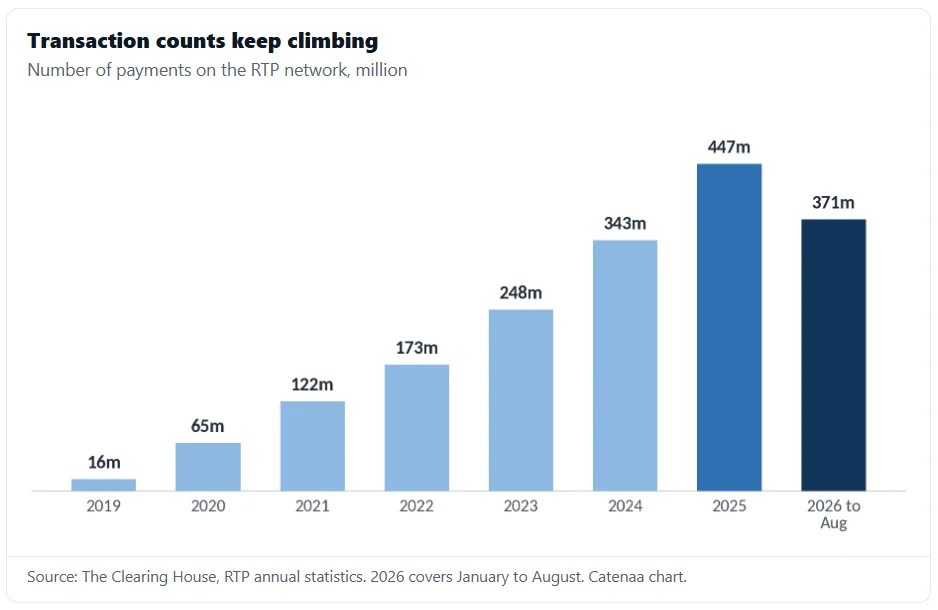
This year has already beaten that total. In the first eight months of 2026, RTP carried $1.47 trillion across 371 million payments.
The network now allows single payments of up to $10 million. On 1 May, it set daily records of 2.27 million payments worth $8.62 billion.
Since its launch, RTP has processed more than 1.7 billion transactions worth over $3.4 trillion in total, according to TCH.
Earlier records came in February. On 13 February, RTP handled 2.05 million payments, and on 18 February it moved $8.36 billion in a single day.
Quant’s growing role
For Quant, the deal is a major win. Gilbert Verdian, its founder and chief executive, spoke in the Quant release. He called tokenised deposits the de facto way banks move money on-chain.
The timing is notable. On the same day, UK banks completed their first live customer payments on a Quant-built platform for tokenised sterling.
As a result, Quant now sits behind bank-led tokenised deposit projects in both the US and the UK. We cover the UK milestone in our report on tokenised deposits at seven UK banks.
What to watch
Several questions remain open. Neither company disclosed financial terms, fees or the list of banks that will use the network first.
Regulation is another factor. Banks will need clear guidance from supervisors on how rules for capital, liquidity and deposit insurance apply to tokenised deposits.
Pricing and access will shape adoption. Smaller banks, in particular, will want low-cost access to compete with larger rivals.
For more on tokenisation and payments, follow our coverage. The Clearing House now has its technology partner, and the 2027 launch clock is running.