


October 05, 2026 – Spending on Visa cards linked to stablecoins grew nearly 200% in a year. Business cards now drive about a sixth of that volume.

In Summary
Visa says payments volume on its stablecoin-linked cards grew nearly 200% year on year.
About 17% of that card volume in fiscal 2026 came from business and commercial programs.
Allium counts $401 billion to $527 billion of stablecoin payments in the first eight months of 2026.
The figures are still small next to Visa’s core network, and Visa does not disclose card volume in dollars.
Stablecoin card spending is growing fast on Visa’s network. Payments volume across more than 160 stablecoin-linked card programs grew nearly 200% year on year, Visa said on October 1.
Businesses are a rising part of that story. About 17% of stablecoin-linked card volume in fiscal 2026 so far came from business and commercial card programs. Visa’s fiscal year ended on September 30. The programs span consumer, business, and commercial cards.
These cards let holders spend stablecoin balances at ordinary merchants. In practice, the shop still receives local currency, while the card program handles the conversion. For crypto-native companies, that turns treasury balances into spending power without a trip through a bank account.
How Fast the Stablecoin Card Market Is Growing
Visa did not publish the dollar value of stablecoin card spending, so the growth rate starts from an undisclosed base. Even so, the program count shows steady expansion.
In April, Visa counted more than 130 stablecoin-linked card programs in over 50 countries. By October, that figure had risen to more than 160, an increase of roughly 23%. At the same time, it added five blockchains for settlement: Arc, Base, Canton, Polygon and Tempo.
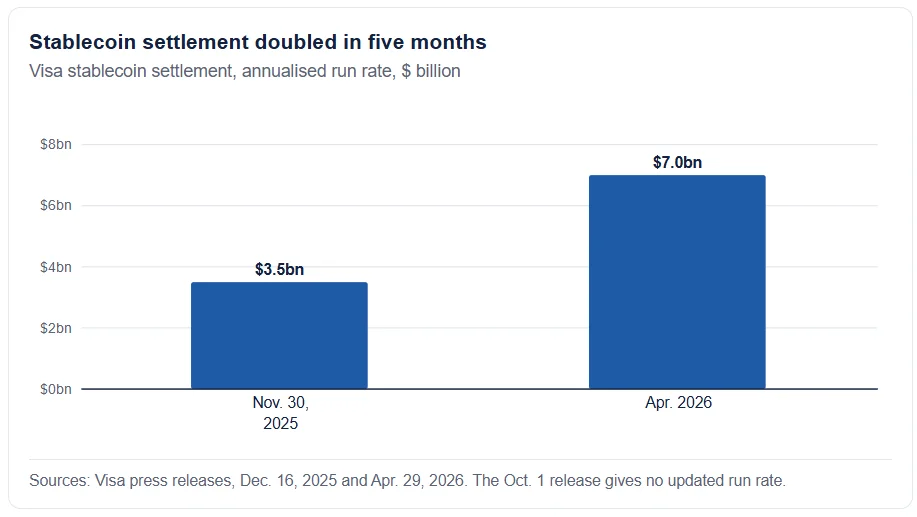
That took its settlement network to nine chains. Visa also said its stablecoin settlement had reached a $7 billion annualised run rate, up 50% from the previous quarter.
Rubail Birwadker, a Visa executive, explained the multi-chain approach. “Our partners are building in a multi-chain world, and they expect their options to reflect that reality,” he said.
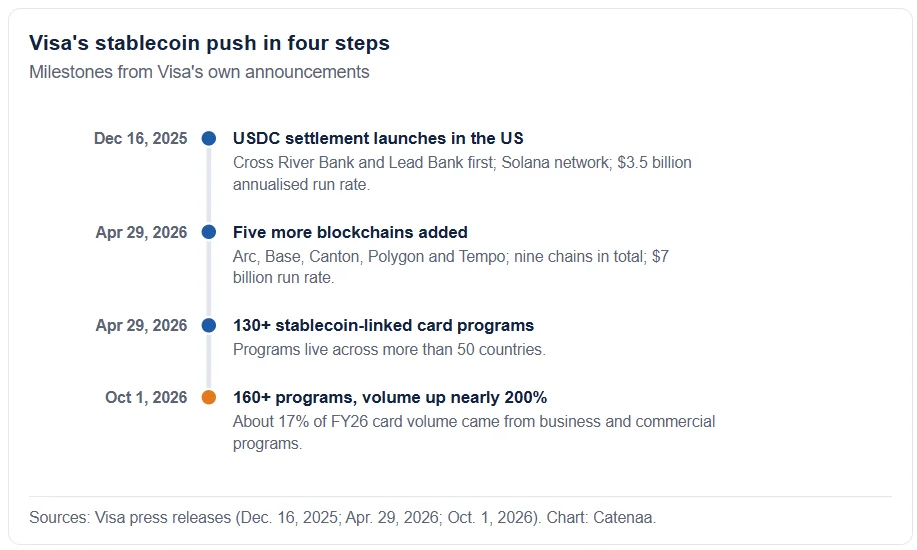
The settlement push began in the United States last December. Visa then launched USDC settlement for US issuers and acquirers, starting with Cross River Bank and Lead Bank on Solana.
At the time, the annualised run rate stood at $3.5 billion. In other words, settlement volume doubled within roughly five months. Visa’s October release, however, did not update that run rate.
What the Allium Data Shows
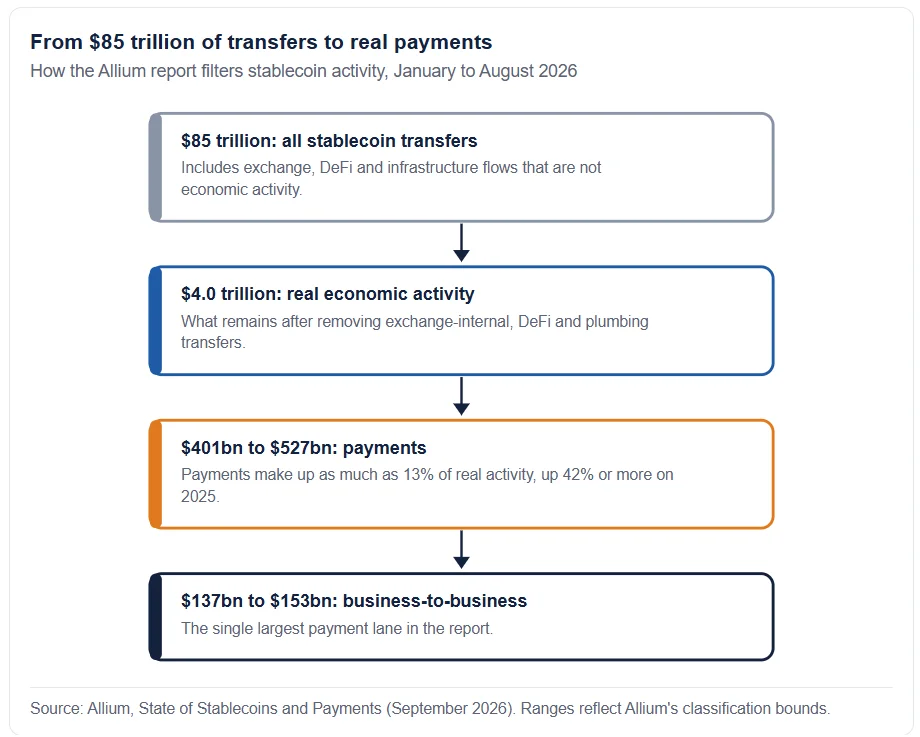
The October release leaned on research from blockchain data firm Allium. Its State of Stablecoins and Payments report counts $401 billion to $527 billion in stablecoin payments. That total covers the first eight months of 2026.
One detail matters here. Visa’s release describes that range as annual payment volume, but Allium’s report covers January to August only. Either way, Allium says payments grew 42% or more in 2025.
Allium started from $85 trillion of total stablecoin transfers. It then stripped out exchange, DeFi, and infrastructure flows, leaving $4.0 trillion of real economic activity. Payments made up as much as 13% of that.
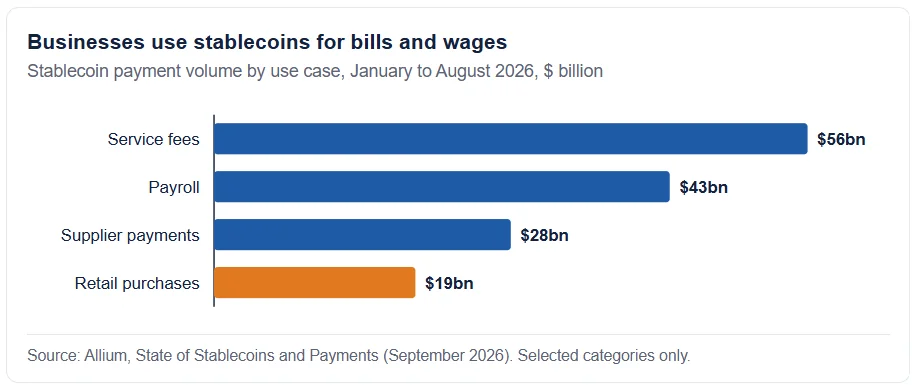
Corporate uses led the way. Service fees accounted for $56 billion, payroll for $43 billion, and supplier payments for $28 billion. Retail purchases, by comparison, came to $19 billion.
Business-to-business settlement was the largest single lane, at $137 billion to $153 billion. Moreover, 43% of business-to-business transfers crossed borders, the highest share of any category.
Businesses also sat on the receiving end of most activity. They took in 58% to 64% of all stablecoin payments, according to Allium. Thailand, Turkey, Indonesia and Mexico led emerging markets by payments received.
Cross-border growth stands out most. Allium says stablecoin cross-border payments grew 64% in 2025, compared with 9% for conventional fiat transfers. That gap explains why card networks want a share of the flow. Still, most payments stay at home: domestic transfers made up 61% of the volume Allium could map to a country.
Why It Matters for Visa
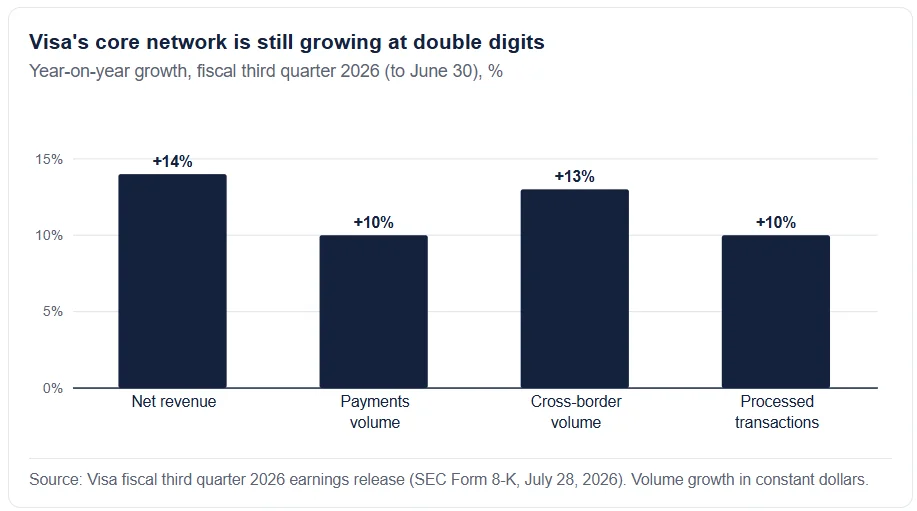
Stablecoin cards remain small beside Visa’s core business. In its fiscal third quarter, Visa’s net revenue rose 14% to $11.6 billion. Payments volume grew 10%, and cross-border volume rose 13%. GAAP net income climbed 7% to $5.6 billion, and Visa returned $6.2 billion to shareholders through buybacks and dividends.
Still, the strategy has a clear logic. By issuing cards and settling in stablecoins, Visa can capture spending that might otherwise bypass card networks entirely.
There is a defensive angle too. If businesses settle more invoices on-chain, card networks risk losing fees. Stablecoin card programs keep Visa in the transaction, even when the money starts on a blockchain.
The next test is disclosure. Investors will want dollar figures for stablecoin card volume, not just growth rates. Visa reported last year’s fiscal fourth quarter on October 28, so new numbers could arrive within weeks.