


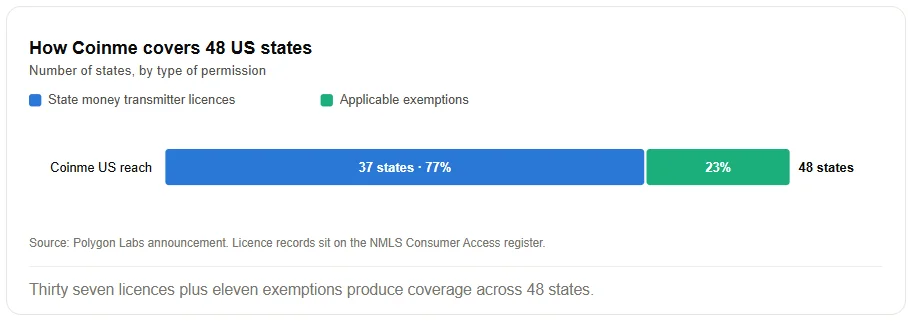
October 15, 2026 – Polygon Labs published its Open Money Stack and closed the Coinme deal, picking up 37 state licences and coverage across 48 US states.

In Summary
Polygon Labs published Open Money Stack and completed its acquisition of Coinme on 14 October.
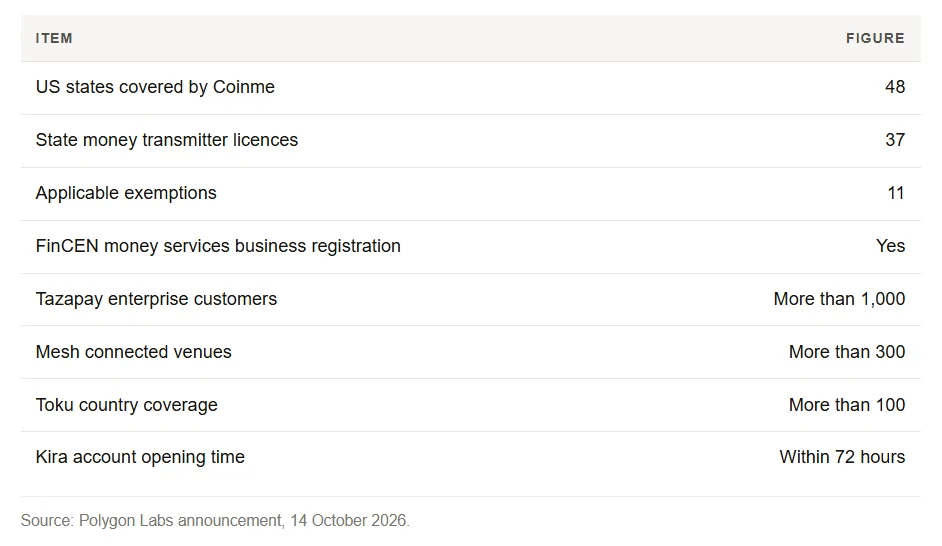
Coinme brings 37 state money transmitter licences, 11 exemptions and coverage of 48 US states.
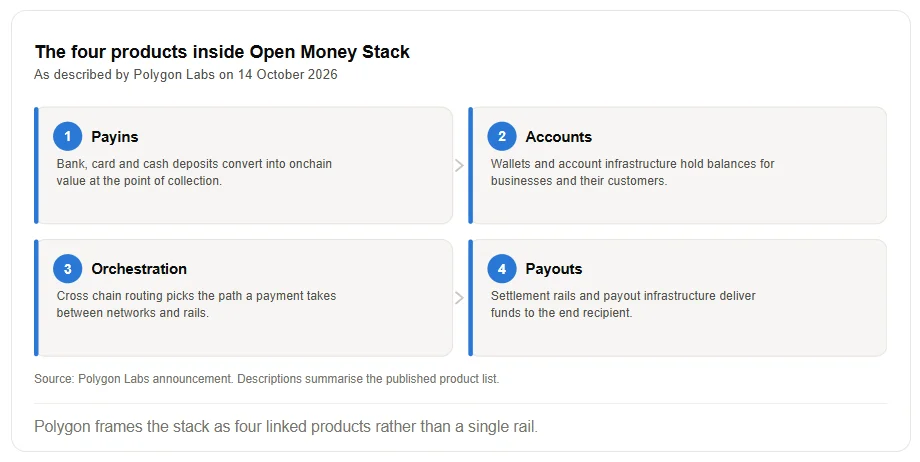
The stack has four products: Payins, Accounts, Orchestration and Payouts.
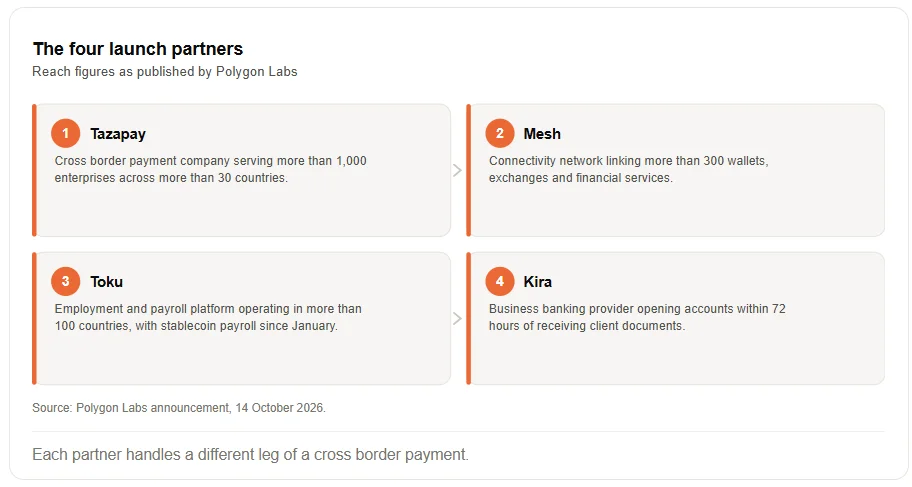
Tazapay, Mesh, Toku and Kira went live as the first named partners.
Polygon carried about $2.88bn of dollar stablecoins, ranking eighth among networks.
Polygon Labs has moved into regulated payments. The company published its Open Money Stack on 14 October. On the same day, Polygon closed its purchase of Coinme. That deal buys licences, not code.
Licensing explains the logic. Coinme covers 48 US states. It holds 37 state money transmitter licences, plus 11 exemptions. The firm also holds a money services registration with the Financial Crimes Enforcement Network. Such approvals take years to collect.
What Polygon actually built
The stack has four parts. First, Payins turn bank, card and cash deposits into onchain value. Second, Accounts hold the balance that results. Third, Orchestration picks the route a payment takes. Finally, Payouts deliver the funds.
Each piece targets a known snag. Stablecoins already move fast between wallets. Yet getting money in and out of banks stays slow. So the licensed on ramp matters more than the chain itself.
Naming matters here too. Polygon calls the stack open, which means other firms can plug in. In short, the pitch is a toolkit rather than a single closed service.
Four partners went live first
Polygon named four launch customers. For example, Tazapay serves more than 1,000 firms in over 30 countries. Likewise, Mesh links more than 300 wallets, exchanges and finance apps. Toku, meanwhile, runs payroll systems across more than 100 countries.
Kira rounds out the group. The firm opens US dollar accounts within 72 hours of getting client papers. It also backs ACH, Fedwire, SWIFT and the FedNow Service. Those rails tie token balances to plain bank payments.
Payroll shows the pattern well. Toku has run stablecoin payroll since January. However, paying a worker still needs local tax and labour rules. Therefore the hard part sits off chain, in law rather than code.
Scale remains the open question
Still, Polygon starts from a modest base. The chain held about $2.88bn of dollar stablecoins on 14 October, per DefiLlama chain data. Ethereum held roughly $144bn. Tron carried about $95bn, while Polygon ranked eighth.
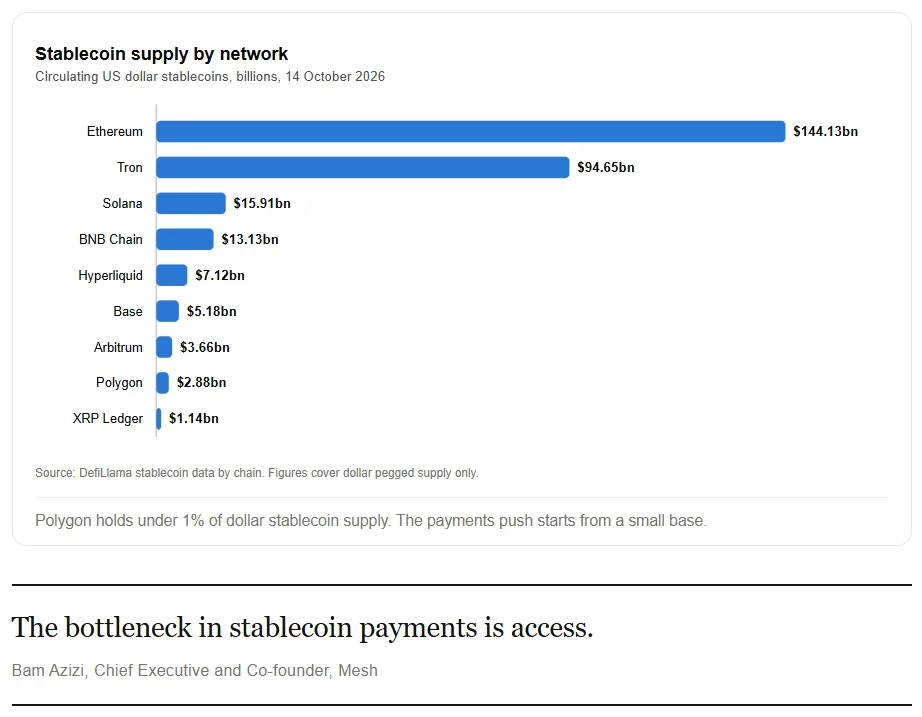
Supply is not the same as use, though. Payment rails can turn over a balance many times a day. So a small float can still carry large flows. Polygon gave no volume or fee figures, which leaves the real test ahead.
Why the licence stack matters
By now, licensed reach has become the real moat. Furthermore, each state licence demands capital, audits and staff. Records sit on the NMLS Consumer Access register. Buying a licensed operator skips that queue.
Rivals have reached the same view. Card networks, exchanges and fintech firms all chase stablecoin flows. Yet few hold a 48 state footprint. That asset now sits inside Polygon Labs.
Timing helps as well. Dollar stablecoin supply stood near $303bn across all chains on 14 October. In other words, the pool is large and still growing. Also, bank rails now settle in seconds through FedNow.
Two markers will show whether this works. First, watch stablecoin supply on the chain. Second, watch whether the named partners publish volume data. Until one of those moves, the licence count remains the only hard number.




