

October 09, 2026 – The open standard lets personal AI agents sign in to businesses with customer-approved permissions, joining a crowded field of agent commerce rules.

In Summary
Meta and Sierra launched the Personal Agent Protocol, an open standard for how personal AI agents deal with businesses.
Customers choose read-only or write access, sessions run on OAuth, and companies set limits on what agents can do.
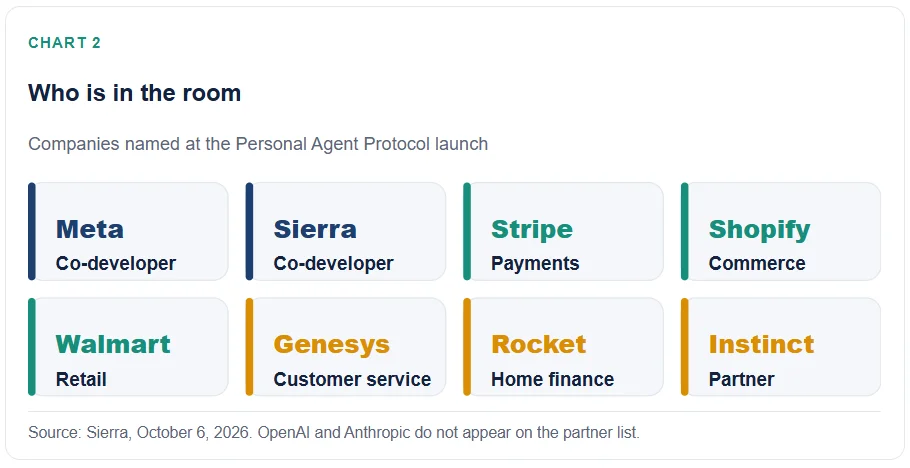
Stripe, Shopify, Walmart, Genesys, Rocket and Instinct are named partners; OpenAI and Anthropic are not.
The protocol joins Stripe and OpenAI’s ACP, Visa’s TAP and Google’s UCP in a crowded field.
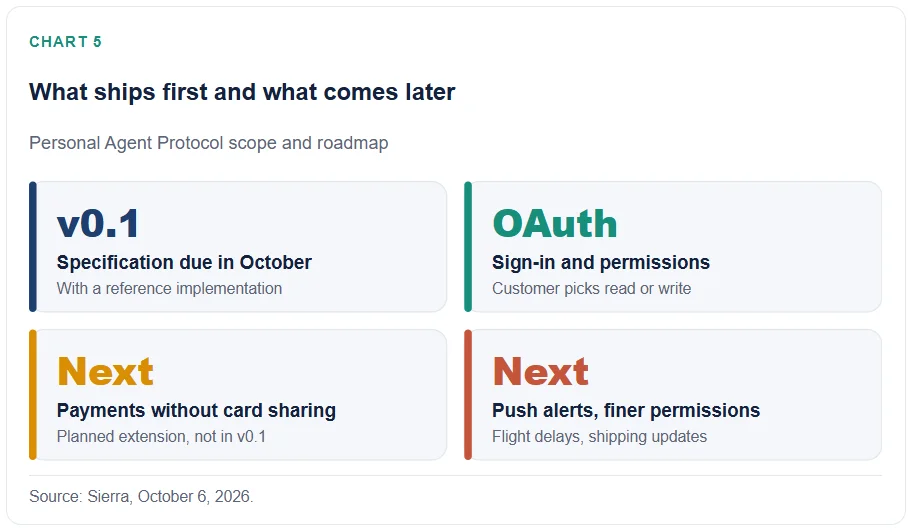
A v0.1 specification is due later in October; payments and push alerts are planned extensions.
Meta and Sierra want to give AI shopping agents a common front door. The two companies unveiled the Personal Agent Protocol on October 6. It is an open standard for how personal agents deal with businesses. Stripe, Shopify and Walmart are among the early partners.
What the Personal Agent Protocol Does
Today, most personal agents browse websites the way people do, according to Sierra’s announcement. When that fails, they fall back on phone lines or web chat. That process is slow and often leaves the task unfinished, the company argues.
Each side wants something different. Consumers want speed and an agent that acts in their interest. Brands want to see what agents do and control it. Agent builders, meanwhile, want one consistent way to work with many companies.
The Personal Agent Protocol aims to replace that guesswork with a direct, secure connection. Sierra co-founders Bret Taylor and Clay Bavor say a task could then finish in seconds. Notably, Sierra itself builds customer-service agents for companies, so it sits on the business side of these exchanges.
How the Sign-In Works
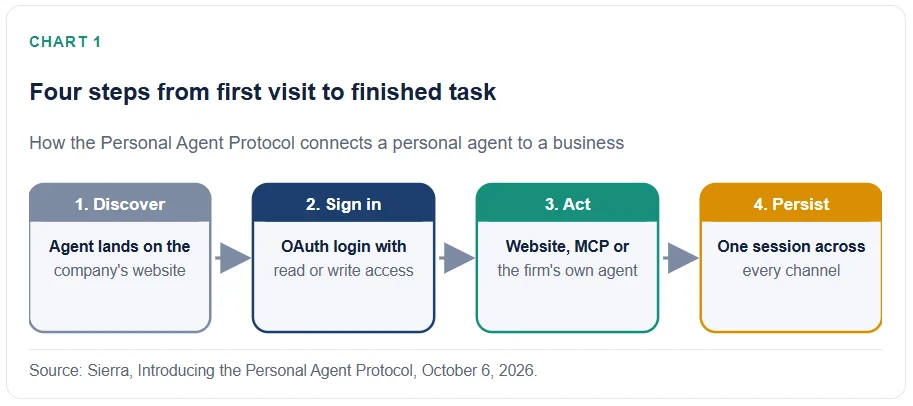
The design puts both sides in control. Consumers decide what access their agent gets, while companies set limits on what agents may do. A session starts on the company’s website, where the agent learns what the business offers.
For simple questions, such as a returns policy, guest access may be enough. Account tasks need more, so the customer signs in or uses credentials stored with the agent. They then choose read-only or write access.
Sessions run on OAuth, the login standard behind many “sign in with” buttons. They also persist across channels, so activity before and after sign-in counts as one visit. Agents can then act through the website, through APIs using standards such as MCP, or through the company’s own agent.
Who Is Backing It
Besides Meta and Sierra, the launch names Genesys, Instinct, Rocket, Shopify, Stripe and Walmart. Notably, OpenAI and Anthropic do not appear on the list.
Partners framed the stakes in their own terms. “Personal AI is creating a new front door to the enterprise,” said Genesys chief executive Tony Bates. Shopify’s Mani Fazeli said the protocol helps set how agents and merchants work together. Rocket’s Shawn Malhotra added that “the next era of AI is about persistent agents taking action.”
Meta has its own reason to care. Last month it launched Muse for Small Business, extending its personal AI agent with tools for running a company. Muse links to services such as Shopify, Stripe and QuickBooks, and it acts only with the owner’s approval. The agent is available in the US and Canada, and it is free for most uses.
A Crowded Field of Agent Standards
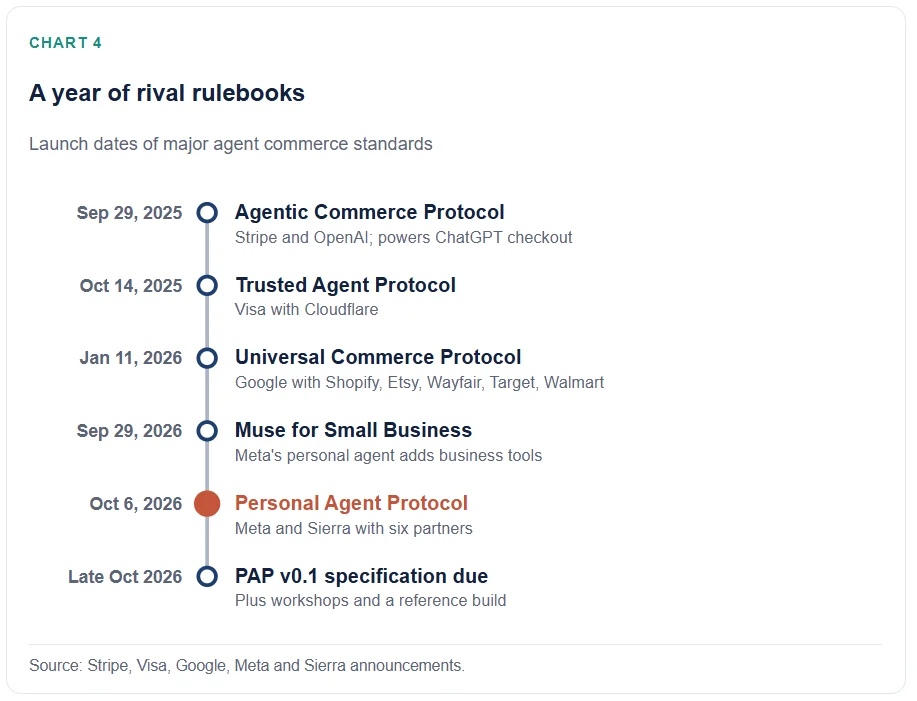
Still, the new protocol joins several rivals. In September 2025, Stripe and OpenAI released the Agentic Commerce Protocol, which powers checkout inside ChatGPT. Businesses that do not use Stripe can still adopt it, Stripe says. Two weeks later, Visa launched its Trusted Agent Protocol with Cloudflare. Visa said AI-driven traffic to US retail websites had jumped more than 4,700% in a year.
Then, in January, Google introduced the Universal Commerce Protocol with Shopify, Etsy, Wayfair, Target and Walmart. More than 20 other organizations endorsed it, Google said. As a result, Stripe, Shopify and Walmart now appear in at least two standards each.
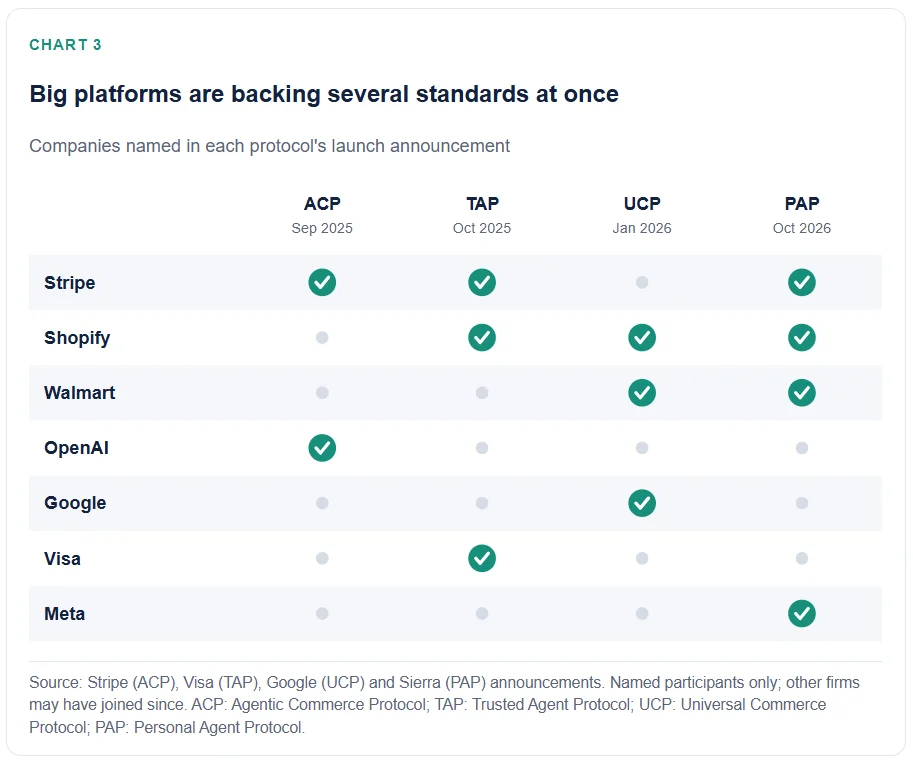
The focus differs, however. Earlier efforts center on checkout and payments. By contrast, the Personal Agent Protocol starts with identity and permissions, and leaves payments for later.
For payment firms, the stakes are high. If agents shop for consumers, whoever controls sign-in and checkout sits close to the money. That helps explain why Stripe has joined three of the four standards.
What Comes Next
Sierra plans to publish a version 0.1 specification later this month, along with design workshops and a reference build. Future extensions could add finer permissions and push alerts, such as flight delays.
Payments are on the list too. Specifically, the partners want agents to complete purchases without sharing card details. Until then, the Personal Agent Protocol is a sign-in standard, not a checkout system.
The bigger question is adoption. Businesses must decide which standards to support, and agent makers must decide which to speak. For retailers, the safest bet may be to support several at once. In the meantime, early partners will shape the rules everyone else follows.