


October 21, 2026 – Meta now represents every advert, product and page as a short string of shared tokens rather than a private identifier. The published gain is 0.35 percent more conversions, on a business earning $59bn a quarter.

In Summary
Meta now represents each advert, product, page and pixel as a short sequence of tokens from a stable semantic vocabulary rather than a dedicated identifier.
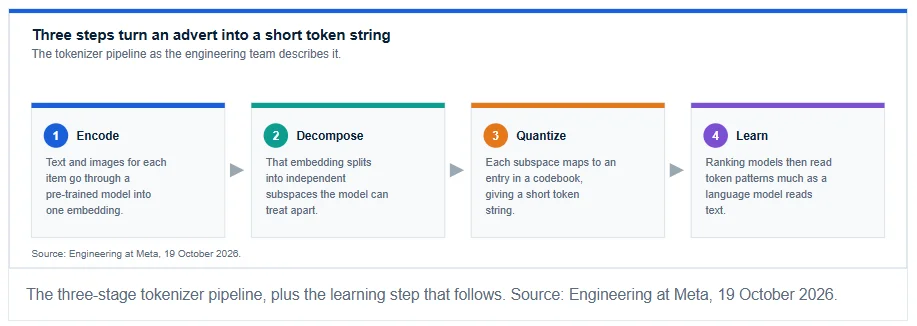
The tokenizer encodes an item into an embedding, decomposes that into independent subspaces, then maps each subspace to a codebook entry.
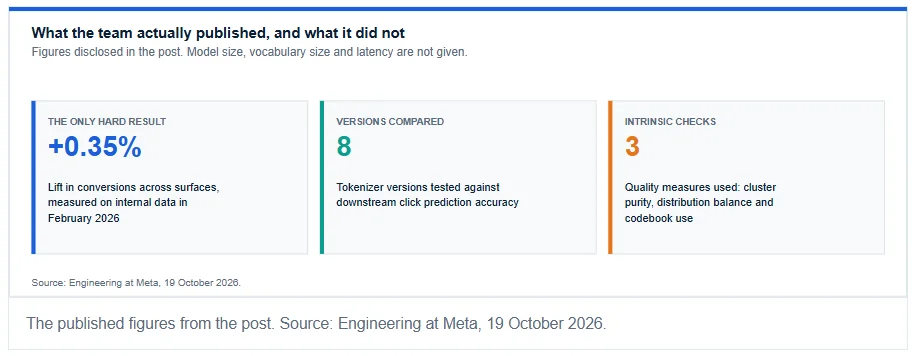
Meta scores tokenizers on cluster purity, distribution balance and codebook use, and says those measures tracked click prediction accuracy across eight versions.
The only published result is a 0.35 percent lift in conversions across surfaces, measured on internal data in February 2026 alongside two other models.
Meta reported $59.36bn of advertising revenue in the second quarter of 2026, up 27.5 percent year on year on Catenaa calculations.
Meta has changed how its ad ranking models see the world. Each advert, product, page and pixel now carries a short string of shared tokens. The old approach gave every item its own private identifier.
The shift sounds small. Yet it targets the oldest weakness in recommendation systems.
The cold start problem in ad ranking
A new advert has no history. So a model built on per-item identifiers has little to work with, and ranks it poorly.
Campaign churn makes it worse. Advertisers rotate creative constantly, so fresh items arrive faster than history can build.
Tokens change that. Because they describe what an item is, the model can relate a new advert to ones it knows well. Furthermore learning carries across campaigns, from last season’s shoe to this season’s.
How the tokenizer works
Three steps do the job. First a pre-trained multimodal model turns text and images into one embedding. That embedding then splits into independent subspaces.
Finally each subspace maps to a codebook entry. The result is a short token string that ranking models read like language.
Measuring the tokenizer itself
Testing a tokenizer used to mean training a full model. Meta now scores three traits first: cluster purity, distribution balance and codebook use.
Across eight versions those scores tracked click prediction accuracy closely. Therefore the team can iterate in hours rather than training cycles.
There is a flywheel in the design. Better guesses on thin, low-impression adverts produce better training signal from those same adverts. In turn that lifts every advert in the system.
What the numbers do and do not say
One result is public: a 0.35 percent lift in conversions across surfaces. Meta measured it on internal data in February 2026, paired with two other models.
Much stays hidden. The post gives no model size, no vocabulary size and no latency figure. So nobody outside the company can check the gain.
The framing matters too. Meta reports a conversion lift, not a revenue lift, and the two differ. Therefore turning 0.35 percent into a dollar figure would overstate the claim.

Why a third of a percent matters
Scale is the answer. Meta booked $59.36bn of advertising revenue in the second quarter, up 27.5 percent year on year, on Catenaa sums.
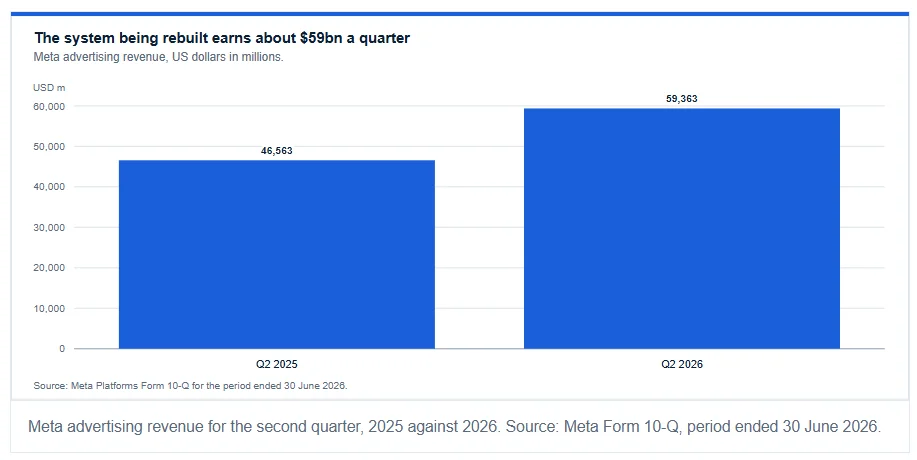
Small percentages move real money at that size. However the lift counts conversions for advertisers, not revenue for the platform.
Volume and price both rose. Impressions grew 14 percent and average price per ad 12 percent, against 3.60 billion daily users in June.
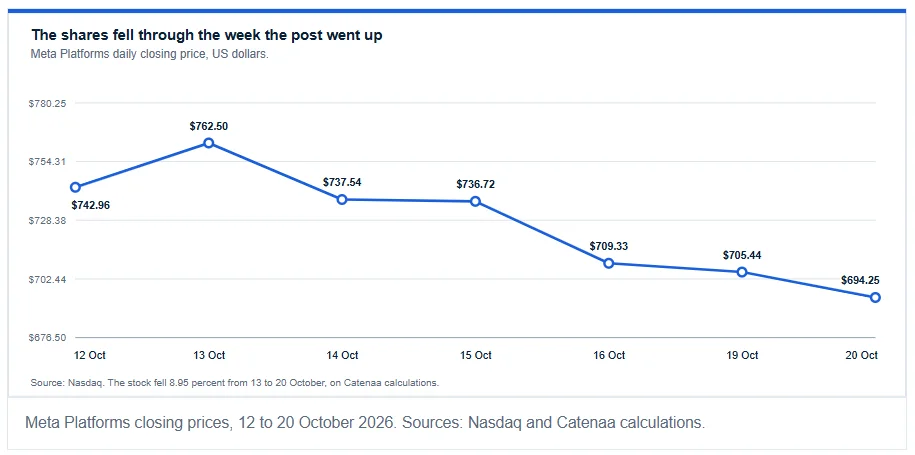
Investors were less cheerful. The shares closed 20 October at $694.25, down 8.95 percent in five sessions, on Catenaa sums.
The direction of travel is clear enough. Meta wants one shared vocabulary across text, image, audio and video. Until then, serving costs cap how far the idea can run.
Context helps here. An earlier post reported larger wins, with 5 percent more conversions on Instagram from the companion model. Tokenization adds to that base rather than replacing it.