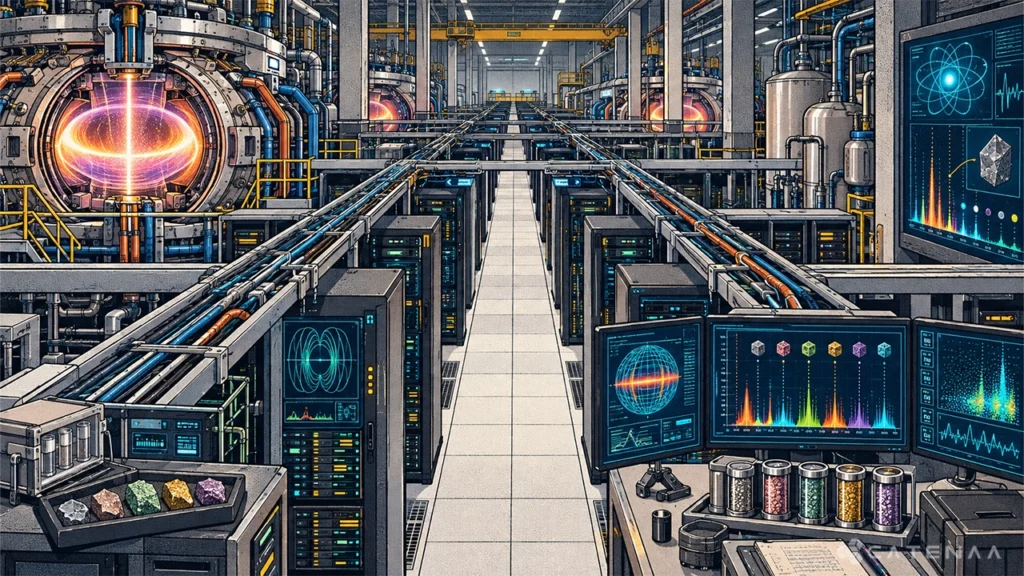


Catenaa, Wednesday, September 16, 2026- Indian deep-tech startup Hylenr Technologies has reported signatures of 32 elements in material samples from its experimental lattice-confinement fusion system, raising the possibility that nuclear processes could eventually be used to produce strategic materials.
The Hyderabad-based company said the detected elements included light and heavy elements, noble gases such as helium, neon and argon, the rare-earth element yttrium and uranium.
Hylenr said the findings followed more than two years of material analysis linked to its work on low-energy nuclear reactor technology.
The company cautioned that the results remain preliminary and have not yet been peer-reviewed.
Hylenr said the observations could point toward an alternative route to nucleosynthesis, the process through which new atomic nuclei are formed from existing protons, neutrons and nuclei.
In nature, nucleosynthesis occurs under extreme conditions inside stars, stellar explosions and other high-energy environments.
Reproducing such processes on Earth normally requires large reactors, particle accelerators or other energy-intensive facilities.
Hylenr is attempting a different approach.
Its experimental system uses hydrogen-loaded metal lattices designed to create highly confined environments inside solid materials.
The company believes interactions involving hydrogen, defects in the lattice, vacancies and surrounding electrons may create conditions that enable nuclear reactions.
Hylenr said post-operation samples showed elemental signatures that were not present at the same levels in pre-operation baseline samples.
The company said each reported signature was examined using more than one analytical technique.
Those methods included energy-dispersive X-ray spectroscopy, X-ray photoelectron spectroscopy, inductively coupled plasma optical emission spectroscopy, wavelength-dispersive X-ray spectroscopy and residual gas analysis.
The company said the combination of techniques was intended to reduce the risk that the detected signals resulted from a single measurement method.
However, identifying elemental signatures does not by itself prove that the elements were created through nuclear transmutation.
Independent replication and peer-reviewed analysis would be required before such a conclusion could gain broad scientific acceptance.
If confirmed, the findings could have implications beyond energy production.
Rare-earth elements are essential to technologies including electric vehicles, wind turbines, robotics, electronics, aerospace systems and defense equipment.
Their supply chains are highly concentrated geographically, making access to some materials an economic and strategic concern.
Hylenr argues that engineered nucleosynthesis could eventually offer another source of selected elements rather than relying exclusively on mining.
Company co-founder Siddhartha Durairajan said the longer-term goal is to engineer material environments capable of producing specific elements.
The company also sees potential overlap between fusion research and critical-material production.
That possibility remains highly speculative.
Low-energy nuclear reaction research has long attracted controversy because extraordinary claims involving excess heat, fusion products and elemental transmutation have often proved difficult to reproduce independently.
Hylenr’s latest announcement therefore faces a high scientific threshold.
The company says its work is based on lattice-confinement fusion, an approach that attempts to use metal structures to hold hydrogen isotopes at extremely high local densities.
Unlike conventional fusion systems, which rely on massive magnets, lasers or extremely hot plasma, lattice-based systems seek to trigger nuclear interactions inside solid materials.
Hylenr has been developing its technology for more than a decade.
The latest findings could become important if outside laboratories reproduce the same elemental signatures and establish a clear nuclear mechanism behind them.
Until then, the results remain an experimental claim rather than evidence that rare-earth manufacturing through fusion is commercially viable.
For the critical-materials sector, however, the idea is potentially far-reaching.
A technology capable of producing selected elements on demand could reduce dependence on mining regions and reshape supply chains for clean energy, electronics and defense.
The next test will be whether Hylenr’s reported results can withstand independent scientific scrutiny.