


October 18, 2026 – FIS has made its AML Investigations Agent commercially available to US banks, including those that are not its clients. The headline time savings, however, are projections rather than measured results.

In Summary
FIS has made its AML Investigations Agent commercially available to US banks, including institutions that are not FIS core clients.
The agent assembles investigation evidence with customer context, links every output to a source record, and cannot close a case without analyst confirmation.
Design partner Amalgamated Bank projects cuts of more than 90 percent in Level 1 alert review, about 98 percent in Level 2 case work and more than 80 percent in SAR drafting.
Those figures are projections from the bank’s own workflow analysis rather than measured results from live use.
FIS cites US AML operations spending of $35bn to $40bn a year and industry false positive rates of 90 to 95 percent.
FIS has put its AML agent on sale to US banks. The tool handles the grunt work in money-laundering probes. It gathers the evidence, then leaves the call to a person.
Moreover, the pitch targets a known bottleneck. Analysts spend most of their day pulling records from scattered systems. Only then can they judge the case.
What the AML agent actually does
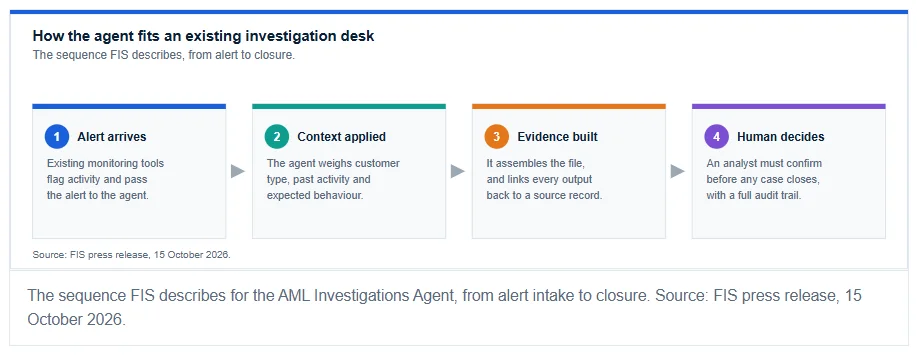
It reads an alert in context. FIS says the tool applies each customer’s type, activity history and expected behaviour before it builds the file. So a summary reflects what is normal for that client.
Traceability sits at the core. Furthermore, every output links back to a source record. Each suggestion also lands in an audit trail.
Crucially, the agent cannot close a case. An analyst must confirm first. That design keeps the regulatory burden where it belongs.
The numbers behind the pitch
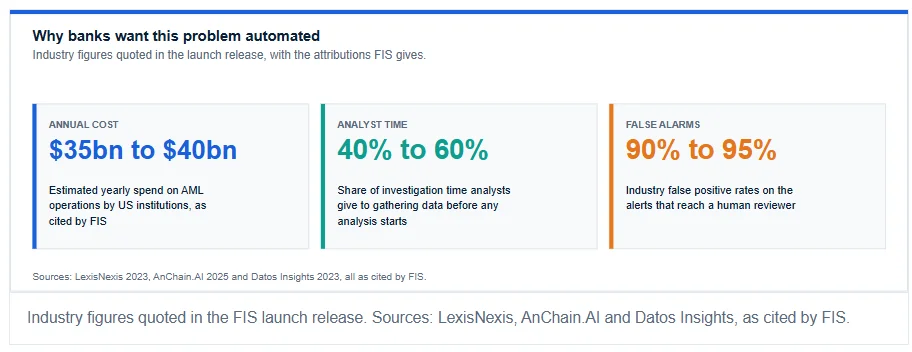
FIS quotes three industry figures. US institutions spend an estimated $35bn to $40bn a year on AML work. Analysts give 40 to 60 percent of their time to assembling data. False positives run at 90 to 95 percent.
Wider compliance costs dwarf that AML line. A LexisNexis study put financial crime compliance at $61bn across the US and Canada, with labour the largest component. Hence any labour saving flows straight to the bottom line.
The savings are projections
Amalgamated Bank supplied the headline claims. Its own workflow study projects Level 1 alert review time falling by more than 90 percent. Level 2 case work drops about 98 percent, and SAR drafting drops by more than 80 percent.
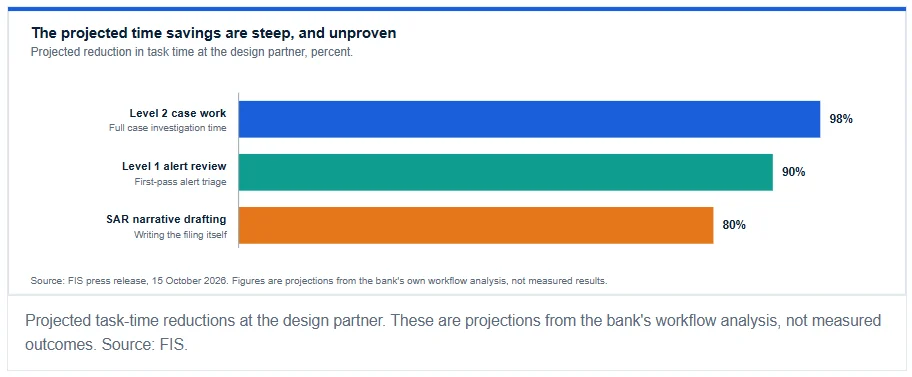
Still, read those numbers carefully. They are forecasts, not results. FIS labels them as projections drawn from the bank’s analysis of its own workflows.
The bank has skin in the game. It joined as a design partner and one of two institutions in the first pilot. Its teams shaped the design, rather than merely deploying it.
Therefore, the projections carry a caveat. A partner that helped build the tool estimated its gains. Independent results will matter more.
Why FIS is selling beyond its own base
Notably, the agent now reaches banks that use rival core systems. It plugs into FIS Horizon and FIS Systematics natively, with IBS support planned. Moreover, it runs inside the FIS private cloud.
Anthropic supplied the models. FIS announced the partnership in May 2026. An Anthropic team then sat with its product and compliance staff.
Furthermore, each bank keeps its own settings. A control layer holds risk logic and thresholds apart. Consequently, one lender cannot see another’s rules.
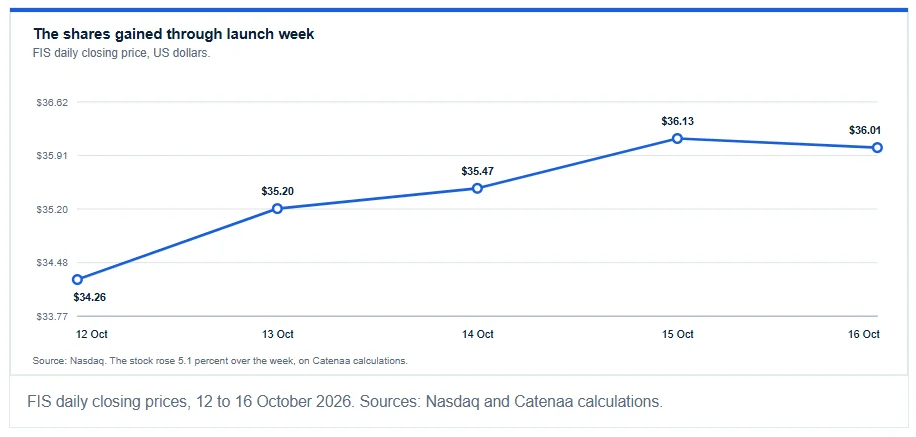
Investors liked the week. FIS shares closed at $36.01 on 16 October, up 5.1 percent across five sessions on Catenaa sums. Even so they remain 47.8 percent below the 52-week high.
The examiner decides, not the vendor
Governance gets its own branding. FIS runs the agent under a responsible-AI framework it calls Trust Assured. In practice, that means named controls, logged steps, and a human sign-off.
The real proof comes from examiners. Banks will adopt this quickly only if supervisors accept the audit trail. Until then, the savings stay on paper.




