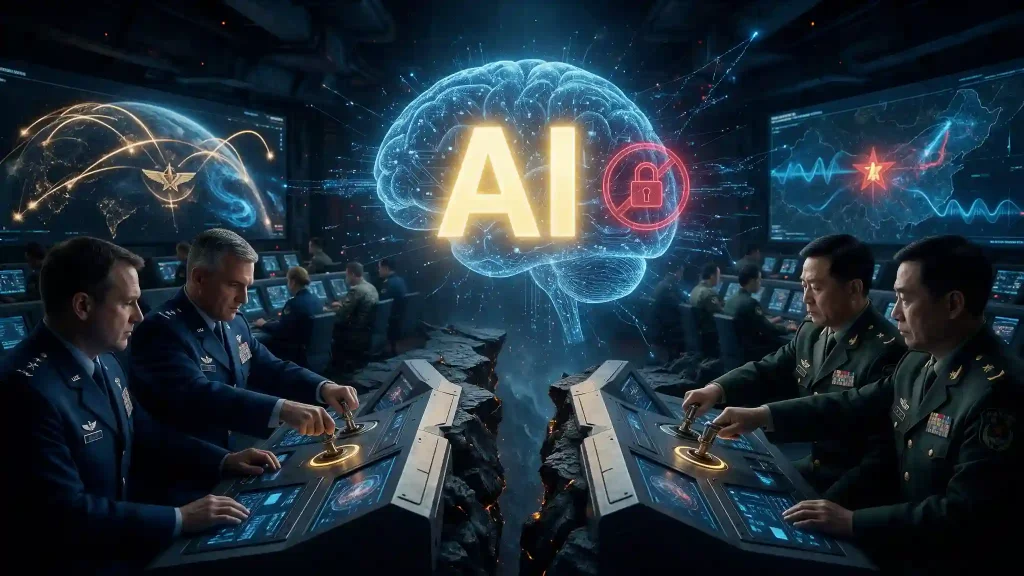


Catenaa, Wednesday, September 23, 2026- Security researchers from the United States and China are urging Washington and Beijing to establish rules ensuring artificial intelligence cannot independently launch nuclear weapons or attack nuclear command systems.
The proposal comes from Melanie W. Sisson of the Brookings Institution and Tianjiao Jiang of Fudan University.
They argue that existing US-China agreement on maintaining human control over nuclear weapons should be extended to other military applications of AI.
One proposed restriction would require humans to authorize any cyberattack against the other country’s nuclear command, control and communications systems, known as NC3.
Those systems connect early-warning networks, political and military decision-makers and the infrastructure used to transmit nuclear orders.
The researchers warn that autonomous attacks against such systems could create uncertainty about whether an incident was deliberate, accidental or caused by malfunctioning software.
AI could make that problem more dangerous because automated systems can operate at speeds that leave political and military leaders little time to assess what is happening before responding.
The proposal also calls for Washington and Beijing to agree on what constitutes meaningful human control over military AI.
Another recommendation is a dedicated communication channel for AI-related military incidents, similar in principle to crisis hotlines used to reduce misunderstanding between nuclear powers.
The aim would be to allow either side to quickly clarify whether unusual activity resulted from an accident, unauthorized action or deliberate attack.
The recommendations build on an agreement reached between the US and China in November 2024.
Then-US President Joe Biden and Chinese President Xi Jinping agreed that humans, rather than AI systems, should retain control over decisions to use nuclear weapons.
They also acknowledged risks associated with military applications of artificial intelligence.
The new proposal argues that nuclear launch authority alone is no longer enough as increasingly capable AI systems become integrated into intelligence, cyber operations, targeting and military decision-making.
Neither Washington nor Beijing has formally adopted the proposed safeguards.
The issue is becoming more pressing as the two countries compete to develop advanced AI for commercial and military use while simultaneously discussing ways to prevent the technology from triggering unintended conflict.
US and Chinese officials have recently begun discussing broader AI safety mechanisms, including ways to communicate about incidents involving national security.
The central concern is not that AI itself intends to start a war.
It is that speed, automation, software errors or misinterpreted machine actions could push two nuclear powers toward escalation before humans fully understand what has happened.