

Catenaa, Tuesday, July 28, 2026- Researchers at ETH Zurich have developed a quantum computing architecture that stores quantum information in microscopic mechanical vibrations rather than conventional electromagnetic memory, marking a significant step toward more scalable quantum computers that separate processing from memory.
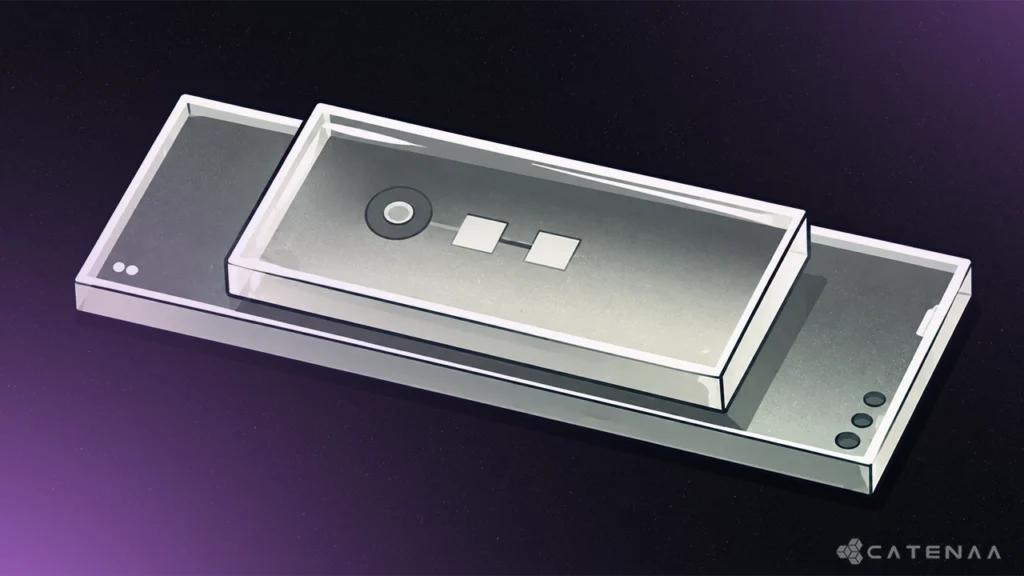
The experimental system uses tiny mechanical resonators, each no larger than microscopic components on a chip, to temporarily store quantum information while a superconducting qubit performs calculations. The findings were published in the journal Science.
The work introduces a computing model that mirrors the architecture of classical computers, where processors and memory perform separate functions, potentially making future quantum systems easier to expand.
The research team, led by quantum physicist Yiwen Chu at ETH Zurich, developed a quantum chip incorporating microscopic mechanical resonators that store quantum information as vibrations known as phonons.
Instead of relying solely on superconducting qubits to both process and retain information, the architecture separates those responsibilities. A superconducting qubit performs computations while the mechanical resonators act as a dedicated quantum working memory.
The researchers demonstrated the system by successfully implementing the Quantum Fourier Transform and a quantum period-finding algorithm, two important computational procedures used in quantum computing.
Their experiments showed that quantum information could be transferred between the processor and multiple mechanical memory modes while maintaining the coherence required for quantum calculations.
Most quantum computers today do not clearly separate processing from memory.
In conventional computers, processors perform calculations while RAM temporarily stores data, allowing each component to specialise in its task.
Quantum computers typically combine those functions within the same hardware, making it increasingly difficult to scale systems as additional qubits and memory resources are required.
ETH Zurich’s architecture applies a similar division of labour by allowing superconducting qubits to focus on computation while mechanical resonators store quantum information until it is needed.
The researchers believe this approach could provide a more practical path toward larger and more efficient quantum systems.
The breakthrough addresses one of quantum computing’s most persistent engineering challenges: scalability.
Mechanical resonators occupy significantly less space than many conventional quantum memory components while supporting multiple independent vibrational modes within a single device.
Each vibrational mode can function as a separate memory location, increasing storage density without requiring additional hardware.
The architecture could also support future applications involving tokenized quantum networks, advanced cryptography, scientific simulations and optimisation problems once larger fault-tolerant quantum computers become practical.
Although the prototype remains experimental, it demonstrates that mechanical memory can actively participate in quantum computation rather than serving solely as passive storage.
According to the research team, fixed mechanical memory enables a clearer distinction between processing and storage while maintaining compatibility with superconducting quantum processors.
Yiwen Chu said the interaction between quantum processors and quantum memory provides an important foundation for building reliable quantum computers capable of solving problems beyond the reach of classical machines.
The researchers also noted that the protocol allows capital-intensive electromagnetic memory components to be replaced with much smaller mechanical resonators capable of storing multiple quantum states within the same physical structure.
They emphasised that the current system represents a proof of concept rather than a commercially deployable quantum computer.
ETH Zurich’s research demonstrates that mechanical vibrations can function as practical quantum memory within a programmable computing architecture.
While the prototype is still far from delivering commercially useful quantum computing, it establishes a new design strategy inspired by the processor-and-memory separation used in today’s classical computers.
If the architecture continues to scale successfully, vibration-based quantum memory could become an important building block for the next generation of quantum computing systems.
Quantum computers process information using qubits, which can exist in multiple states simultaneously through quantum superposition. Unlike conventional computers that separate processors and memory, most existing quantum systems combine both functions within the same hardware, creating engineering challenges as systems grow larger. ETH Zurich’s new architecture introduces microscopic mechanical resonators that store quantum information as phonons, or quantised vibrations, while superconducting qubits perform calculations. This processor-memory separation resembles the CPU and RAM model used in classical computing and could improve scalability by allowing more compact memory designs. The research, published in Science, provides experimental evidence that mechanical quantum memory can support programmable quantum algorithms, offering a promising direction for future quantum computer development.