


September 23, 2026 – The Eurosystem’s new platform settles tokenised asset trades in central bank money. Thirteen banks, four DLT operators and the Bundesbank have already joined.

In Summary
The Eurosystem launched Pontes on 21 September, enabling wholesale tokenised asset trades to settle in central bank money.
Thirteen market participants, four DLT operators and the Deutsche Bundesbank onboarded before launch.
Participants can settle with cash tokens on a Eurosystem DLT platform or trigger payment through T2, with finality in T2.
The ECB will invest part of its own funds portfolio in tokenised securities, settled via Pontes.
Pontes follows 2024 trials with 64 participants that settled about 1.59 billion euros; full implementation is due by 2028.
The euro area now has live tokenised settlement in central bank money. On 21 September, the Eurosystem launched Pontes, a platform that settles wholesale transactions in tokenised assets. Eighteen institutions have already onboarded and can use it immediately.
Pontes is the first step in the Eurosystem’s strategy for tokenised finance. It links market platforms that run on distributed ledger technology, or DLT, to the existing TARGET Services.
Piero Cipollone sits on the ECB’s Executive Board. Pontes, he said, “brings the stability and trust of central bank money” to tokenised finance in Europe. Furthermore, he said it would help the sector scale.
Why Tokenised Settlement Needs Central Bank Money
Tokenisation turns an asset into a digital token on a shared ledger. The cash leg, however, stayed the weak point. Buyers and sellers had to pay in bank money, in stablecoins, or off the ledger.
Each of those routes carries credit or liquidity risk. Central bank money carries none. Therefore, access to it removes the main barrier for big investors. In short, tokenised settlement now rests on the safest cash in the system.
The Eurosystem heard that message during its 2024 tests. Users said a risk-free cash asset was vital for wider use, the ECB reported. So the design starts there.
What the Pontes Platform Actually Does
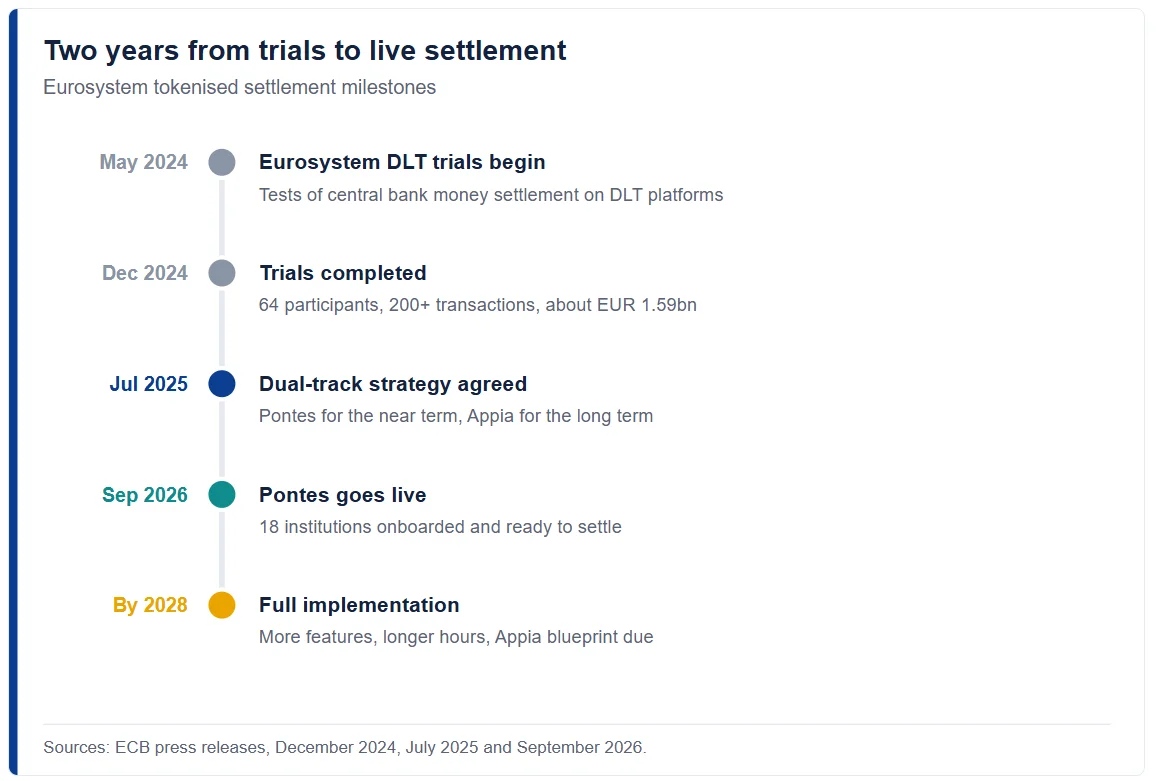
Pontes offers two routes, the TARGET Services pages show. First, banks can pay with cash tokens on a Eurosystem ledger. Alternatively, a trigger can move the cash leg through T2. T2 is the euro area real-time gross settlement system.
Either way, settlement finality sits in T2. A Hash-Link protocol connects the securities leg and the cash leg, which enables delivery versus payment. As a result, both legs succeed or both fail.
Access follows existing rules. Any firm with T2 access can join. Eligible operators include securities depositories, ledger operators, payment systems and clearing houses.
Who Joined the First Wave
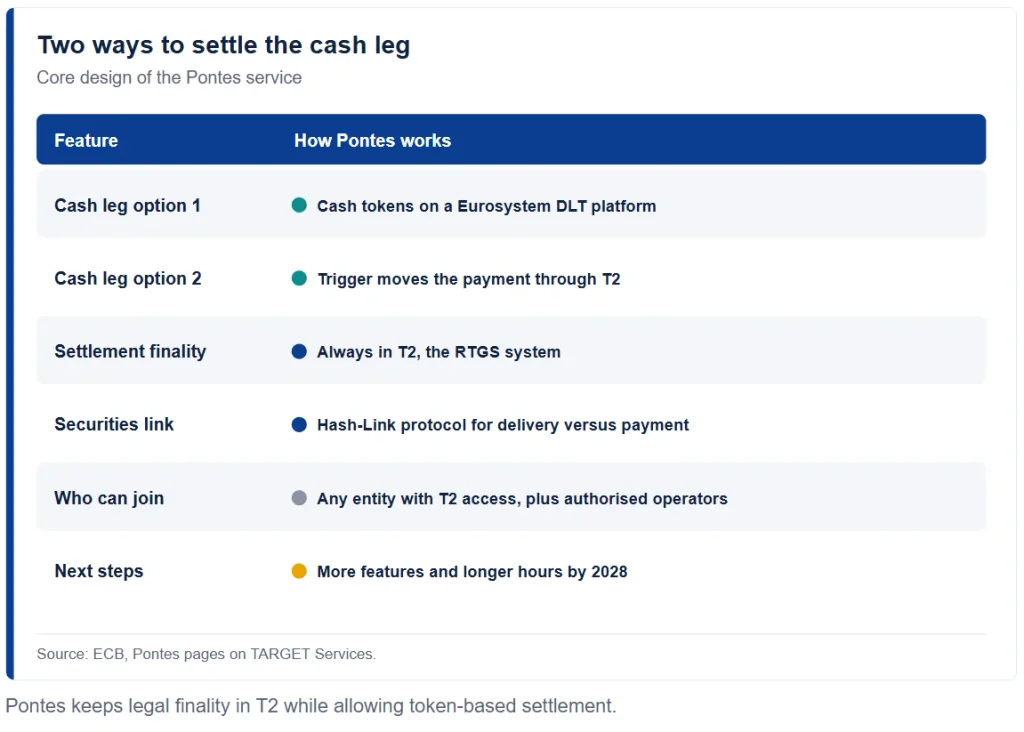
The founding group leans towards Germany. Deutsche Bank, DZ Bank, Deka Bank, BayernLB, KfW and NRW.BANK have all joined. So has the Deutsche Bundesbank, acting as a market participant.
Spain contributes Santander, ABANCA and Cecabank. France brings Société Générale, Caisse des Dépôts et Consignations and Memo Bank. The European Investment Bank joins as a supranational issuer.
Four ledger operators complete the list: Axiology, Cashlink, Clearstream and SWIAT. Moreover, the ECB says more firms will connect in the coming months. Meanwhile, the platform stays open to new members.
The ECB Will Invest Its Own Money
The central bank is also putting money behind the project. It plans to invest a small slice of its own funds in tokenised bonds. Those trades will settle in central bank money through Pontes.
The own funds portfolio sits outside monetary policy. It earns income that helps cover the ECB’s running costs. First purchases will focus on euro bonds from euro area states, agencies and European bodies.
The aim is practical know-how. By buying directly, the ECB will see the whole chain, from trade to settlement. Its Executive Board will set the timing once the prep work ends.
From Trials to Live Tokenised Settlement
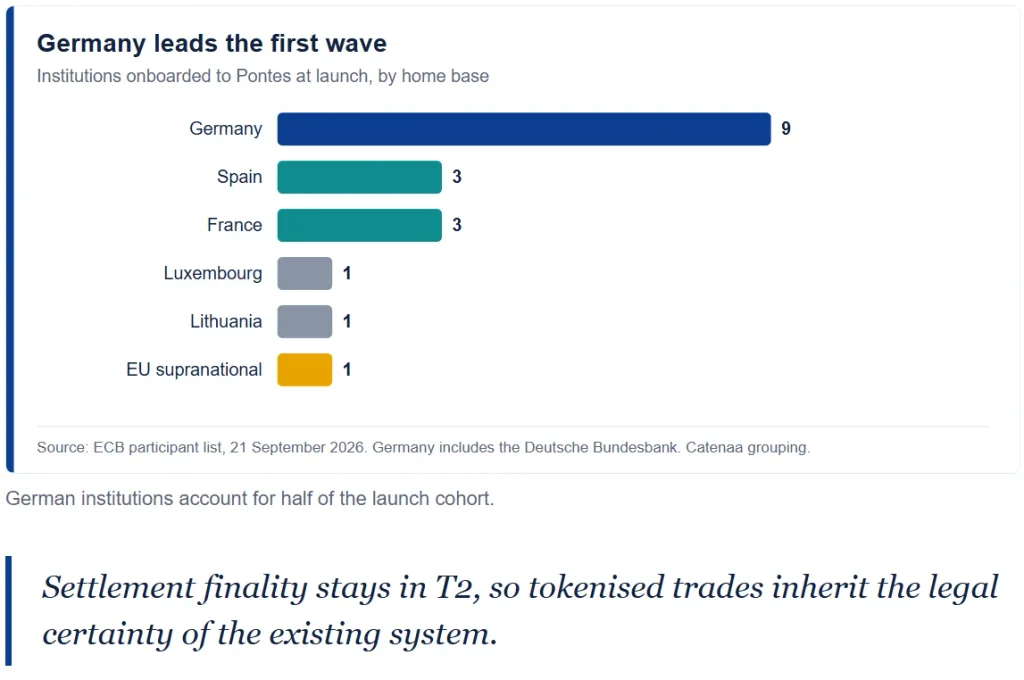
The route here took two years. Between May and November 2024, the Eurosystem ran trials with 64 participants. They completed more than 200 transactions worth about 1.59 billion euros.
In July 2025, the ECB chose a dual-track plan. Pontes covers the near term. Appia, the second track, will set out a blueprint for a wider market by 2028. Danmarks Nationalbank also takes part in that work.
Pontes itself will grow in stages. The ECB expects full implementation by 2028, with longer operating hours and more features.
What It Means for Banks and Markets
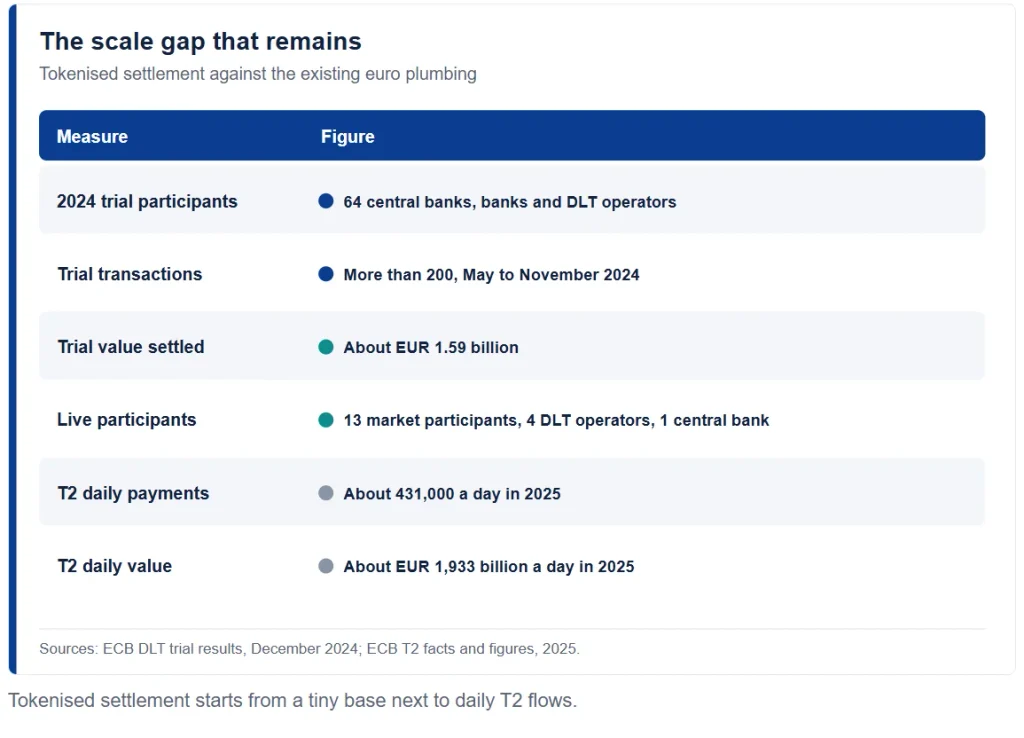
Scale remains the open question. T2 settles about 431,000 payments a day, worth roughly 1,933 billion euros. Tokenised volumes start from almost nothing against that backdrop. The average T2 payment, by comparison, is worth about 4.5 million euros.
Costs matter too. Every extra settlement rail adds work for back offices and risk teams. Banks will therefore push for one standard rather than several.
Still, the shift matters for treasurers and custodians. Banks that issue tokenised bonds can now settle them without credit risk on the cash leg. Smart contract risk, by contrast, does not go away. That keeps code audits in focus.
Competition also shapes the timetable. Other regions are testing similar rails, and private stablecoins keep growing. For now, though, Europe has a working link between token markets and the safest money on offer. Next, watch how fast volumes build.