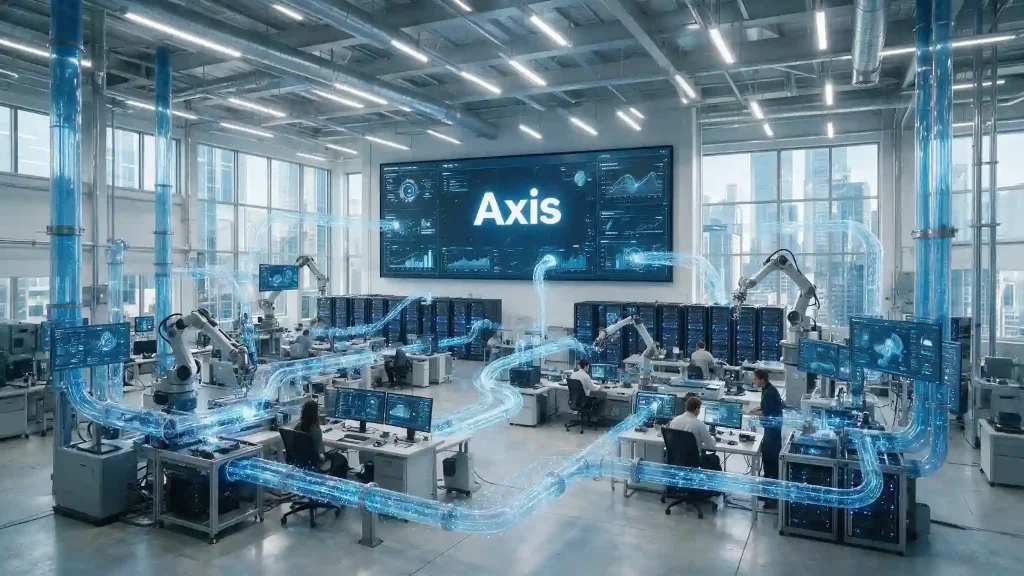


Catenaa, Monday, August 03, 2026- Axis Robotics has raised $12 million in seed funding to expand a data-generation platform designed for physical artificial intelligence, reflecting growing investor interest in one of robotics’ most significant technical challenges: obtaining enough real-world training data to build general-purpose intelligent machines.
The funding round was led by Hack VC with participation from Nomad Capital, Pi Network Ventures, 10K Ventures and several angel investors.
Unlike large language models, which learn from vast amounts of internet text, physical AI systems must be trained using real-world interactions involving movement, objects and environments.
Axis aims to address that bottleneck by building what it describes as a “compounding data engine” that continuously generates, improves and expands robotic training datasets through a combination of simulation, human participation and machine learning.
Artificial intelligence has made rapid progress in language, images and software because enormous datasets already existed online.
Robotics faces a fundamentally different problem.
Machines cannot learn physical tasks simply by reading text or watching videos.
They require billions of examples showing how to grasp objects, manipulate tools, navigate environments and recover from mistakes.
Collecting that information traditionally requires expensive laboratories, specialized robots and extensive human supervision.
Those limitations have slowed the development of general-purpose robotic intelligence despite advances in AI models.
Many researchers increasingly argue that data availability, rather than computing power, has become the principal obstacle to physical AI.
Axis is attempting to industrialize robotic data production.
Its platform combines automated task generation, browser-based robot teleoperation, mobile data collection and automated processing into a single workflow.
Instead of relying exclusively on engineers operating robots in laboratories, the company enables distributed contributors to generate training data remotely.
The system also incorporates human feedback whenever robotic models make mistakes, allowing corrected behavior to feed directly back into future model training.
This creates what AI researchers describe as a feedback loop in which every failure produces new learning opportunities.
As datasets expand, the platform continually improves both model quality and data diversity.
One of Axis’ central arguments is that simply collecting more robotic data is not enough.
Training datasets must expose AI systems to diverse environments, lighting conditions, object arrangements and robot designs.
The company’s task-generation engine automatically randomizes those variables to create large numbers of unique scenarios.
According to Axis, benchmark testing demonstrated improved performance compared with equally sized datasets that lacked similar diversity.
If those results hold across broader industry testing, they reinforce a growing belief within AI research that carefully engineered datasets may produce greater improvements than simply increasing data volume.
That philosophy increasingly mirrors developments in large language models, where data quality has become as important as dataset size.
Unlike fully automated systems, Axis continues to rely heavily on people.
The company says more than 100,000 contributors now participate in its distributed data collection network, generating both simulated and real-world interaction data.
Human participants intervene when robotic models fail, demonstrating correct actions that are then incorporated into future training.
This hybrid approach reflects an important trend in modern AI development.
Rather than replacing human expertise entirely, many advanced AI systems increasingly depend on human supervision to refine model behavior and improve performance in difficult edge cases.
That strategy has already proven effective in language models and is now becoming more common in robotics.
Axis said it has begun commercial deployments with robotics manufacturers, automation companies and industrial technology firms.
Rather than selling robots directly, the company provides customized training datasets tailored to specific hardware platforms and applications.
Potential customers include robotics developers building warehouse automation, manufacturing systems, service robots and autonomous machines.
As physical AI expands beyond research laboratories into commercial environments, demand for specialized training data is expected to increase significantly.
Companies may increasingly purchase datasets in much the same way software developers license cloud computing resources today.
The funding also reflects changing investment priorities within artificial intelligence.
Much attention has focused on foundation models and AI applications over the past several years.
Increasingly, investors are directing capital toward infrastructure supporting those systems.
In language AI, infrastructure includes computing hardware, networking and data centers.
For robotics, high-quality data generation may become an equally critical layer.
Companies capable of supplying reliable, scalable datasets could occupy a strategic position within the physical AI ecosystem regardless of which robot manufacturers ultimately dominate the market.
Axis Robotics illustrates how the AI industry is moving beyond model development toward solving the practical constraints limiting real-world deployment.
The ability to produce diverse, high-quality training data at scale could become one of the defining competitive advantages in robotics.
If successful, platforms like Axis may accelerate the development of robots capable of operating across factories, warehouses, logistics networks and everyday environments without requiring extensive retraining for each new task.
The market for AI data itself may therefore become as strategically important as the market for AI models.
Axis Robotics’ funding round is notable not simply because of the capital raised, but because of what investors are backing.
The company is focusing on the infrastructure needed to train future generations of intelligent machines rather than building robots alone.
As physical AI matures, companies that solve the data bottleneck may become foundational suppliers to the broader robotics industry, helping determine how quickly general-purpose robotic intelligence becomes commercially viable.
Physical AI refers to artificial intelligence systems that control robots and autonomous machines operating in the real world. Unlike large language models trained primarily on internet text, physical AI requires enormous quantities of movement, perception and interaction data collected from real or simulated environments. Researchers increasingly view scalable data generation as one of the largest obstacles to developing general-purpose robotics. Venture investment has consequently expanded beyond AI models themselves into companies building the infrastructure needed to create, manage and improve robotic training datasets.




