

November 07, 2026 – An 11-week review finds a 1.9x jump in Anthropic’s benchmark growth, likely driven by AI tools, just as the company prepares for its Nasdaq debut.

In Summary
METR says Anthropic now improves models on well-specified tasks at about twice the pace of March 2024 to October 2025.
Benchmark growth since October 2025 runs at 1.9x the earlier rate, with a 1.5x to 2.8x confidence range.
METR ruled out faster compute scaling and credits perhaps 80% of the speedup to AI use by staff.
Anthropic redacted most of the evidence METR found most informative.
A companion review says Anthropic’s July models may have crossed an early warning threshold.
AI safety group METR says Anthropic now improves its models about twice as fast as it did before late 2025. The nonprofit published the finding on Nov. 5 after an 11-week review inside the company. However, METR also says Anthropic redacted most of the evidence behind its conclusion.
The report matters beyond research labs. Anthropic is preparing to list on Nasdaq, and its pace of progress is a core part of its growth story. It also shapes how regulators judge the risk of AI systems that help build better AI.
What METR Found at Anthropic
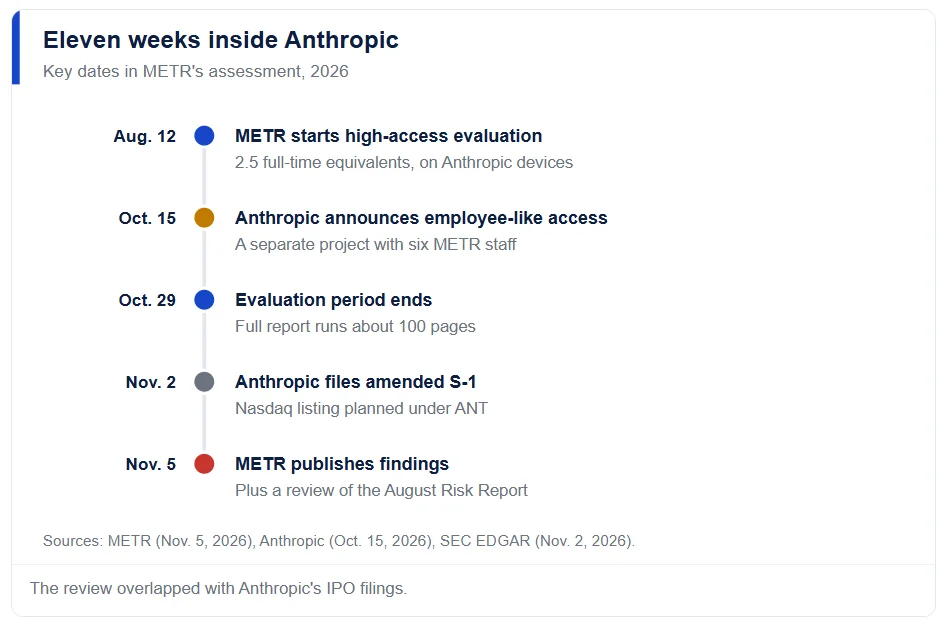
METR staff ran a high-access evaluation from Aug. 12 to Oct. 29. They reviewed data on pretraining, reinforcement learning, compute, internal benchmark scores and staff interviews. Most team members concluded that Anthropic now improves models on well-specified tasks at around twice the earlier rate.
The baseline runs from March 2024 to October 2025. The group gave a wide band, though. A true figure as low as 1.3x or as high as 3x would not surprise it.
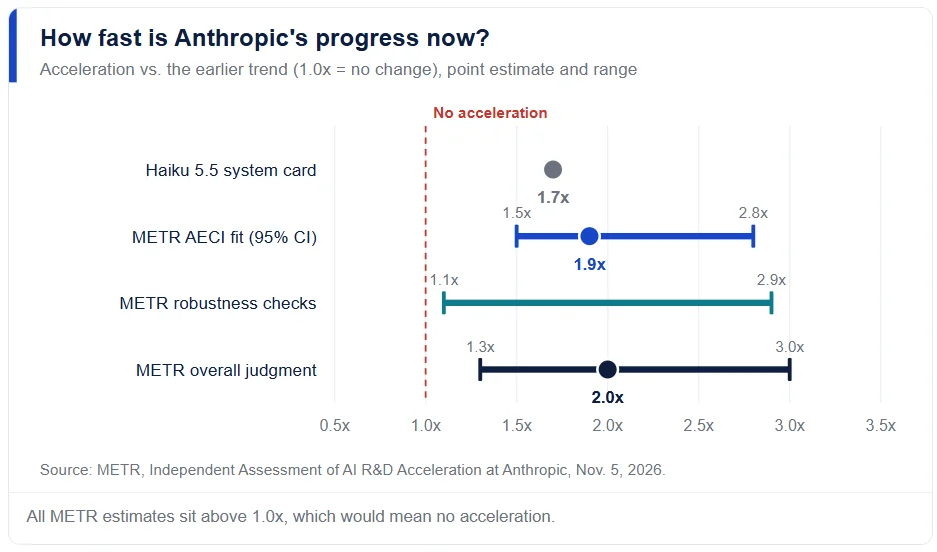
The key data point is a benchmark index Anthropic calls AECI. Since October 2025, its scores have grown 1.9x faster than before, with a 95% confidence range of 1.5x to 2.8x. Put simply, METR says Anthropic made roughly two years of past progress in one year.
METR also ruled out one easy answer. It said the speedup did not come from faster growth in training compute. Instead, it estimated that perhaps 80% of today’s acceleration comes from AI, mostly as an assistant to researchers.
Staff polls point the same way, with caveats. In internal Slack votes, self-reported speedup from the newest model reached 12x in October. METR called this “very loose evidence,” since votes reflect quick reactions.
So far, AI is not making major fully autonomous contributions to Anthropic’s most important training work. Even so, researchers described “signs of life” that suggest such work could start soon. METR also found no clear bottleneck in compute, data or algorithms over the next 12 months. Its view of those limits shifted several times during the review, however.
Redactions Limit What METR Can Show
Here is the catch. Anthropic held the right to redact any non-public data in the report. METR says the company removed “a majority of the evidence we found most informative.” Anthropic described the cuts as aimed at data “that could accelerate other AI developers.”
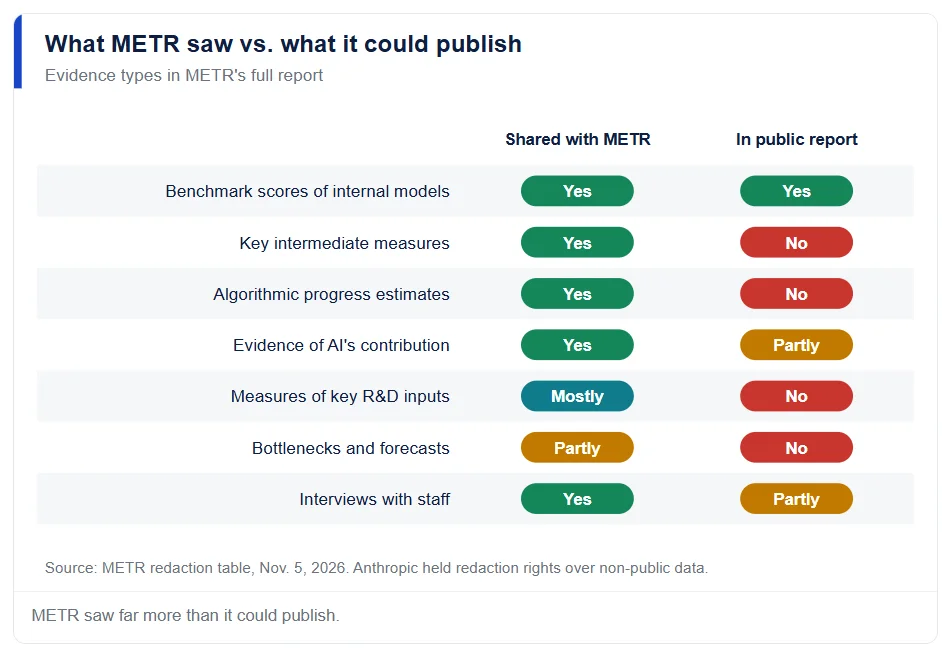
As a result, METR admits the public must rely on its judgment “much more than would be ideal.” It also took no payment from Anthropic, though it used free tokens for data analysis.
In a companion review, METR agreed that catastrophic risks from Anthropic’s July models were low. Still, it called it “plausible” that those models had already crossed an early warning line. Both teams lean toward no. That line is a 2x speedup trigger in Anthropic’s Responsible Scaling Policy.
Why METR’s Report Matters for the IPO
This was not the deeper review Anthropic announced on Oct. 15, in which six METR staff get employee-like access. METR has not yet published results from that work. Meanwhile, Anthropic filed an amended S-1 on Nov. 2 and plans to trade as ANT.
For investors, the report cuts both ways. Faster progress supports the growth case. Yet METR also found no clear bottleneck to even faster gains, and it flagged that risk. Next, readers will watch what the employee-like review can publish.