

Catenaa, Wednesday, August 19, 2026- US housing weakened sharply in July as high mortgage rates restrained builders and buyers, while artificial intelligence investment helped manufacturing move in the opposite direction.
Single-family housing starts fell 9.9% from June to a seasonally adjusted annual rate of 808,000 units, the lowest since November 2022.
Total housing starts, including apartments and other multifamily properties, dropped 12.4% to 1.239 million units.
The weakness was not confined to construction.
Pending sales of existing homes fell 2.3% in July from June and 2.2% from a year earlier, reaching their lowest level since January.
Together, the figures show a housing market still struggling with expensive borrowing and elevated home prices.
Single-family homebuilding was 15.7% lower than a year earlier. Builders, however, showed some willingness to prepare for future construction. Single-family building permits rose 2.5% to an annual rate of 894,000 units. Overall residential permits increased 5% to 1.443 million.
Permits normally provide an indication of future construction, but the increase does not guarantee builders will immediately start projects.
High mortgage rates have made it harder to sell completed homes and encouraged builders to remain cautious about adding supply.
Housing completions also declined in July, adding another sign of slowing activity.
Conditions were similarly weak in the existing-home market. Pending sales declined across all four major US regions during July. The West recorded the largest monthly drop at 4.7%, followed by the South at 2.2%, Northeast at 2% and Midwest at 0.7%.
Pending sales normally lead completed transactions by one or two months.
The latest decline therefore suggests weak sales could persist into late summer.
National Association of Realtors Chief Economist Lawrence Yun said the highest mortgage rates of the year arrived during the middle of summer, reducing contract signings.
Home prices remain near record levels, creating another affordability barrier.
The rate on a typical 30-year fixed mortgage stood around 6.77% in early August, near its highest level in more than a year.
NAR estimates pending contracts remain about 30% below 2019 levels despite US payroll employment being roughly 5% higher.
That gap suggests potential demand remains, but many buyers cannot yet afford to act on it.
Manufacturing told a different story. Federal Reserve data showed factory output rising 0.2% in July, following a revised 0.3% increase in June. Manufacturing production reached its highest level since April 2022.
AI investment remained an important source of demand. Business-equipment production rose 0.8%, while information-processing equipment increased 1.5%. Semiconductor production climbed 2.4%, and output of computers and peripheral equipment rose 1.8%. Construction supplies also gained 0.8%.
These industries are benefiting from billions of dollars being directed toward data centers, advanced computing infrastructure and the equipment needed to support artificial intelligence systems.
The expansion increasingly reaches beyond semiconductor manufacturers themselves.
Building AI infrastructure requires power equipment, cooling systems, electrical components, construction materials and other industrial goods.
Defense and space equipment production also rose 1.8% during July.
Motor vehicle production was weaker, showing that manufacturing strength remains uneven.
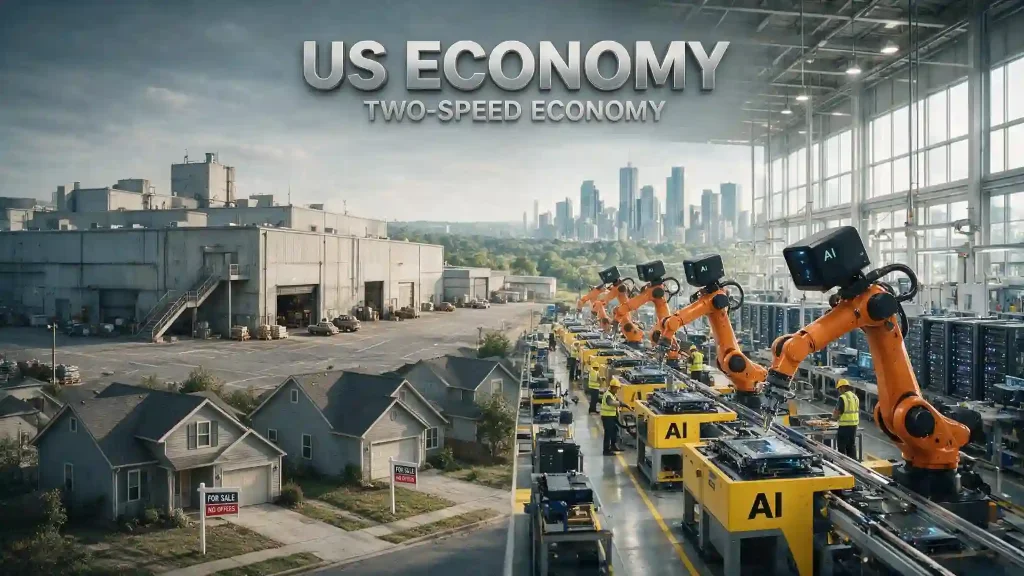
The July figures reveal two sectors responding very differently to the same economic environment.
Housing is highly sensitive to interest rates because most purchases depend on mortgages.
Higher borrowing costs immediately reduce what households can afford and make developers more cautious about starting projects.
AI infrastructure spending operates differently.
Large technology companies and other businesses are committing enormous amounts of capital to computing capacity despite elevated interest rates.
That investment is creating demand throughout parts of the manufacturing supply chain.
The result is an economy where one capital-intensive sector is being suppressed by borrowing costs while another is expanding because of a powerful investment cycle.
Catenaa View
The contrast between housing and manufacturing may become increasingly important for financial markets. Weak housing normally strengthens arguments that restrictive interest rates are weighing on the economy. But the AI investment boom is supplying enough industrial demand to keep parts of manufacturing expanding.
That complicates the picture facing the Federal Reserve. The economy is not weakening uniformly.
Households seeking mortgages are feeling the effects of expensive credit much more directly than companies spending heavily on AI infrastructure. For markets, the divergence could matter more than either report in isolation. A sustained housing slowdown would increase pressure for lower borrowing costs.
But continued strength in business investment and manufacturing could reduce the urgency for rapid monetary easing if broader economic activity remains resilient.
AI is therefore beginning to influence more than technology stocks. Spending on data centers, semiconductors and computing equipment is becoming visible in national industrial production data. At the same time, housing shows how strongly higher rates are still affecting ordinary consumers.
The US economy in July increasingly looked like two different economies operating under the same interest rate.
US housing activity has struggled since mortgage rates rose sharply from the low levels seen earlier in the decade. July single-family starts fell to their lowest annualized pace since November 2022, while pending existing-home sales reached their weakest level since January. Manufacturing has shown greater resilience, supported by investment in AI infrastructure, semiconductors and business equipment. Federal Reserve data showed both total industrial production and manufacturing output rising 0.2% in July.