


September 30, 2026 – Zenkuda matched the standard treatment for wet AMD while giving most patients six months between injections. A US filing is planned for the fourth quarter.
In Summary
Zenkuda and tabirafusp-ted both met the primary vision endpoint against aflibercept in the Phase 3 DAYBREAK trial.
54% of Zenkuda patients reached six-month dosing at year one, with no intraocular inflammation.
Kodiak shares rose 178% to $89.92, lifting market value to about $5.7 billion.
The company plans to file for US approval in the fourth quarter of 2026, but held only $125.9 million in cash at June end.

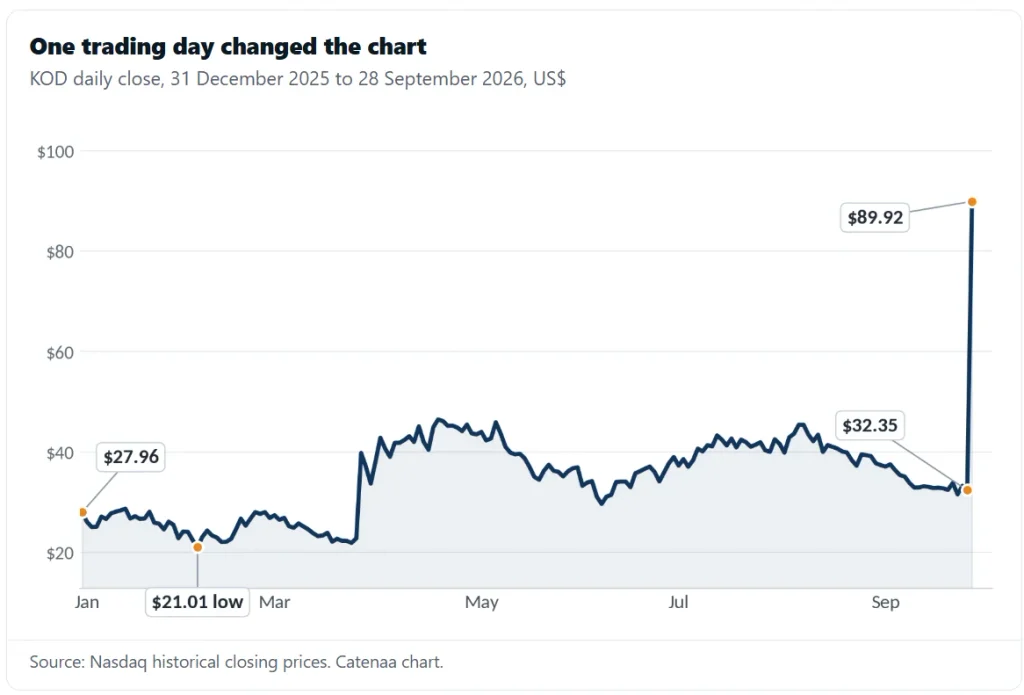
Kodiak Sciences shares nearly tripled on Monday after its lead eye drug met the main goal of a pivotal trial. The stock closed at $89.92, up 178% from Friday’s $32.35, according to Nasdaq data.
The company reported topline results from DAYBREAK, a Phase 3 study in wet age-related macular degeneration. Both of its tested drugs, Zenkuda and tabirafusp-ted, matched the standard drug aflibercept on vision gains at one year.
For context, wet age-related macular degeneration causes leaking blood vessels at the back of the eye. Without treatment, it can quickly damage central vision. Patients usually need regular injections into the eye.
What DAYBREAK showed
The DAYBREAK trial began in August 2024 and aims to enrol about 675 patients. It tested Zenkuda and tabirafusp-ted in parallel arms against aflibercept, given on its standard label schedule.
Specifically, Zenkuda met the non-inferiority goal for vision with a p-value of 0.0007. Tabirafusp-ted also met its vision endpoint, with a p-value of 0.0036. In simple terms, both performed about as well as the current standard on eyesight.
The key selling point is durability. Some 54% of Zenkuda patients reached a six-month gap between doses by year one. That result held under strict criteria that required a new injection for any detectable fluid.
Fewer injections matter to patients and doctors. Each visit takes time, and many patients are elderly. Consequently, a drug that lasts longer can ease that burden for families and clinics alike.
Outside experts sounded upbeat. Dr. Charles Wykoff of Retina Consultants of Texas said the results exceeded his expectations. He noted that more than half of patients reached a 24-week dosing interval.
Similarly, Dr. David Brown of Retina Consultants of America called the results impressive. He pointed out that the retreatment rules closely mirrored the zero-fluid approach many clinics use.
Safety looked clean
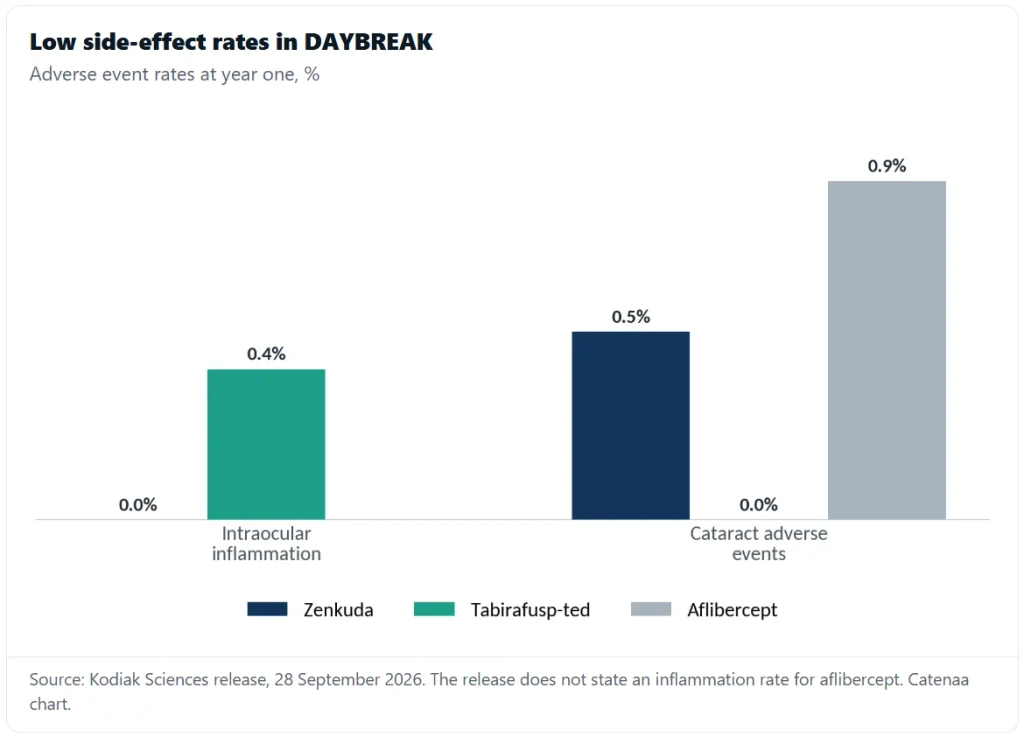
Safety was a concern in earlier studies of the drug, so investors watched it closely. In DAYBREAK, Zenkuda showed no intraocular inflammation. Its cataract adverse event rate was 0.5%, against 0.9% for aflibercept.
Likewise, tabirafusp-ted showed a 0.4% inflammation rate and no cataract adverse events. Both drugs were well tolerated, according to the company.
The road to approval
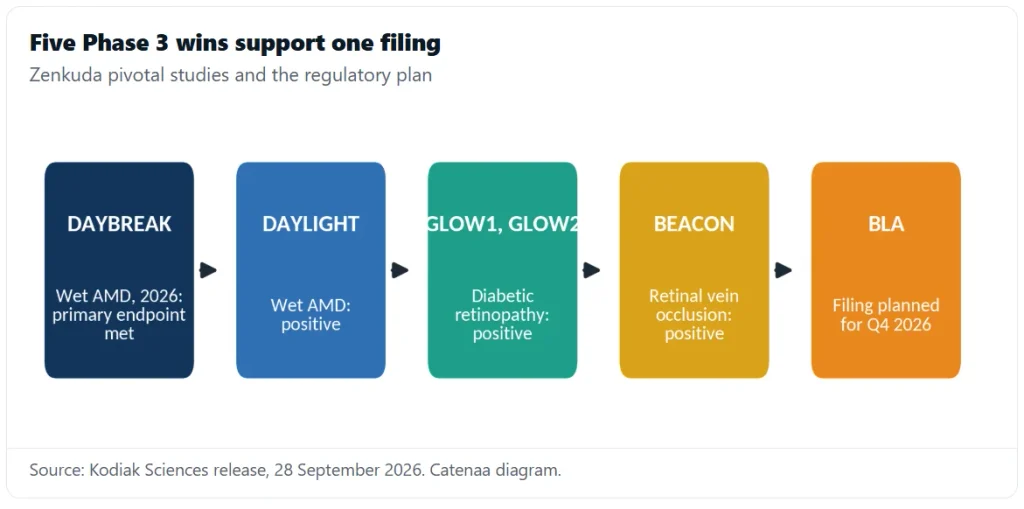
Next, Kodiak Sciences plans to file for US approval of Zenkuda in the fourth quarter of 2026. The filing will draw on five positive Phase 3 studies across three diseases.
Those include DAYBREAK and DAYLIGHT in wet AMD, GLOW1 and GLOW2 in diabetic retinopathy, and BEACON in retinal vein occlusion. In the diabetic retinopathy studies, all patients stayed on six-month dosing at year one.
Competition will be tough. Aflibercept, sold as Eylea, is one of the most widely used treatments in the field. As a result, Zenkuda would need to win share from well-established brands if regulators approve it.
The science behind the drug aims for longer action. According to the company, Zenkuda has a mean ocular half-life of about 20 days. That is roughly three times that of approved therapies.
Notably, Kodiak builds its drugs on what it calls an antibody biopolymer conjugate platform. In essence, it attaches the active antibody to a large polymer so the medicine stays in the eye for longer.
Meanwhile, other readouts are close. Kodiak expects first Phase 3 results for a third drug, KSI-101, in December 2026. It is also testing tabirafusp-ted in diabetic macular edema.
What the rally means for Kodiak Sciences investors
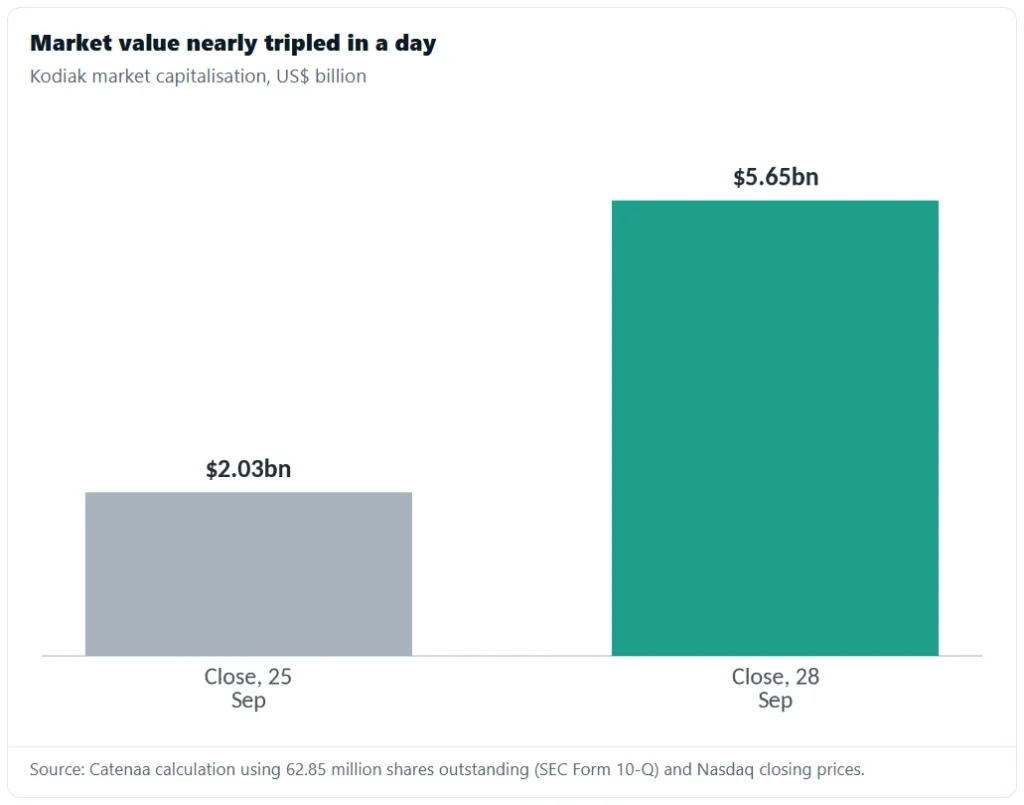
Clearly, the move reshaped the company’s value. With about 62.85 million shares outstanding, Kodiak’s market capitalisation rose from roughly $2.0 billion to $5.7 billion in one session.
Before the news, however, the stock had drifted. It closed 2025 at $27.96 and fell as low as $21.01 in February. The company had flagged the readout date on 25 September.
Funding remains a question. Kodiak held $125.9 million in cash and cash equivalents at the end of June, according to its quarterly report. It lost $123.8 million in the first half of 2026.
At that rate of loss, the cash on hand would not last long without new funding. However, a higher share price makes any equity raise far less dilutive than it would have been a week ago.
Therefore, the company may seek new capital or a partner to launch Zenkuda. For biotech investors, the result shows how one trial can reprice a company. It also adds a new rival in a crowded retina market.