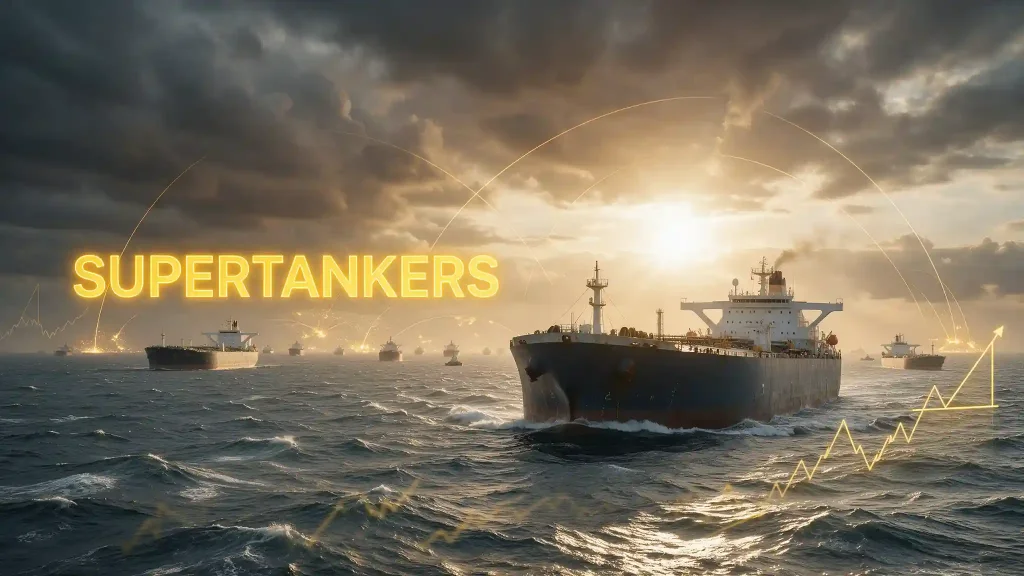


Catenaa, Thursday, September 24, 2026- A global shortage of oil supertankers is beginning to disrupt long-distance crude trading as soaring freight costs make some traditional supply routes too expensive for refiners.
Very large crude carriers, or VLCCs, capable of transporting about 2 million barrels each, have become scarce in several major loading regions.
Bloomberg reported that shipping a cargo from Houston to Asia now adds about $26 a barrel to the delivered cost of crude, equivalent to roughly $52 million for a full VLCC cargo.
That transport cost alone is now equal to about one-quarter of the price of West Texas Intermediate crude.
Rates on the benchmark Persian Gulf-to-China route have climbed even higher.
VLCCs on that route are earning more than $1.2 million a day, levels shipping executives and brokers say are without precedent.
The cost surge is already changing buying patterns.
US crude flows to Asia have fallen in recent weeks as freight rates roughly tripled, according to ship-tracking firm Vortexa.
A Japanese refiner recently bought Alaskan crude, despite the grade being less suited to its processing system, because the shorter voyage reduced shipping costs.
Asian refiners are also using smaller Aframax tankers for some US cargoes, while Atlantic Basin shipments are increasingly being split between two Suezmax vessels rather than one VLCC.
Suezmax earnings have climbed above $300,000 a day.
Europe is facing similar pressure.
While Brent futures recently traded close to $110 a barrel, physical Dated Brent climbed above $131 as refiners competed for nearby crude that could arrive quickly.
Longer-haul Angolan barrels, which normally travel to China, have become harder to sell.
The shortage has intensified since the US-Iran conflict disrupted established shipping routes.
Tankers moving oil through the Strait of Hormuz are spending longer on voyages and increasingly transferring cargoes near Oman.
Other vessels are sailing around Africa to avoid security risks, tying up ships for longer periods and reducing the number available for new bookings.
The disruption comes after years of limited investment in new tanker capacity.
Reuters reported that more than 217 VLCCs have been ordered in 2026, representing more than $20 billion in investment. About one-fifth of the existing VLCC fleet is more than 20 years old.
Those ships will take years to deliver.
For now, high freight costs risk doing more than increasing transport expenses.
If distant crude becomes too expensive to process profitably, refiners may simply stop buying it.
That could fragment the global oil market into shorter regional supply routes at a time when fuel markets are already under severe pressure.