

October 05, 2026 – Seven producers rolled over their targets for a second month. Their monitoring committee warned that damaged energy assets take time and money to restore.

In Summary
Seven OPEC+ members kept November oil output targets at September levels on Sunday.
Their combined required production totals about 31.0 million barrels a day.
Strait of Hormuz transits averaged about 3.7 vessels a day in September, versus 68 before the war.
OPEC+ monitors warned that repairing damaged energy infrastructure is costly and slow.
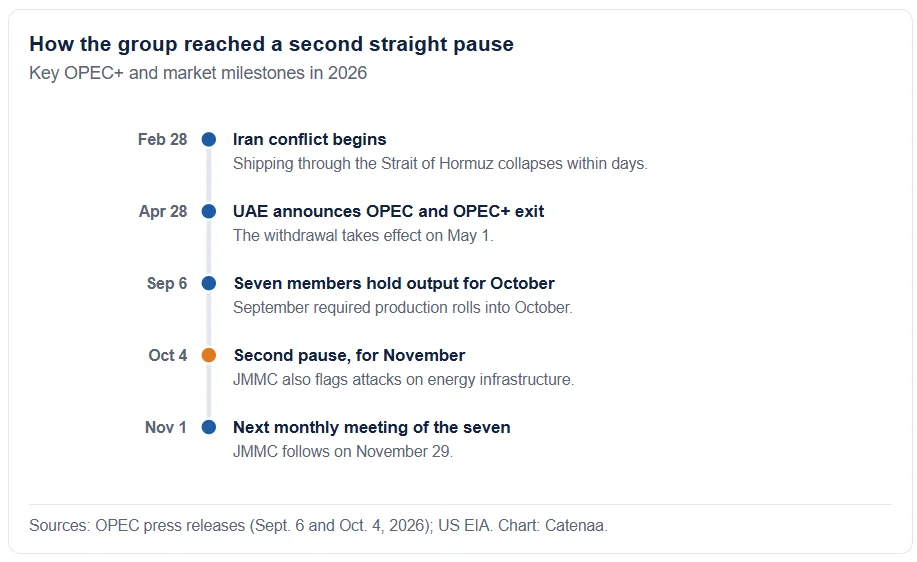
OPEC+ kept its oil output targets unchanged for November at a virtual meeting on Sunday. Seven members agreed to maintain their September required production for another month. The group will meet again on November 1.
Saudi Arabia, Russia, Iraq, Kuwait, Kazakhstan, Algeria and Oman took part. These are the countries behind the voluntary cuts of April and November 2023. They also restated their commitment to full conformity with the Declaration of Cooperation.
Sunday’s decision marks a second straight pause. On September 6, the same seven countries rolled September targets into October.
What the Oil Output Targets Say
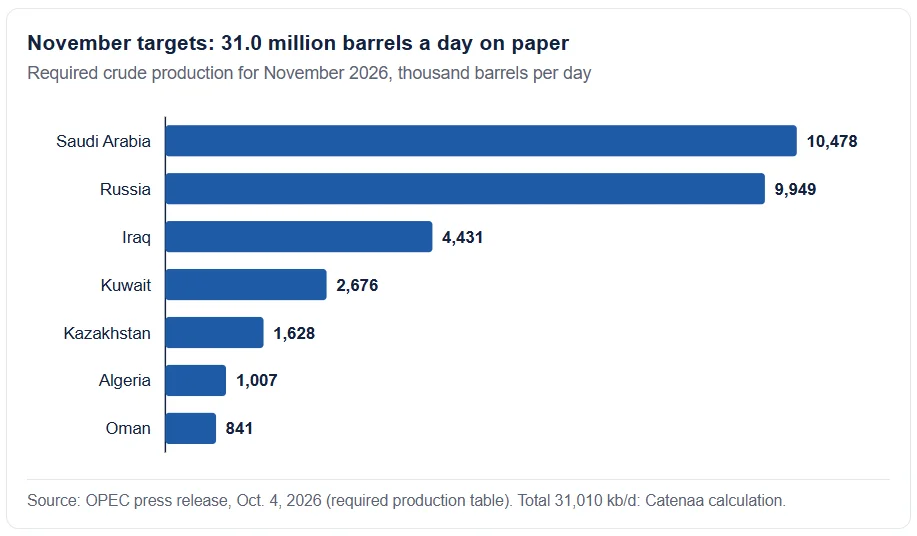
OPEC’s table puts Saudi Arabia’s November requirement at 10.478 million barrels a day. Russia follows at 9.949 million, while Iraq sits at 4.431 million. Together, the seven targets add up to about 31.0 million barrels a day.
The group is smaller than it was. According to the US Energy Information Administration, the United Arab Emirates left both OPEC and OPEC+ on May 1. In 2025, the UAE pumped about 3.4 million barrels a day and held 4.2 million of capacity.
Its exit cut OPEC+ to roughly 42% of global crude production, from about 46%. As a result, the remaining members carry less sway over prices than before.
There is also a gap between targets and reality. Saudi Arabia’s November requirement exceeds the 9.3 million barrels a day it actually produced in 2025, EIA figures show. In practice, the binding limit for Gulf producers is now export capacity, not quota.
Hormuz Matters More Than Quotas
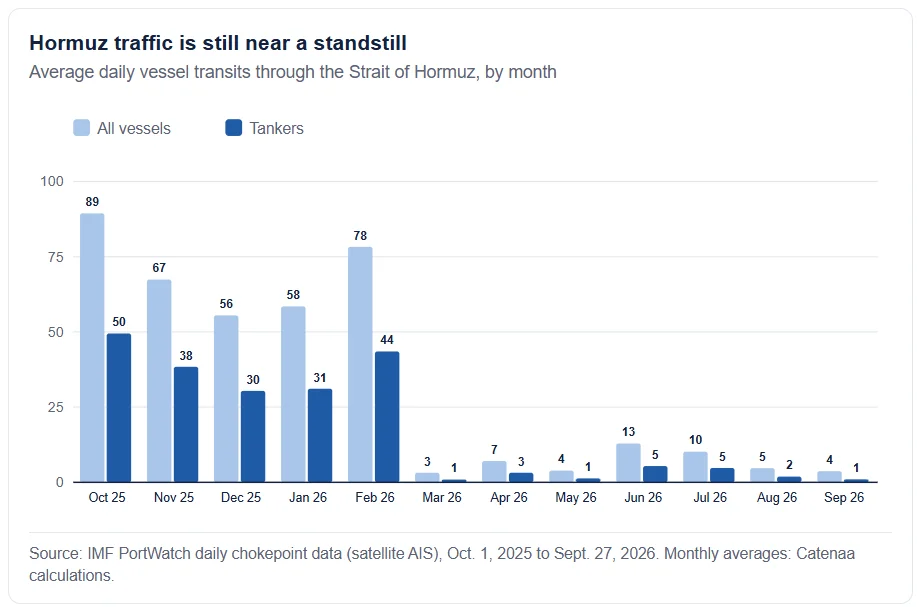
For now, shipping lanes matter more than quotas. Daily transits through the Strait of Hormuz averaged about 3.7 vessels in September, IMF PortWatch data to September 27 show. Tankers averaged roughly one a day. Traffic briefly improved in June, to about 13 vessels a day, before falling back again.
Before the conflict, traffic looked very different. From January 1 to February 27, the strait handled about 68 vessels a day, including 37 tankers. The collapse began after fighting broke out on February 28. By EIA estimates, the strait carried about 20 million barrels a day in 2024. That was roughly a fifth of global oil use.
As a result, Gulf members hold targets they cannot fully meet. Saudi Arabia can reroute some crude through its East-West pipeline, which can move 5 million barrels a day for export. Kuwait and southern Iraq, by contrast, depend heavily on the strait.
Meanwhile, the Joint Ministerial Monitoring Committee met the same day. Its statement stressed the need to safeguard international maritime routes. It also warned that restoring damaged energy assets is both costly and slow, which affects overall supply.
The committee reviewed July and August output data and noted overall conformity among OPEC and non-OPEC members. Its members include Nigeria and Venezuela alongside the core Gulf and Russian producers. It will meet again on November 29.
Oil Prices Stay Elevated
Prices reflect the disruption. Brent spot crude cost $113.96 a barrel on September 29, according to EIA data. That compares with $61.35 at the end of 2025 and $71.32 on February 27.
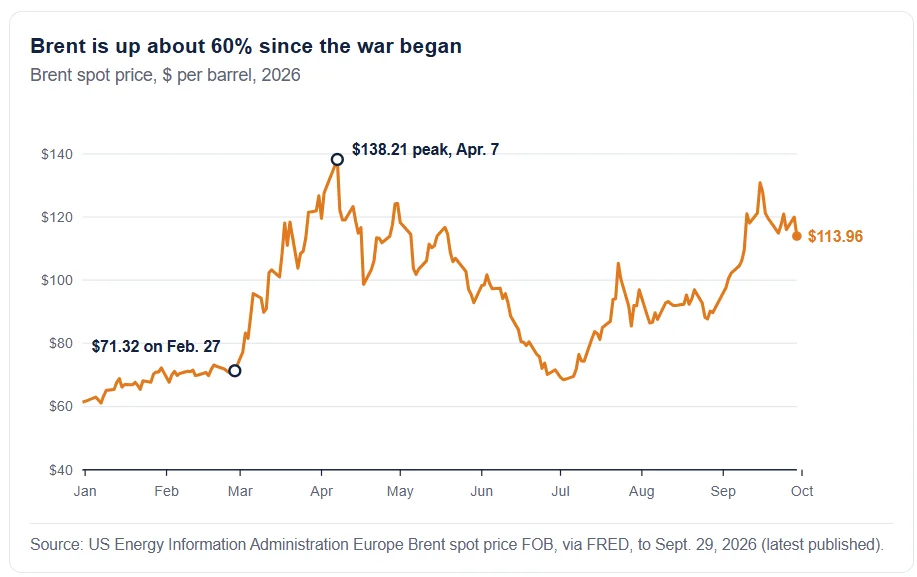
Brent peaked at $138.21 on April 7, about five weeks into the conflict. It has eased since then, but it still trades far above pre-war levels. In fact, Brent averaged $114.08 in September, up from $91.08 in August. That was the highest monthly average since April, Catenaa calculations from EIA data show.
In its September outlook, the EIA said global oil inventories had fallen by about 400 million barrels this year. It expects Brent to average about $90 in the second half of 2026 and $74 in 2027.
The agency also assumes export constraints will persist through year-end. Consequently, it sees Middle East crude output staying below pre-conflict levels until the second quarter of 2027.
What Comes Next
The EIA publishes its next outlook on Tuesday, October 6. That report should show whether the agency still expects flows through Hormuz to recover gradually.
After that, the seven producers reconvene on November 1 and will likely face the same question. They have promised to keep meeting monthly to review market conditions. Until ships move freely through Hormuz, however, oil output targets will matter less than the route to market.
For consumers and central banks, the message is uncomfortable. Supply remains tight, inventories are thinner, and higher energy costs continue to push up inflation.