

A Senate vote on the CLARITY Act is finally scheduled for the week of July 20. Yet the long-awaited merged draft dropped the ethics clause Democrats had demanded, three of them declared open opposition, and the odds of passage collapsed to about 35 per cent. Here is what the endgame reveals.
In Summary
A vote is finally scheduled for the week of July 20. Majority Leader John Thune has pledged floor action before the recess, after the National Defence Authorisation Act took priority the prior week.
The merged draft made the math worse, not better. Released on July 14, it omitted the ethics clause Democrats demanded. Senators Chris Murphy, Chris Van Hollen and Jeff Merkley then declared open opposition.
The vote math is brutal. Republicans hold 53 seats and need 60. With two likely Republican defections, supporters must find roughly seven Democrats. The draft was meant to add them. It subtracted them instead.
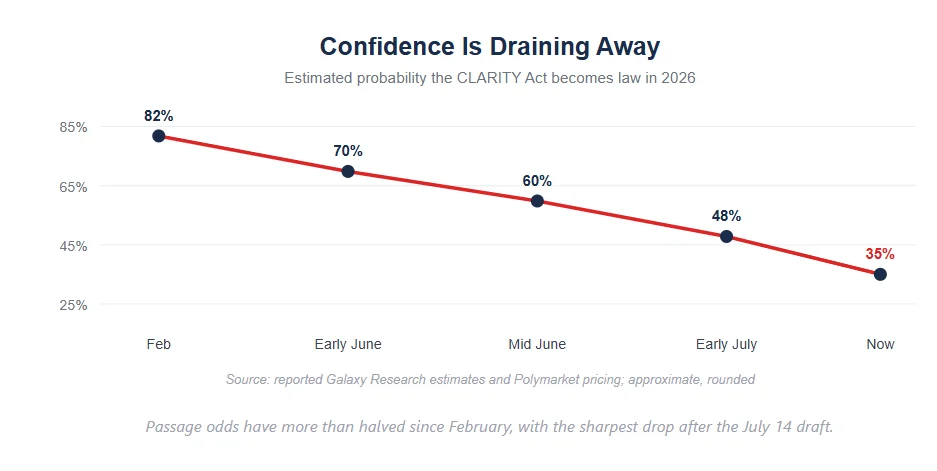
Passage odds collapsed. Polymarket now prices the 2026 passage near 35 per cent, down from 82 per cent in February and about 48 per cent a week ago.
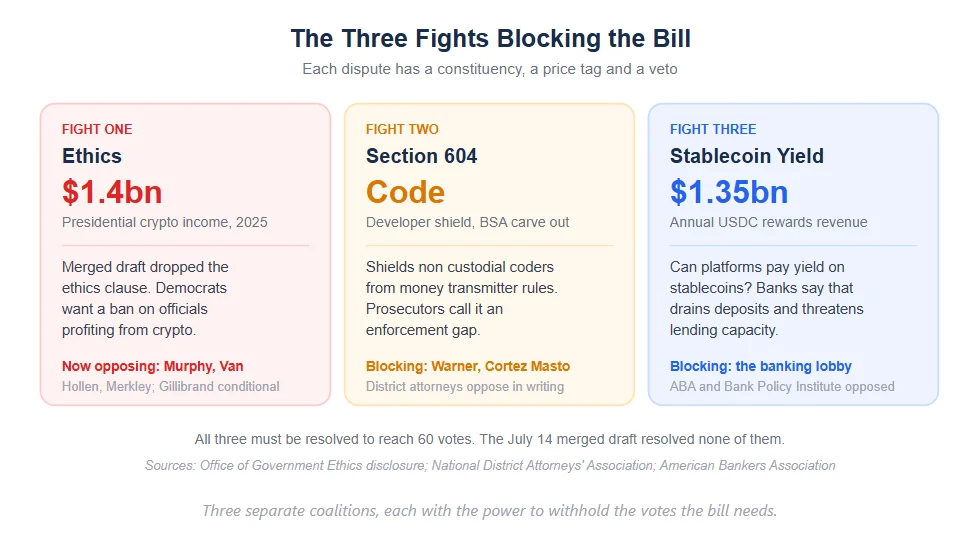
Three fights still block progress on crypto regulation: ethics rules covering the President’s $1.4 billion in crypto income, the Section 604 developer shield, and stablecoin yields worth about $1.35 billion a year to a single exchange.
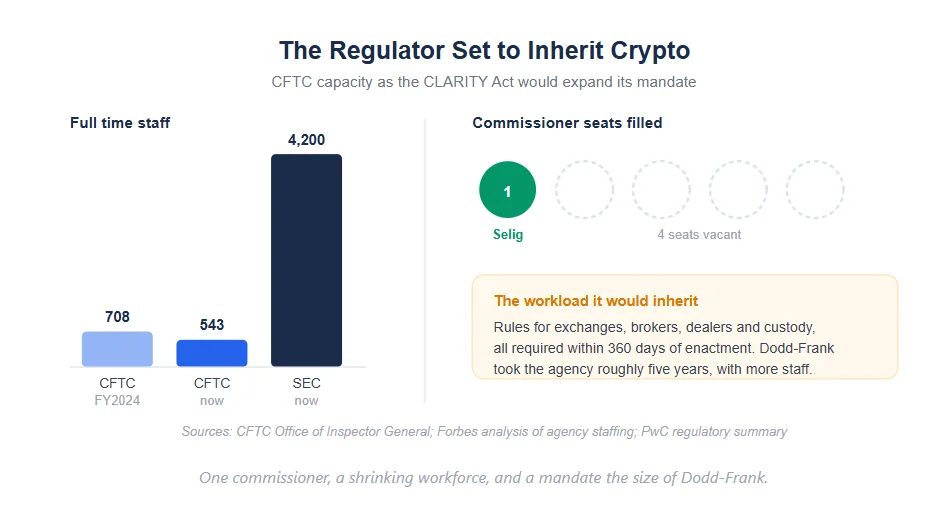
The CFTC capacity problem has become a political weapon. The regulator has one of five commissioners and roughly 543 staff members. Those vacancies are now part of the negotiation itself.
August 7 is the hard deadline. Senator Cynthia Lummis warns that failure in 2026 could push US crypto regulation to 2030.
What Changed This Week: A Vote Date and a Fracture
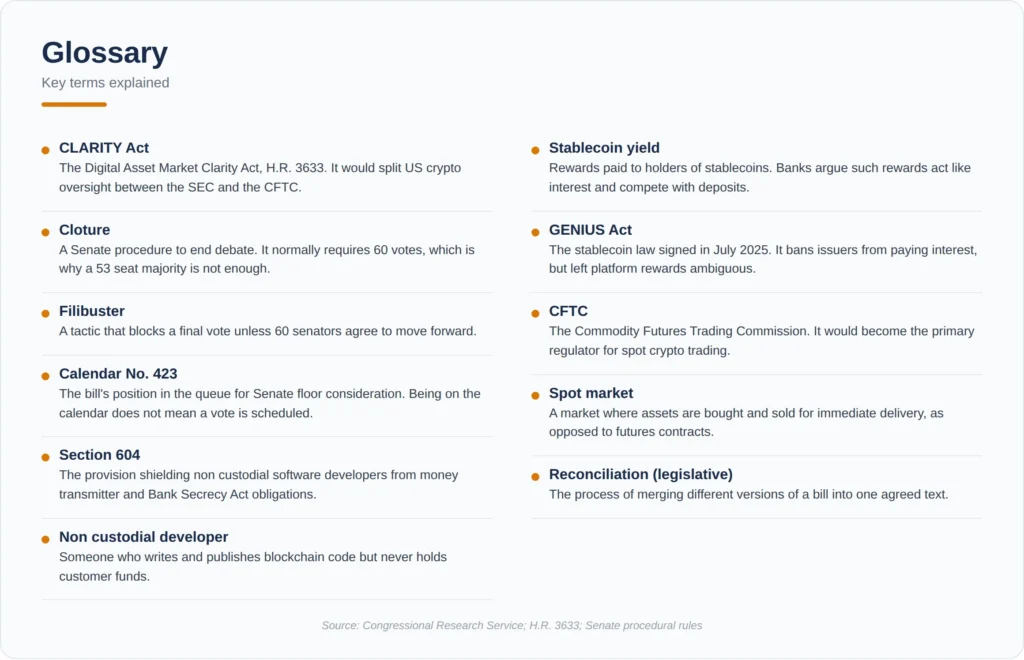
For weeks, the story was paralysed. The bill missed its July 4 signing target and sat frozen at Calendar No. 423 on the Senate Legislative Calendar. Now two things have changed at once, and they point in opposite directions.
First, the good news for supporters. Majority Leader John Thune has pledged a floor vote before the August recess, and the week of July 20 is now the active target. After the National Defence Authorisation Act consumed floor time in the week of July 13, the CLARITY Act moved to the front of the queue.
Then came the bad news. On July 14, negotiators finally released the merged draft that combines the Banking and Agriculture Committee texts. Crucially, it omitted the ethics provision Democrats had named as the price of their votes. Within hours, Senators Chris Murphy, Chris Van Hollen and Jeff Merkley held a press conference to declare open opposition.
So the picture is paradoxical. A vote is closer than ever, yet the votes to win it are drifting away. As Murphy put it, there is no reason to pass a new crypto system if it does not stop what he called the President’s corruption. The blockage is not procedural. It is substantive, and three specific disputes still fracture the coalition.
The Vote Math That Decides Everything
Start with arithmetic, because everything else flows from it. Most major legislation needs 60 votes in the Senate to overcome a filibuster. Republicans hold 53 seats.
Furthermore, two Republicans, Josh Hawley and Rand Paul, are expected to vote no on substantive grounds. That leaves roughly 51 reliable Republican votes. Supporters therefore need at least seven Democrats, and possibly nine.
How many Democrats have backed the bill so far? Two. Ruben Gallego and Angela Alsobrooks voted yes in committee. However, both stressed their support was conditional and does not commit them to a floor vote.
Worse for supporters, the merged draft was supposed to attract more Democrats. It did the opposite. Three senators moved from quiet scepticism to public opposition, and a fourth, Kirsten Gillibrand, has said an ethics provision is a condition of her vote, not a preference. The coalition is shrinking at exactly the moment it needs to grow.
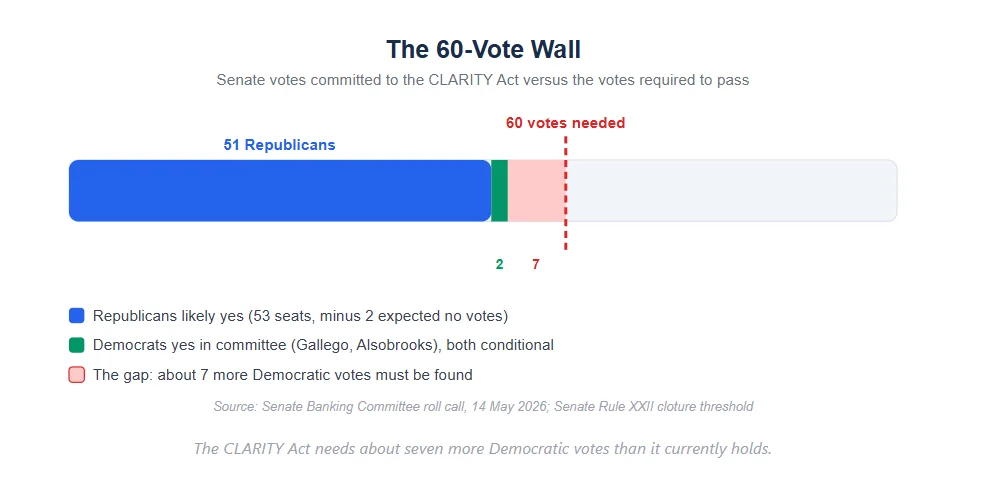
Meanwhile, the nine Democrats who voted no in committee form the pool from which those votes must come. Rather than signalling movement toward yes, three of them just moved further away. That single fact explains the deadlock better than any procedural analysis.
Fight One: Ethics and the President’s $1.4 Billion
The first fight is the most politically charged, and it is now the one sinking the bill. On 1 July, the Office of Government Ethics released the President’s annual financial disclosure. It showed roughly $1.4 billion in crypto-related income for 2025. The single largest stream, about $636 million, came from issuing the memecoin that bears his name.
Consequently, Democrats argue that a bill classifying the very assets a sitting President holds cannot be treated as neutral plumbing. They want enforceable language that makes it illegal for presidents, lawmakers, and their families to issue or profit from digital assets.
Republicans and the White House resist any provision aimed at the President’s personal holdings. An ethics amendment from Senator Chris Van Hollen already failed on a party-line vote in committee. One compromise idea, letting state attorneys general sue over violations, was withdrawn. A narrower version limiting enforcement to the US Attorney General was rejected by Democrats as circular, since that official serves at the President’s pleasure.
Then the merged draft dropped the ethics title entirely. That decision turned three sceptics into open opponents. Senator Gillibrand, among the chamber’s most crypto-friendly Democrats, still calls ethics language a condition of her vote. When your friendliest allies draw a red line, the coalition has a problem.
Fight Two: Section 604 and the Developer Shield
The second fight is quieter but legally deeper. Section 604 incorporates the Blockchain Regulatory Certainty Act. It shields non-custodial software developers, meaning people who publish code but never touch customer money, from money transmitter registration and Bank Secrecy Act duties.
Developers call this the bill’s most important protection. Writing code, they argue, is not running a bank.
Law enforcement disagrees. The National District Attorneys’ Association told Senate leadership the provision would materially impair criminal investigations involving cryptocurrency. Sheriffs’ groups and police chiefs raised similar objections.
The White House Crypto Council convened those groups and won the first-ever endorsement of the bill from one law enforcement organisation. Nevertheless, the core dispute survived. Senators Mark Warner and Catherine Cortez Masto have tied their floor support to law enforcement sign-off. Neither has received it.
Fight Three: Stablecoin Yield and the Banking Lobby
The third fight involves the most measurable money. It asks whether crypto platforms may continue paying rewards to paying customers on stablecoin holdings.
The GENIUS Act, signed in July 2025, banned stablecoin issuers from paying interest. However, it left open whether platforms distributing those coins can pass the yield through. That ambiguity is worth about $1.35 billion a year in rewards revenue to Coinbase alone.
Banks want the loophole closed. The American Bankers Association and the Bank Policy Institute argue that yield-bearing stablecoins would act as deposit substitutes, pulling household savings out of the banking system. JPMorgan’s Jamie Dimon has publicly attacked the provision.
Therefore, this is not really a compliance argument. It is a contest over who controls the next generation of dollar payments and whose deposits fund lending.
The Clarity Trade Broke Down
Here is where the story turns genuinely instructive for investors. The conventional thesis said regulatory clarity would lift crypto prices. Institutions would arrive. Capital would flow.
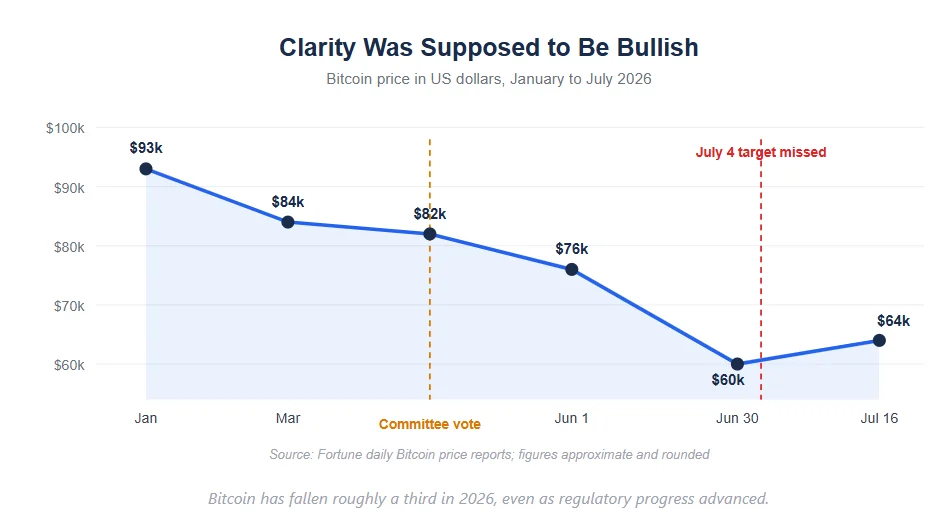
Reality has been unkind to that thesis. Bitcoin started 2026 above $93,000. It now trades near $64,000, having touched a 21-month low in late June, followed by a fragile mid-July bounce on softer inflation data.
Admittedly, the bill is not the main culprit. The Federal Reserve, under new chair Kevin Warsh, held rates steady and removed this year’s expected cut. Money rotated into equities and Treasuries. Spot Bitcoin ETFs have shed roughly $4 billion over the past month.
Even so, the stalled bill matters. Analysts note that little fresh money is entering those funds, partly because the legal certainty institutions were waiting for has not arrived. In other words, clarity was priced in as a catalyst. Its absence became a drag. This week’s small rebound came from cooler inflation, not from Washington.
Prediction markets tell the same story of collapsing conviction. Odds of passage in 2026 stood at 82% in February and near 70% in early June. After the merged draft split the Democrats, Polymarket cut them to about 35%.
The Enforcement Bottleneck Became a Political Weapon
Previous analysis flagged the regulator’s capacity as the hidden risk. That risk has now come into view and has become an obstacle to the bill itself.
Consider the state of the Commodity Futures Trading Commission. It is designed to seat five commissioners. It currently has one chairman, Michael Selig. Its workforce has fallen from 708 in fiscal 2024 to roughly 543 today, a drop of more than a fifth. The Securities and Exchange Commission employs around 4,200 staff and has a budget roughly six times larger.
Yet the CLARITY Act would hand this agency a workload that former officials compare to Dodd-Frank. That earlier reform took the CFTC about five years to implement, with more staff than it has now. The bill, by contrast, requires rules to be issued within 360 days.
Selig says artificial intelligence is filling the gap and that the agency runs more efficiently than ever. Lawmakers from both parties are unconvinced.
The empty desks are no longer a footnote to the bill. This week, they became a bargaining chip inside it.
Indeed, the vacancies have now turned into a live dispute between the White House and Senate Democrats, each blaming the other for the unfilled seats. Supporters warn a short-staffed regulator cannot police a market worth roughly $2.2 trillion. The agency’s own inspector general named digital asset regulation a top risk for fiscal 2026.
The Week of July 20 and What Happens by August 7
The vote is now expected in the week of July 20. From there, only a handful of working days remain before the recess begins around 7 August.
In that window, several things must still happen in sequence. First, leadership must file a motion for cloture. Each closure sequence can consume most of a work week. Second, the ethics dispute must be settled well enough to win back the Democrats the draft just lost. Third, the bill must clear 60 votes. Fourth, the House must accept the Senate text. House Agriculture leaders have signalled they would move fast if the Senate delivers.
Nevertheless, the calendar is unforgiving. The Senate does not return until mid-September, and by then the midterm campaign dominates everything. Senator Cynthia Lummis has warned that failure in 2026 could push the process to 2030, forcing a future Congress to start over.
A scheduled vote is not the same as a winning vote. Right now, the CLARITY Act has the first without the second.
Three signals worth watching
Rather than tracking headlines, watch three concrete tells. Does an ethics title reappear in the text before the floor vote? Do any of the four ethics holdouts, especially Gillibrand, soften once it does? And does Thune actually call the cloture vote, or quietly let it slip toward the recess?
If an ethics compromise does not materialise within days, the 2026 window effectively closes.
What This Means for Investors, Builders and Students
For investors, the lesson is about narrative risk. Markets priced regulatory clarity as an inevitable catalyst. It was neither inevitable nor, so far, a catalyst. Legislative timelines are not investment timelines, and even a law would take until 2027 to produce enforceable rules.
For builders, the calculus has hardened. Europe’s MiCA framework became fully binding on 1 July. Singapore and the United Arab Emirates continue to offer certainty today. Every month Washington delays, the relative appeal of those jurisdictions grows.
For students and general readers, this episode is a superb civics lesson. A bill can pass a chamber, clear a committee, win industry backing and still stall. Not because the idea is unpopular, but because three narrow interests, each protecting something real, can withhold the votes they need.
Ultimately, the CLARITY Act remains the furthest-advanced crypto legislation in American history. It now has a vote on the calendar, yet fewer sure votes than it had a month ago. The deepest irony sits in plain view. The bill was meant to remove politics from crypto markets. Instead, the President’s own crypto fortune has become the single biggest obstacle to passing it.